
TL;DR:
- AC cools indoor spaces but does not provide heating, ventilation, or air filtration.
- HVAC systems include heating, ventilation, air conditioning, and air quality controls for year-round comfort.
- Proper sizing, sealing ducts, and regular maintenance are essential for system efficiency and longevity.
Most homeowners in Moreno Valley use the terms AC and HVAC like they mean the same thing. They don't. Mixing them up can lead to buying the wrong system, missing out on energy savings, or spending more on repairs than necessary. If you manage a rental property or own a home in the Inland Empire, knowing the real difference between these two systems changes how you shop, maintain, and budget for comfort. This guide breaks down what each system does, how they compare in cost and efficiency, and which one actually fits your property and local climate.
Table of Contents
- What is an AC system and what does it do?
- What does an HVAC system include and how is it different?
- Side-by-side comparison: AC vs. HVAC in Moreno Valley homes
- How technology and efficiency differ: What homeowners should know
- Which system is right for you? Local climate, comfort, and ownership factors
- Our take: Why smart decisions go beyond just AC vs. HVAC
- Need help choosing or upgrading? Get expert HVAC guidance
- Frequently asked questions
Key Takeaways
| Point | Details |
|---|---|
| AC vs. HVAC fundamentals | AC cools air only, while HVAC handles heating, cooling, and ventilation. |
| Cost and complexity | AC units are simpler and cheaper, but HVAC systems provide full-year comfort with higher upfront investment. |
| Efficiency and maintenance | Modern HVAC can cut energy use significantly, but both systems need regular servicing for best results. |
| Choosing for your home | Consider climate, property size, and air quality needs when deciding between AC and HVAC. |
What is an AC system and what does it do?
Air conditioning, or AC, is a system designed to do one thing well: cool your indoor space by removing heat and humidity from the air. It pulls warm air from inside, passes it over a cold evaporator coil, and releases the heat outside through the condenser unit. Simple in concept, but the components working together make it happen.
The four core components of any AC system are:
- Compressor: Pressurizes the refrigerant to move heat through the system
- Condenser coil: Releases the collected heat outside your home
- Evaporator coil: Absorbs heat from your indoor air
- Expansion device: Regulates refrigerant flow and pressure between the coils
As the cooling-only system using a compressor, condenser, and evaporator, AC is straightforward and effective for homes that only need relief from summer heat. In Moreno Valley, where summer temperatures regularly push past 100°F, a well-functioning AC unit is not optional. It is essential.
AC units work best in smaller homes, apartments, or properties where heating is rarely needed. They are also common in older homes where ductwork was never designed to handle a full heating and cooling system. The limitation is clear though: AC only cools. It does not heat your home, does not actively filter air beyond a basic filter, and does not manage ventilation or humidity in winter months.
If your property sits in a climate where winters are mild and you never run a heater, an AC-only setup might cover your needs just fine. But for most homeowners who want year-round comfort and better indoor air, AC alone leaves gaps.
If you ever notice your system underperforming, reviewing AC troubleshooting basics can help you identify common issues before calling a technician.
Pro Tip: Schedule AC maintenance every spring before the heat peaks. Cleaning coils, checking refrigerant, and replacing filters before summer extends your system's life and keeps efficiency high when you need it most.
What does an HVAC system include and how is it different?
HVAC stands for Heating, Ventilation, and Air Conditioning. It is not a single unit. It is an integrated system that handles your home's temperature, air movement, and air quality across every season. Think of it as the full package compared to AC's single function.
A complete HVAC system typically includes:
- Furnace or heat pump: Provides heating in cooler months
- Air conditioning unit: Handles cooling (yes, AC is part of HVAC)
- Ductwork and fans: Distribute conditioned air throughout the home
- Air filtration and ventilation components: Improve indoor air quality and manage fresh air exchange
"A full HVAC system regulates temperature, humidity, and air purity for all-season comfort."
The ventilation and filtration components are what really separate HVAC from a standalone AC. HVAC systems provide heating, cooling, ventilation, and superior air quality control, making them the better choice for homes where occupants deal with allergies, dust, or poor circulation. Learning more about improving indoor air quality shows just how much a full system can change daily life inside your home.
One number that puts HVAC's role in perspective: 48% of home energy in the U.S. is consumed by heating and cooling systems combined. That means the system you choose and how well you maintain it has a direct, measurable impact on your monthly utility bills.
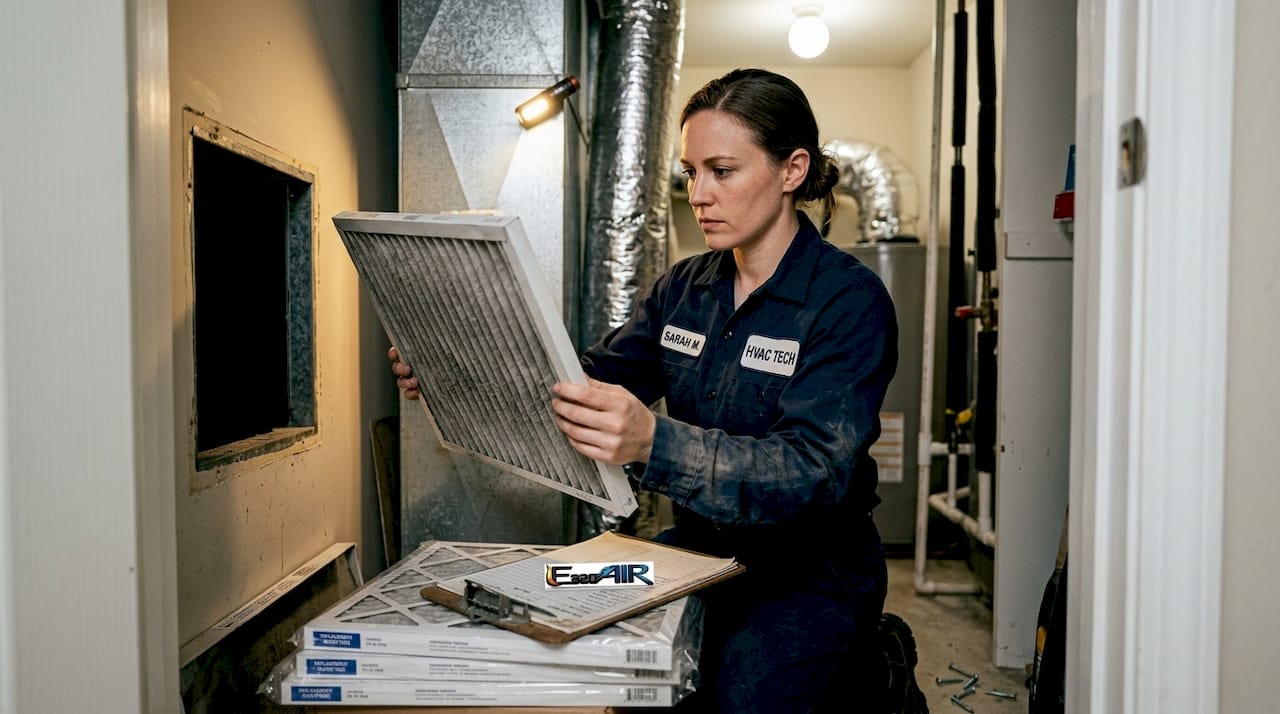
Choosing the right HVAC filters and efficiency setup also plays a big role in how well the system performs over time. A clogged or wrong-sized filter forces the system to work harder, raises energy use, and shortens equipment life.
For Moreno Valley homeowners, HVAC makes sense when you want one system to handle everything, from a cold January night to a brutal August afternoon, without switching between separate units or worrying about gaps in coverage.
Side-by-side comparison: AC vs. HVAC in Moreno Valley homes
Looking at both systems next to each other makes the decision much clearer. Here is how they stack up across the factors that matter most to homeowners and property managers:
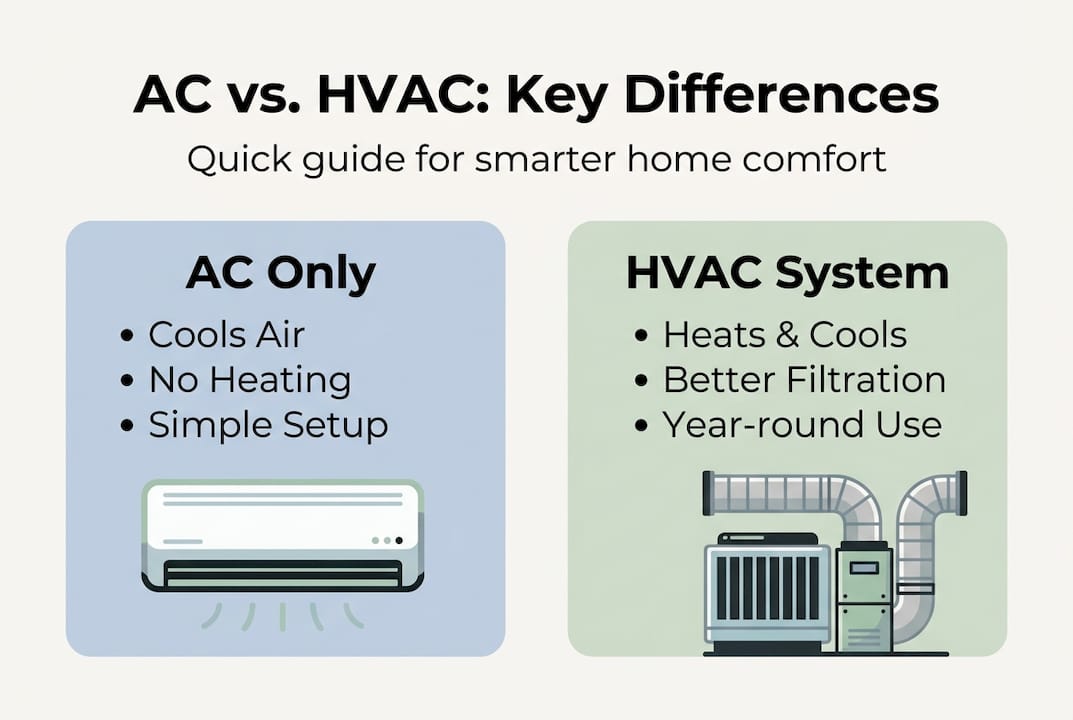
| Feature | AC only | Full HVAC system |
|---|---|---|
| Cooling | Yes | Yes |
| Heating | No | Yes |
| Ventilation | Limited | Full |
| Air filtration | Basic | Advanced |
| Installation cost | Lower | Higher |
| Operating cost | Seasonal | Year-round |
| Best for | Small homes, mild winters | Larger homes, all-season needs |
| Adds home value | Moderate | Higher |
AC is a component of HVAC; HVAC is more expensive upfront but controls the entire climate and adds value year-round. For Moreno Valley's hot, dry summers, a quality AC unit handles the peak demand. But the mild winters here can still drop into the low 40s overnight, and a home without heating becomes uncomfortable fast.
Installation costs for a central AC system typically range from $3,500 to $7,500 depending on home size and equipment brand. A full HVAC system with heating runs $7,000 to $15,000 or more. That gap feels large upfront, but when you factor in comfort, air quality, and property value, many homeowners find the investment pays back over time.
If you are evaluating best replacement options for California homes, the local climate, utility rates, and available rebates all shape which direction makes the most financial sense.
Pro Tip: When deciding between AC and HVAC, think five to ten years ahead. A home you plan to sell, expand, or rent out benefits more from a full HVAC system because buyers and tenants expect year-round comfort and good air quality.
How technology and efficiency differ: What homeowners should know
Beyond function, the technology inside these systems creates real differences in how much you pay to run them every month.
A standalone AC runs a refrigeration cycle: refrigerant absorbs indoor heat, moves it outside, and repeats. It is effective but limited. A full HVAC system adds heating options (furnace or heat pump), smart thermostats, zoning controls, and advanced filtration. More moving parts, but also more ways to save energy and customize comfort.
The key efficiency metric to know is SEER2 (Seasonal Energy Efficiency Ratio 2), which replaced the old SEER standard in 2023. Higher SEER2 ratings mean lower operating costs. Modern AC and heat pump systems range from 13.4 to 26 SEER2. Variable refrigerant flow (VRF) systems used in larger properties use significantly less power by adjusting output to match demand in real time.
| System type | SEER2 range | % of home energy use | Recommended service interval |
|---|---|---|---|
| Basic AC | 13.4 to 16 | 15 to 20% | Annual |
| High-efficiency AC | 18 to 26 | 10 to 15% | Annual |
| Full HVAC (heat pump) | 15 to 26 | Up to 48% combined | Bi-annual |
| VRF system | Equivalent to 20+ | Varies | Annual |
Modern HVAC can save 30%+ energy over basic AC, and duct leakage alone wastes up to 40% of conditioned air in homes with poorly sealed systems. That last number is worth sitting with. Nearly half your cooled or heated air could be escaping into your attic or walls before it ever reaches you.
Here are the most effective ways to maximize efficiency regardless of which system you choose:
- Seal and insulate ductwork to stop conditioned air from escaping
- Upgrade to a programmable or smart thermostat for better control
- Explore HVAC zoning for efficiency to cool or heat only occupied areas
- Change filters every 1 to 3 months based on usage and air quality
- Ensure proper HVAC sizing from the start to avoid short cycling and wasted energy
Recent energy savings studies continue to confirm that system sizing and duct integrity matter more than equipment brand when it comes to real-world performance.
Which system is right for you? Local climate, comfort, and ownership factors
Knowing the differences is one thing. Applying that knowledge to your specific property in Moreno Valley is where it gets practical.
Here is a simple process to guide your decision:
- Assess your climate needs. Moreno Valley summers are intense, regularly exceeding 100°F. Winters are mild but can dip into the 40s. If you only need cooling, AC may be enough. If you want year-round comfort without switching systems, HVAC wins.
- Evaluate your property size. Smaller homes and apartments under 1,200 square feet often do fine with a quality AC unit. Larger homes, multi-room properties, or rentals benefit from a full HVAC system with proper zoning.
- Consider your air quality priorities. If anyone in the home has allergies, asthma, or respiratory sensitivities, the advanced filtration in a full HVAC system makes a real difference.
- Think about future needs. Planning to add rooms, convert a garage, or sell the property? A full HVAC system adds flexibility and market value.
- Factor in maintenance capacity. In hot climates, AC may be sufficient, but HVAC brings future-proofing and air quality benefits worth the added complexity.
For Moreno Valley specifically, the seasonal HVAC needs of Riverside County homes lean toward systems that can handle extreme summer demand without breaking down. Routine maintenance, filter changes every one to three months, and annual professional service keep either system running efficiently.
If you are unsure where to start, understanding the role of HVAC contractors helps clarify what a professional assessment covers and why it is worth doing before any purchase or upgrade.
Our take: Why smart decisions go beyond just AC vs. HVAC
After years of working with homeowners and property managers across the Inland Empire, here is what most guides skip: the label matters far less than the details underneath it.
We see people buy a new HVAC system and still struggle with uneven temperatures and high bills because nobody addressed the leaky, uninsulated ducts running through a hot attic. We also see homeowners in Moreno Valley perfectly comfortable with a well-sized, well-maintained AC unit because their property and lifestyle fit that solution.
The biggest myth in this space is that there is a universal right answer. There is not. The right system is the one sized correctly for your home using a Manual J load calculation, installed with sealed and insulated ducts, and matched to your actual usage patterns.
Future-proofing with high-SEER2 equipment often pays for itself within five to eight years in energy savings alone, even in hot, dry climates where heating demand is low. The importance of proper sizing cannot be overstated. An oversized system short-cycles, wears out faster, and leaves your home feeling clammy.
Pro Tip: Before committing to any system, ask your contractor for a Manual J sizing calculation. If they skip it, find someone who won't.
Need help choosing or upgrading? Get expert HVAC guidance
Choosing between AC and HVAC is not a decision you should make based on price tags alone. The right system depends on your home's size, your local climate, your air quality needs, and your long-term plans. Getting that match right from the start saves money, avoids repairs, and keeps your family comfortable year-round.

Our team specializes in helping Moreno Valley homeowners and property managers find the right solution, whether that means a new installation, an upgrade, or a maintenance plan. Our HVAC installation experts handle everything from system selection to final testing. You can also browse our real-world issue solutions to see how we have solved common AC and HVAC problems for local properties just like yours.
Frequently asked questions
Is AC part of an HVAC system?
Yes, air conditioning is one component of a larger HVAC system, which also includes heating and ventilation. AC handles cooling only, while HVAC manages the full climate.
Which system is better for Moreno Valley: AC or HVAC?
In hot, dry climates, AC may be sufficient for cooling-only needs, but HVAC is recommended for homes that need year-round comfort and better indoor air quality.
Does HVAC use more energy than AC?
Modern HVAC can cut energy use by over 30% compared to older basic systems, but both AC and HVAC waste energy when poorly maintained or incorrectly sized.
What maintenance do AC and HVAC systems need?
Both need regular filter changes and annual professional service. Annual service and filter changes are critical for efficiency, and HVAC systems may also require periodic ductwork and vent cleaning.