
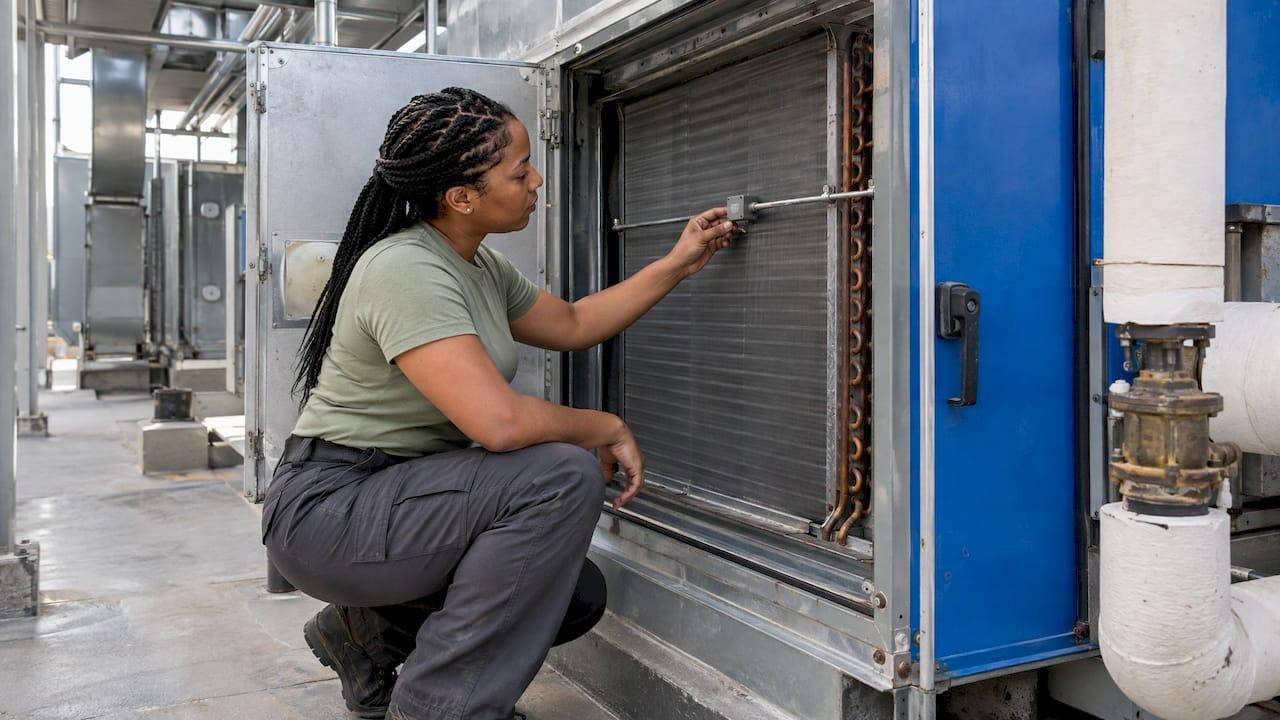
Commercial HVAC winterization means getting heating equipment tested, water-filled parts protected and controls set before the first cold snap. In the Inland Empire, the work centers on two things: proving your heat works after a long cooling season, and protecting coils, condensate lines and outdoor plumbing from the occasional hard freeze. Do it in the fall, while service calendars are open and before an emergency call costs more.
TL;DR
- Start 4 to 6 weeks before cold weather: service heating equipment, replace filters and calibrate thermostats and building controls.
- Freezes are rare but real in the Inland Empire. Water coils, exposed piping and unattended buildings are the weak points.
- Staff can handle filters, clearances and walk-throughs. Heat exchangers, gas and electrical components, freeze controls and glycol belong to a licensed technician.
- Rooftop units that ran hard all summer should be inspected for wear before they have to heat the building.
- A pre-season visit is cheaper and calmer than an emergency repair during a cold night.
Table of Contents
- Why winterize in a mild climate
- What needs attention first
- A commercial HVAC winterization checklist
- Who does what
- Timing for the Inland Empire
- Perspective: what we see in the field
- Get your building ready with E320air
- What to do when a system fails anyway
- FAQ
- Sources
Why winterize in a mild climate
Southern California rarely feels like a winter market, so many owners skip this step. The risk comes from that very assumption. FM Global's freeze-protection data sheet notes that some of the most severe freeze damage occurs at facilities in moderate, temperate zones, including subtropical regions, where freezes are infrequent and short. Buildings there are not designed or operated with freezing in mind.
The Inland Empire does get cold nights. Local news has reported freeze warnings for parts of the Inland Empire, with outdoor plumbing flagged as at risk when temperatures dropped to the high 20s. A hard freeze might come once a year, or not at all. One night is enough for a burst coil.
The cost of a failure is lopsided. The Institute for Business & Home Safety says burst pipes are the leading cause of property damage from winter weather. Its guidance targets buildings north of the 32°F line on the 2018 International Building Code winter design temperature map, so treat it as a benchmark for good practice rather than a rule that applies to every Southern California site. Its suggestion to hold interior temperatures at or above 55°F, and watch that they never fall below 40°F, is a sensible target for any building with water-filled equipment.
There is also the heating side. Equipment that has sat idle since spring often fails on the first real cold morning. That is when every other building in town is calling for service.
What needs attention first
Not every building has the same exposure. These are the areas where winter problems start.
- Water-filled piping and coils. FM Global lists water coils in air handling units, outdoor equipment and unheated or unattended buildings among the places to protect.
- Rooftop units and package units. Most small and mid-size commercial buildings here are served by rooftop equipment. It takes the weather directly and works hard all year.
- Vacant or low-traffic spaces. A suite that stays unheated can chill plumbing that runs through it. IFM's facility guidance recommends consistent indoor temperatures even in low-traffic areas.
- Outdoor water lines. Hose bibs, backflow assemblies and landscape irrigation are exposed. If you manage the grounds too, look at irrigation winterization costs to plan that work alongside your HVAC visit.
- Condensate drains and exterior vents. Church Mutual advises keeping exterior venting and HVAC openings clear, with enough ground clearance that nothing blocks them.
A commercial HVAC winterization checklist
Work through this in order. Each step says who should do it.
1. Book a professional heating inspection (technician)
The single most useful step is a full heating tune-up before you need heat. Church Mutual says to have furnaces and heating systems professionally inspected and serviced. A technician should:
- Test the ignition sequence, burners, flame sensors and safety limits on gas furnaces and heating sections.
- Inspect heat exchangers for cracks and corrosion.
- Check flue and venting connections.
- Measure temperature rise and airflow against the equipment's data plate.
- Test reversing valves and defrost operation on heat pump units.
- Inspect belts, motors, contactors, capacitors and wiring.
For rooftop equipment, our own rooftop unit maintenance checklist lists measurable checks a building manager can ask for. If a unit already showed trouble during summer, read why commercial rooftop AC units fail and fix it before the heating season.
2. Replace filters and clear airflow paths (staff or technician)
IFM Flagship advises replacing or cleaning air filters as part of winter readiness. Dirty filters cut airflow, raise energy use and can push a heat exchanger toward overheating. Also clear return grilles, supply registers and the area around rooftop curbs and outdoor units. Debris after fall winds is common in the Inland Empire.
3. Verify thermostats, schedules and controls (staff or technician)
Switch schedules from cooling to heating setpoints, and confirm that occupied and unoccupied modes make sense. IFM suggests verifying thermostat and control settings and checking that dampers and actuators work correctly. Walk the building on a cool morning and note rooms that are too hot or too cold. Airflow imbalances show up as uneven temperatures, and they waste energy.
One caution on automation. ACHR News reports that winterization is almost never fully handled by the central building automation system. Manual steps such as opening valves, draining piping and closing warm-weather ventilation openings are usually still needed.
4. Protect coils and water loops (technician)
This is the step that prevents the most expensive damage. ACHR News quotes an industry source who says about a third of coils are damaged by freezing, and that a ruptured coil can flood a facility once it thaws. That figure is one person's estimate, but the failure mode is well documented.
For air handling units with water coils, FM Global specifies a freeze stat covering the whole coil face. It should be interlocked to stop the blower, close outside air dampers, open return dampers, open the valves serving the coils, and alert building managers when it senses 40°F. A technician should test that sequence, not just confirm that the device exists.

If you use glycol, concentration matters. One maintenance guide recommends verifying glycol in outdoor-exposed loops with a refractometer, setting low-limit controls at or above 38°F and confirming heat trace is energized. Treat it as a practical guideline and follow the equipment manufacturer's specification for your system.
Do not improvise glycol changes. ACHR News warns that flushing coils with glycol in winter when they normally carry plain water is risky, because weak leftover concentrations can breed microbes that foul piping and coils. This is a job for a technician who knows your loop.
5. Insulate exposed piping (staff or technician)
IFM recommends insulating exposed or vulnerable piping. Check foam insulation on rooftop and exterior lines for sun damage, gaps and missing sections. Pipes that run through attics, crawlspaces, mechanical rooms or unheated suites deserve the closest look.

6. Locate and test shutoff valves (staff)
The same guide advises knowing where main shutoffs are and making sure staff can reach them fast. Test each valve so it turns, label it, and put its location in your emergency plan. A burst pipe can cause thousands of dollars in damage within minutes, so speed matters.
7. Handle cooling towers and chillers if you have them (technician)
Larger sites with towers need a plan. The 2016 ASHRAE Handbook notes that closed-circuit towers are best protected with antifreeze where the design allows, with exposed piping insulated and heat traced, and an emergency draining system in case power fails during freezing weather. Induced-draft towers can have fans run in reverse at low speed to deice air intakes. In our climate that is a contingency plan for rare nights, but it should still be written down.
8. Review fire protection with the right contractor
Sprinklers are not an HVAC task. One facilities guide stresses that fire protection is a licensed sprinkler contractor's call, and that a well-meant fix can leave a building unprotected. Book that inspection separately, and tell the contractor about any space that is no longer heated.
Who does what
| Task | Building staff | Licensed HVAC technician |
|---|---|---|
| Filter replacement | Yes, on a set schedule | Yes, during service |
| Clearing debris around units and vents | Yes | Yes |
| Thermostat schedules and setpoints | Yes | Calibration and controls checks |
| Heat exchanger, burner and flue inspection | No | Yes |
| Gas, electrical and refrigerant work | No | Yes |
| Freeze stat testing and coil protection | No | Yes |
| Glycol concentration and loop work | No | Yes |
| Valve location and labeling | Yes | Advises |
| Sprinkler systems | No | Sprinkler contractor |
ASHRAE Standard 180-2018 puts the responsibility on the owner: the building owner is responsible for meeting the requirements and for a maintenance program that preserves the capability of HVAC systems. That makes a written seasonal schedule worth having. Assign each task to a person or a vendor, and record the date it was done.
Timing for the Inland Empire
Colder weather usually arrives late in the year, so aim to finish winterization in October or November. Heating contractors get busy when the first cold week hits, and one maintenance guide suggests starting about six weeks before the first freeze. The same guide says emergency labor can cost 1.5 to 2.5 times standard rates, which is a vendor's claim, but it matches what most facility managers see: after-hours calls cost more than planned visits.
If you are reading this in November, you are not late. Schedule the heating inspection now, handle filters and controls this week, and ask your technician to put freeze controls on the same visit.
Plan around a few local conditions:
- Desert-edge sites such as Hesperia, Banning and Yucaipa run colder at night than the valley floor. See our Hesperia winterization guide for how nights there differ.
- Valley sites in Riverside, Ontario, Fontana and Corona rarely freeze, so the main goal is reliable heat and protection for the occasional cold snap.
- Heat pump buildings need defrost cycles to work properly. Our heat pump defrost guide explains what normal looks like, and when a long cycle needs a technician.
- Unattended properties such as vacant suites, storage units and seasonal sites need a minimum temperature held and someone assigned to check them.
Perspective: what we see in the field
We find that most winter breakdowns in commercial buildings are not mysterious. A unit worked hard all summer, nobody looked at the heating side, and the first cold morning exposed a worn igniter, a clogged filter or a thermostat still set for cooling.
Our approach is simple: inspect first, explain what we find in plain terms, and let you decide. Licensed and insured technicians can service all major brands, so your building does not need a specific manufacturer to get a thorough pre-season check. If something needs repair or an upgrade, we lay out the options, including financing, so a worn system can be replaced on your timeline rather than during a cold snap.
For property managers, we think the best investment is a scheduled visit every fall and spring. It keeps equipment efficient, reduces surprise outages for tenants and gives you a record of the work. We are available around the clock, including weekends and holidays, for the times when something fails anyway.
Edward
Get your building ready with E320air
We handle commercial HVAC repairs, routine maintenance, installations and emergency service across the Inland Empire, from Riverside and San Bernardino to Corona, Ontario and Hemet. A pre-winter visit from our licensed and insured technicians covers heating inspection, filters, controls and the checks that protect your equipment when the temperature drops.
To schedule a seasonal visit or ask about upgrades and financing, see our commercial HVAC services. If your property also has a gas heater that needs attention, our heater repair page covers that service.
What to do when a system fails anyway
Even well-maintained systems break. Have a short plan on paper:
- Know the shutoff procedure for each unit. Our HVAC emergency shutoff guide walks through the basics, although it is written around California homes.
- Keep your technician's after-hours number where on-call staff can find it.
- If a coil or pipe is leaking, shut off the water and the unit, and call for service right away.
- After repairs, follow a proper restart sequence. Our HVAC startup process guide explains the steps.
If you own smaller properties such as duplexes or live-work spaces, the homeowner winterization steps apply as a simpler version of this list.
FAQ
Does a commercial building in Southern California really need winterization?
Yes, though it looks different from winterization in a cold state. You are mostly ensuring heating works and protecting water-filled equipment from occasional freezes. Experts note that damage can be severe in mild regions because freezes are unexpected and buildings are unprepared.
When should I schedule commercial HVAC winterization?
Aim for early to mid fall, before the first cold nights. A heating inspection four to six weeks before you expect to need heat leaves time for repairs and parts. If you are already into November, book it now.
What can my maintenance staff do themselves?
Staff can replace filters, clear debris, adjust schedules, label shutoff valves and walk the building looking for cold spots. Anything involving gas, electrical components, refrigerant, freeze controls or glycol should go to a licensed HVAC technician.
What temperature should I keep an unoccupied commercial space?
The Institute for Business & Home Safety suggests keeping interior temperatures at 55°F or higher and monitoring that they never drop below 40°F. Use that as a guide for spaces with plumbing or water coils, and confirm the setting with your technician.
Sources
- FM Global Data Sheet 9-18, Prevention of Freeze-Ups
- IBHS, Protect Your Business from Winter Weather
- ABC7, Freeze warnings in Southern California
- ACHR News, Institutional HVAC Projects Require Specific Solutions
- ACHR News, The Non-automated, Operational Instructions of Winterization
- IFM Flagship, Facility Manager's Guide to Winter Readiness
- Church Mutual, Preparing Your Buildings and Facilities for Winter Weather
- 2016 ASHRAE Handbook, HVAC Systems and Equipment (cooling towers)
- Oxmaint, Seasonal HVAC Maintenance Checklist
- Oxmaint, Winter Property Weatherization and Maintenance Checklist
- RunTight, Facility Winterization: The Fall PM Checklist
- ANSI/ASHRAE/ACCA Standard 180-2018
- Irrigation Winterization Cost in NH: 2026 Price Guide