
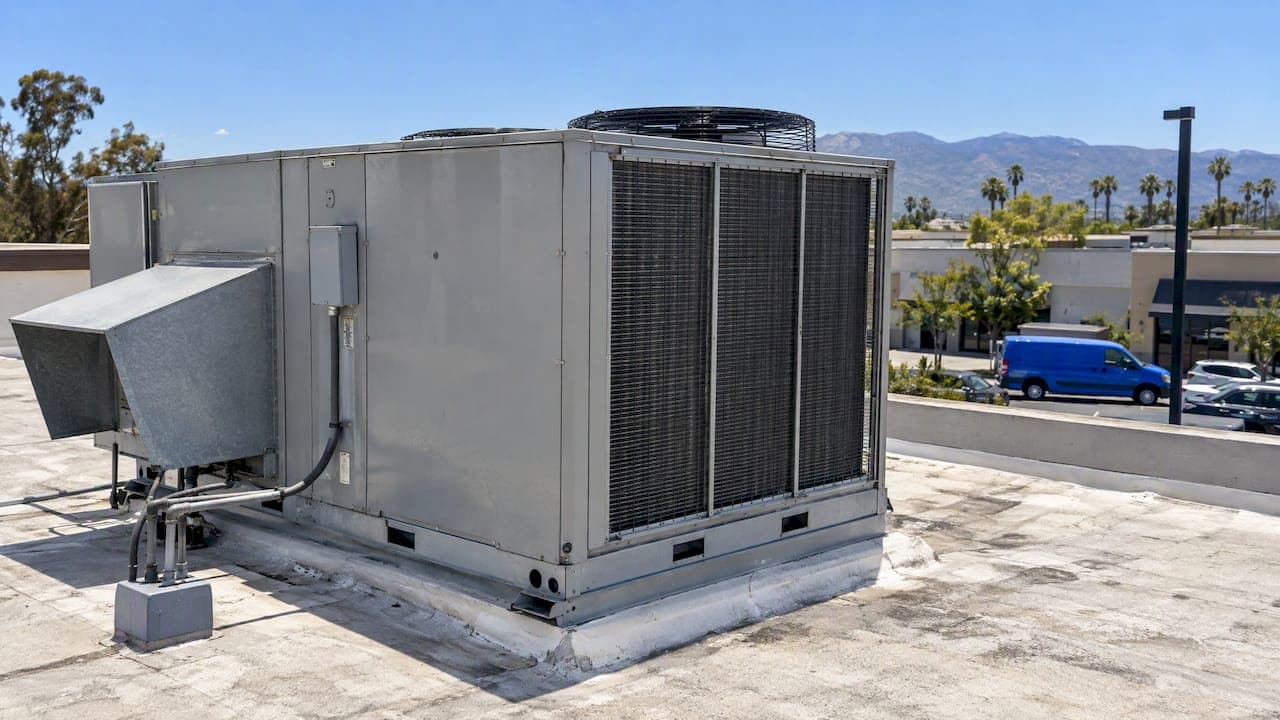
When a commercial rooftop unit (RTU) stops cooling, the cause is usually one of a short list: restricted airflow, a fouled condenser coil, a refrigerant problem, an electrical fault, or a control or economizer fault. Most of these can be narrowed down in minutes by someone who knows the order to check things in. Some of them should never be touched by building staff at all. This guide walks through each cause, the checks that are safe for an operator, the signs that mean "shut it off and call," and what maintenance does to keep a unit alive through an Inland Empire summer.
TL;DR
- Most RTU cooling failures trace back to dirty filters and coils, low airflow, refrigerant charge problems, electrical faults, or failed economizers and sensors.
- Check the basics first: thermostat setpoint and mode, filters, and whether the outdoor section and fans are actually running. Leave refrigerant and live electrical work to a certified technician.
- Shut the unit down if you see ice on the coil or a repeating high- or low-pressure lockout. Resetting it again and again can turn a cheap fix into a compressor replacement.
- A unit that still runs is not necessarily healthy. Hidden faults can burn energy for years before anyone notices.
- In hot Inland Southern California, coil cleaning and airflow checks before summer are the highest-value maintenance you can schedule.
Table of Contents
- Why rooftop units fail when the heat arrives
- The most common causes of a rooftop unit not cooling
- What to check first when the unit runs but the space is hot
- Warning signs: shut it down and call a technician
- What building staff should not do
- Perspective: what we see on Inland Empire roofs
- How maintenance prevents rooftop failures in a hot climate
- When to repair and when to replace
- Need a rooftop unit looked at?
- FAQ
- Sources
Why rooftop units fail when the heat arrives
A rooftop unit is a packaged system: compressor, condenser coil, evaporator coil, supply fan, filters, controls and often an economizer, all in one box on your roof. It works hardest exactly when the roof is hottest. In the Inland Empire, from Riverside and Moreno Valley to Ontario, Fontana and Corona, roof surfaces regularly run far hotter than the air temperature, and the condenser has to reject heat into that environment.
Anything that was marginal in April shows up in July. A coil that was 30% clogged is now a high-pressure lockout. A belt that was slipping now won't move enough air. A contactor with pitted points now fails on a 105-degree afternoon. That is why the same stores and offices call in on the same hot days.
Research on rooftop equipment separates two kinds of problems. Hard failures stop the unit and force a service call. Among the hard failures studied, electrical faults were the most common, while compressor failures were the costliest. Soft faults leave the unit running while it uses more energy and delivers less cooling. A unit that runs is not the same as a unit that works.

The most common causes of a rooftop unit not cooling
The same families of problems appear across field studies, government guidance and technician references. The common packaged-unit problems include stuck or inoperable dampers, dirty or clogged filters and coils, incorrect refrigerant charge, failing compressors, failed fans, badly implemented controls and failed sensors.
Dirty filters and restricted airflow
Filters are the cheapest part of the unit and the most common starting point. A loaded filter starves the evaporator coil of air, which cuts capacity and can freeze the coil. The U.S. Department of Energy lists dirty filters and coils, restricted ducts and an ineffective fan such as a slipping belt among the principal faults that reduce cooling.
Airflow problems are also built in from installation. In a California field study of small commercial rooftop units, about 70% of the units tested moved 350 cfm per ton or less, with an average of 325 cfm per ton. Low airflow is a quiet problem: the unit runs, the space never quite catches up, and nobody connects it to the fan or the ductwork.
Fouled condenser coils
The condenser coil rejects heat from the refrigerant. When cottonwood fluff, leaves, dust, grease from a nearby kitchen exhaust or plastic bags cover it, head pressure climbs. The unit loses capacity, then trips on high pressure. Field guides for technicians note that in hot climates like ours, debris and recirculated air near parapets often foul the condenser coil, spiking head pressure and ending in lost cooling.

If your unit sits close to a parapet wall, next to another unit, or downwind of an exhaust fan, it is more exposed to this than one in open space.
Frozen evaporator coil
Ice on the evaporator coil is a symptom, not a cause. Dirty filters, low airflow or low refrigerant are the usual reasons, according to a technician-oriented troubleshooting guide. The blower may still run, but what comes out of the supply is warm or weak. Our own explainer on why an HVAC system freezes in summer covers the mechanism in more detail.
Refrigerant charge and leaks
Refrigerant problems are common and often misdiagnosed. The California field study found that 46% of tested units failed its refrigerant-charge screening test, and the PECI/NEEA study it cites found refrigerant-circuit problems in 72% of tested units. Those are older studies, but they show how often charge problems hide in service records.
The point for building owners: a low charge means a leak somewhere. Adding refrigerant without finding the leak is a recurring bill. The EPA's guidance for technicians says that finding and repairing leaks rather than topping off is best practice. Our guide to evaporator coil leaks explains why those repairs vary so much in cost.
Electrical faults
Electrical failures lead the hard-failure list in the ACEEE research above. Typical culprits are contactors, capacitors, fan motors, transformers, tripped breakers and loose or burned terminals. A unit that hums but does not start, a fan that spins while the compressor stays silent, or a unit that went dead after a power event all point here.
Sometimes the problem is upstream of the unit entirely: a tripped breaker, a failed disconnect, a voltage dip from the utility. If you manage multiple sites, this overview of facility outage causes helps separate a building power issue from an equipment fault before you dispatch anyone.
Economizer, damper and sensor failures
The economizer brings in outside air when it is cool enough to help. When it fails, you get either wasted energy or poor comfort. The California field study found economizer failures in 64% of the units studied. The cited causes included mechanical or electrical failures, incorrect installation or setup, leaking dampers, drifting sensors and incompatible controls.
A damper stuck open on a 100-degree day forces the unit to cool raw outdoor air all afternoon. A damper that is stuck closed starves the space of ventilation. Either one can look like "the AC isn't keeping up." Our piece on economizer benefits, savings and code explains what a working economizer should be doing.
Compressor failure
The compressor is the most expensive single failure. It is also frequently the end result of something else: low charge, a flooded start, a blocked coil running at high head pressure, or repeated restarts after a lockout. Crankcase heaters matter here. Manufacturer instructions for large rooftop units call for energizing crankcase heaters for at least 8 to 12 hours before startup, which tells you how seriously liquid refrigerant in the crankcase is taken.
What to check first when the unit runs but the space is hot
Good diagnosis follows the sequence of operation. Technicians who compare what the unit is doing with what it should be doing find problems faster than those who swap parts based on symptoms.
Here is a safe order for someone on the building staff:
- Check the thermostat or building controller. Confirm the setpoint, the mode, and any schedule or override. A surprising number of "failures" are a setback schedule or a unit left in fan-only mode. Copeland's troubleshooting sequence starts with space temperature and the cooling setpoint, then moves through compressor status, overrides and configuration, and control power.
- Look at the filters. If they are gray and packed, replace them with the right size and rating. This costs little and fixes more calls than any other single step.
- Confirm the fans are running. On the roof, with the unit's disconnect untouched, see whether the condenser fan is turning and whether supply air is moving inside.
- Inspect the condenser coil from outside. Visible debris, matted dust or a coil that has been bent flat tells you where to look. Do not pressure-wash a coil; a technician should clean it with the right method.
- Look for ice. Frost on refrigerant lines or the evaporator coil means shut it off (see below).
- Note any fault code or lockout light and write it down before anyone resets anything.
The next layer, which is checking whether a cooling call actually reaches the unit at the terminal board, measuring control voltage and then assessing airflow and electrical supply before refrigerant diagnostics, is technician work. For a broader walkthrough of the same logic on smaller systems, see our air conditioner troubleshooting guide and the article on what is actually wrong when an AC is not cooling.
Warning signs: shut it down and call a technician
Some symptoms are an instruction, not a puzzle.
| Sign | What it often means | What to do |
|---|---|---|
| Ice on the evaporator coil or refrigerant lines | Low airflow, dirty filters or low refrigerant | Turn cooling off, let it fully defrost before restarting, then call |
| High-pressure lockout that returns | Fouled condenser, failed condenser fan, overcharge | Do not keep resetting; call |
| Low-pressure lockout | Refrigerant leak, restricted metering device, frozen coil | Do not keep resetting; call |
| Hum, buzz or clicking with no start | Failed capacitor, contactor or seized motor | Shut off at the disconnect and call |
| Burning smell, scorched wiring, tripped breaker that will not hold | Electrical fault | Leave it off and call |
| Oily residue on lines or fittings | Refrigerant leak | Call; do not add refrigerant |
| Water stains on the ceiling below the unit | Clogged condensate drain, curb or flashing leak | Call, and check the roof too |
The lockout rule deserves emphasis. Technician guidance says to shut down and fully defrost an iced coil before restarting, and not to reset a lockout over and over without finding the cause. Each reset can send the compressor through another stress cycle.
For a hard shutdown in the middle of a business day, our contractor's six signs to call a pro is a useful checklist for deciding whether you are looking at an emergency.
What building staff should not do
A good rule: operators handle what they can see and reverse. Technicians handle what they can measure and certify.
- Do not handle refrigerant. Federal rules require technicians servicing equipment containing HCFC refrigerants to hold EPA Section 608 certification. Manufacturer manuals add that refrigerant must not be released to the atmosphere, and that additions or removals must follow federal, state and local law.
- Do not test live electrical circuits above low-voltage control levels without proper training and equipment.
- Do not bypass safeties or jumper out a lockout to get through the afternoon.
- Do not keep restarting a unit that has locked out or iced up.
- Do not replace parts by guesswork. A new contactor on a unit with a fouled coil only delays the next call.
One more practical tip: the same manufacturer notes that the unit's service literature ships in the control panel and that the owner should keep the manual for maintenance personnel. Keep a copy in your facility binder, with the model and serial numbers and your service history. It speeds up every future visit.
Perspective: what we see on Inland Empire roofs
We work on residential and commercial systems across the Inland Empire, and the pattern on commercial roofs is consistent. The call usually comes on the first run of hot days, and the root cause is usually something that was building for months: a coil loaded with dust, a belt wearing out, a filter nobody changed, an economizer that has not moved properly in years.
Three things we tell property managers and business owners:
- Treat the first hot week as a test of your maintenance, not a surprise. If a unit fails then, ask what the last service actually included. A "checked and running" note is not the same as coils inspected, belts and bearings checked, drains cleared, and controls verified against the sequence.
- Fix causes, not symptoms. If the compressor tripped, find out why. If refrigerant is low, find the leak. A repair that skips the cause usually returns as a bigger repair.
- Plan replacement before the failure forces it. An aging unit with repeated lockouts, a compressor already stressed and a refrigerant type that is getting harder to service is a budgeting conversation. It is far better to have it in spring than on a 108-degree Friday with customers waiting.
We are licensed and insured, we service all major brands, and we answer calls around the clock, including weekends and holidays, because HVAC does not fail on a convenient schedule. We also try to minimize disruption to your tenants and customers, and we offer flexible payment options including financing when a bigger repair or replacement is the right call.
— Edward
How maintenance prevents rooftop failures in a hot climate
Maintenance is not about ticking a box. It is about catching degrading performance before the unit quits. Federal facilities guidance describes condition-based operations and maintenance as a way for staff to monitor equipment and identify degraded performance early, supporting life-cycle asset management. The same guidance describes this approach as putting operations staff on the first line of maintenance, which can extend equipment life.
For commercial roofs here, the highest-value items are:
- Filters: replace on a schedule tied to your dust load, not the calendar alone. Properties near construction, open lots or freeway corridors load filters faster.
- Condenser and evaporator coils: inspect and clean before summer. The EPA's commissioning checklist for indoor air quality has staff verify that filters and coils are clean, that condensate drains properly, and that ducts are free of excessive dust or debris.
- Belts, bearings and fan motors: check tension, wear and amperage.
- Electrical: inspect contactors, capacitors and terminals for pitting and heat discoloration; tighten connections.
- Economizer and sensors: run the damper through its range and verify sensors against a reference, rather than assuming the controller is right.
- Refrigerant circuit: check pressures and temperatures against expected values for the day's conditions.
- Condensate drains and roof condition: a clogged drain can damage the roof membrane and the ceiling below.
Startup standards for commercial rooftop units include verifying refrigerant pressures, checking motor rotation, inspecting coils and calibrating sensors. A good seasonal visit repeats those steps. Our checklist of eight measurable rooftop unit checks shows what a visit should record, and the startup process guide covers the same logic at a residential scale.
Why silent faults matter
Not every fault announces itself. A University of California Davis case study on rooftop diagnostics notes that automated fault detection can detect performance degradation and alert staff to non-emergency faults that might otherwise go unnoticed, and that such faults can waste significant energy without affecting comfort, sometimes for years.
The scale of the issue is documented. A 2023 U.S. Department of Energy and Lawrence Berkeley National Laboratory study assembled fault records from 7,974 commercial rooftop units, along with thousands of air-handling and terminal units, and found that sensing, mechanical and control faults are common in commercial HVAC.
You do not need software to benefit from that lesson. You need a service report that records readings, not just "unit operational," so you can compare this year to last year.
When to repair and when to replace
Repair makes sense when the failure is isolated and the unit is otherwise sound: a capacitor, a contactor, a motor, a belt, a coil cleaning, a leak repaired at an accessible joint. Start talking replacement when several of these are true:
- Compressor failure or repeated compressor stress events.
- Frequent lockouts even after coils and airflow are corrected.
- Corroded coils in several places or repeated leaks.
- A unit that cannot keep up with the load even when everything is clean, which may mean the space changed (new tenants, more equipment, added occupancy).
- Repair costs that keep stacking up year after year.
A replacement is also a chance to fix design problems: better placement away from parapets, a properly set up economizer, and controls that match the sequence you actually want. Our HVAC installation team can help size and plan it.
Need a rooftop unit looked at?
If your rooftop unit is down or struggling, our commercial HVAC team handles emergency repairs, routine maintenance and system upgrades for businesses and property managers across the Inland Empire, from Riverside and Ontario to Temecula-area corridors, Hemet and Redlands. We do not publish flat prices because every roof and unit is different; we diagnose first, explain what we found in plain terms, and quote before major work.
FAQ
Why is my rooftop unit running but the building is still hot?
The most common reasons are restricted airflow from dirty filters or a slipping belt, a fouled condenser coil, a refrigerant charge problem, or a damper or sensor fault that keeps the unit from delivering what it should. Check the thermostat settings and filters first, then call a technician to measure airflow, pressures and temperatures. A running compressor does not prove the unit is cooling properly.
Can I add refrigerant myself if the unit is low?
No. Servicing equipment containing these refrigerants requires EPA Section 608 certification, and a low charge means there is a leak that should be found and repaired. Topping off without repair wastes money and can leave the compressor running with the wrong charge.
Is it safe to keep resetting a unit that trips?
It is not. A high- or low-pressure lockout is the unit protecting itself. Repeated resets without finding the cause can damage the compressor, which is the costliest component. Write down any fault code, leave the unit off, and have a technician find the reason.
How often should a commercial rooftop unit be serviced?
At minimum, have each unit inspected before the cooling season, with filter changes and checks between visits based on how dusty your site is. Buildings with heavy loads, restaurants, or units close to dirt, traffic or construction benefit from more frequent coil and filter attention.
Does an economizer failure really affect cooling?
Yes. A damper stuck open pulls hot outdoor air into the building, and one stuck closed limits ventilation. California field research found economizer failures in most units studied, so it is worth having the damper and sensors tested during your seasonal service.
Sources
- Wireless Condition Monitoring and Maintenance for Rooftop Units (ACEEE)
- Upstream Solutions to Downstream Problems (ACEEE)
- Residential Air Conditioning Fault Detection (U.S. Department of Energy)
- How Faulty are Commercial Buildings? HVAC Fault Prevalence (DOE/LBNL)
- RTU Not Cooling? Common Causes and Diagnostics
- Rooftop units: the working technician's field guide
- Copeland RTU troubleshooting sequence
- EPA: What technicians and contractors need to know about phasing out HCFC refrigerants
- Trane IntelliPak 2 installation and maintenance manual
- Operations & Maintenance Best Practices Guide (FEMP)
- EPA IAQ Commissioning Checklist and Instructions
- Diagnostics for Rooftop Packaged Air Conditioners (UC Davis WCEC)
- High Performance Rooftop Unit Specification (U.S. Department of Energy)
- Facility Outage Causes Explained for Property Managers