
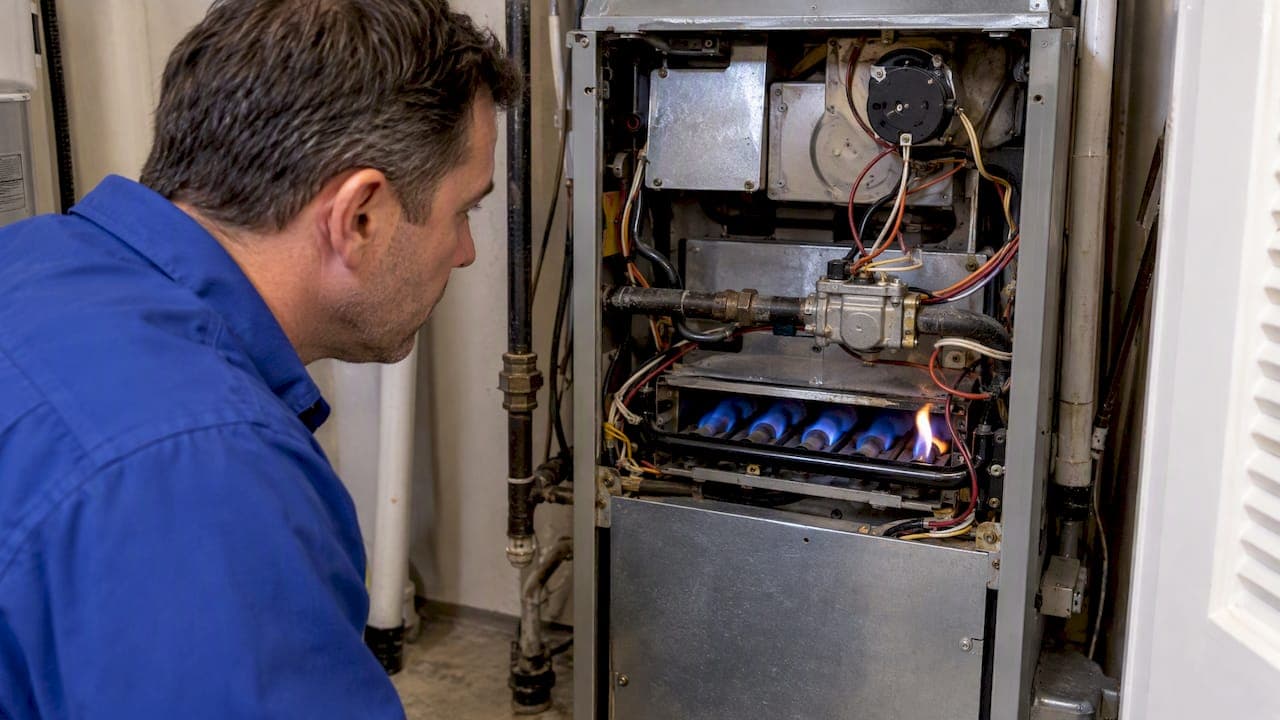
Flame rollout means burner flames are escaping the combustion chamber and burning outside of where they belong, usually in the burner compartment at the front of your furnace. It is a safety problem, not a nuisance. Turn the furnace off at the thermostat, keep the panel closed, and call a licensed HVAC technician before you run the system again. If anyone has headaches, nausea or dizziness, or a carbon monoxide alarm is sounding, get everyone outside first and call 911.
Below, we explain why rollout happens, what a tripped rollout switch is telling you, what you can safely check yourself, and what a proper repair involves.
TL;DR
- Flame rollout happens when burner flames are pushed or pulled out of the combustion chamber, most often because of a blocked flue, a dirty or cracked heat exchanger, or negative pressure in the house.
- A rollout switch is a safety device that shuts off gas when it senses excess heat. When it trips, something is wrong with the furnace, and the switch is not the problem.
- Do not repeatedly reset the switch or bypass it. If it trips twice, or you see yellow, pulsing or bouncing flames, shut the system down and call a pro.
- A carbon monoxide reading of 30 ppm or higher is an evacuation-level event, according to the U.S. Department of Energy's Building America Solution Center.
- Yearly professional maintenance is the best prevention.
Table of Contents
- What flame rollout actually is
- What you may see and smell
- Why flames roll out: the common causes
- What the flame rollout switch does
- What to do right now if flames roll out
- What you can safely check yourself
- What a proper repair looks like
- Our perspective on flame rollout
- Preventing rollout: maintenance that matters
- When we can help
- FAQ
- Sources
What flame rollout actually is
In a healthy gas furnace, the burners fire into a heat exchanger. The draft, whether from an inducer motor or a hot flue, pulls the flames and the combustion gases through the heat exchanger and out the vent. The flames stay inside, burn steady and look blue.
Rollout is when that flow fails. Some of the flames curl backward and out of the combustion chamber. PICKHVAC describes it as burner flames that come backward, or "roll out." The burner compartment holds wiring, a gas valve and other components that are not built to take direct flame. That is how a rollout turns into a fire risk, and why the exhaust that should be leaving through the vent can end up in your home as carbon monoxide (CO).
If rollout does cause fire or smoke damage, a public adjuster who handles fire and smoke damage claims can help you document the loss and deal with your insurer. The better plan is to make sure it never gets that far.
What you may see and smell
Rollout is not always dramatic. These are the signs, from obvious to subtle:
- Flames that pulse, bounce, or lean toward the front panel when the burners light.
- Yellow or orange flames instead of a clear blue.
- Scorch marks, soot or discoloration inside the burner compartment, or on the front of the cabinet.
- A furnace that starts, runs briefly and shuts off, or refuses to restart.
- A burning smell near the furnace. Our guide on why a furnace smells like burning explains which smells are harmless and which are not.
Practitioners also check for scorch marks in the burner compartment, rust on the heat exchanger and debris that restricts airflow, because a homeowner doing a quick visual check can miss them.
If you smell gas, that is a separate emergency. Read what to do when your furnace smells like gas and act on it immediately.
Why flames roll out: the common causes
The Building America Solution Center identifies the primary cause as restricted suction or airflow within the heat exchanger, which stops the burner flames from being drawn into the unit as they should. The usual contributors are below.
| Cause | What happens | Typical signs |
|---|---|---|
| Blocked or restricted flue or vent | Exhaust cannot leave, so pressure builds and flames are pushed back | Rollout switch trips, soot at the vent, a furnace that shuts down mid-cycle |
| Dirty, sooty or corroded heat exchanger | Passages narrow, so the draft cannot pull flames through | Rust flakes, soot, yellow flames |
| Cracked heat exchanger | Blower air enters the combustion side and disturbs the flames | Flames that flicker when the blower starts, CO alarms |
| Dirty burners or orifices, low gas pressure | Uneven, lazy flames that drift out | Yellow tips, delayed ignition |
| Negative pressure in the home | Exhaust fans and leaky ducts pull air, and flames, the wrong way | Problems that appear when a dryer or range hood is running |
Blocked flue or vent
Birds' nests, debris, a collapsed liner or a poorly sloped vent pipe can all choke the exhaust path. A blocked flue is one of the first things a technician checks after a switch trips.

A dirty or damaged heat exchanger
Soot and rust narrow the passages the flames must travel through. A crack is more serious. Air from the blower can be forced through the crack into the combustion side and push flames out. Cracks can also let combustion gases leak into the air you breathe. We cover that scenario in detail in heat exchanger crack risks and when to evacuate.
Dirty burners and low gas pressure
Dirty burner orifices can lower gas pressure at the burner and make the flame lazy and unstable. This is part of what a tune-up cleans up. Checking manifold gas pressure takes the right instruments and training, and it is not a DIY job.
Backdrafting and negative pressure
The U.S. Department of Energy's Building Science Education program describes flame rollout as often a symptom of backdrafting, especially in older furnaces that draw air from the living space instead of sealed combustion units. In a tight modern house, a strong bathroom or kitchen exhaust fan, a clothes dryer, or leaky return ducts can depressurize the furnace room and pull exhaust and flame the wrong way.

That applies in the Inland Empire as much as anywhere. A garage or closet furnace in a home that has been sealed up for energy savings, with a few exhaust fans running, is a classic setup for pressure problems.
What the flame rollout switch does
The flame rollout switch is a thermal safety cutoff mounted near the burners. If it senses excess heat in the burner compartment, it opens and shuts off the gas supply. The CPSC notes that these switches have been required on gas-fired furnaces made since 1987.
This is why a tripped switch deserves respect. It is a warning light with consequences. HVAC Training Shop puts it bluntly: a tripped flame rollout switch is not normal, and it means the furnace has a problem that can be dangerous if ignored.
Some switches are manual reset, with a small red button. Others are automatic, and some trip permanently and need replacement. Either way, the order of operations is the same: find out why it tripped, then fix that.
Can you reset a tripped switch?
Sources differ in tone, but they agree on the limit. PICKHVAC says it is reasonable to reset it once or twice to see whether it tripped for a minor reason. Practitioners also advise shutting the furnace off and calling a pro if the flames look yellow or pulsate, or if the switch trips a second time.
Our view is more conservative. Because the Building America Solution Center says not to attempt DIY repairs after rollout or backdrafting, we recommend calling a licensed technician before a reset. The reset button should never be taped down, jumped, or replaced with a higher-rated part.
How a technician tests a switch
A technician can test the switch with a multimeter on the ohms setting. According to HVAC Training Shop, a healthy switch that has not tripped reads close to zero ohms. An open line or very high resistance means it has failed and needs to be replaced. A bad switch is only half the story, though. Replacing it without finding what made it trip is how people end up with a repeat event.
What to do right now if flames roll out
- Turn the thermostat to off. This stops the call for heat. If you can reach the furnace's power switch safely, turn that off too. Do not stand with your face near the open burner compartment.
- Leave the front panel on. With the cover off, flames can curl over the cabinet, and the furnace should not be run that way.
- Ventilate and check for CO symptoms. Headache, nausea, dizziness, or confusion in more than one person, or pets acting sick, call for fresh air and 911.
- Check your CO alarm. The Building America Solution Center sets 30 ppm or higher as an evacuation threshold. Leave the house and call emergency services if you reach it.
- If you smell gas, leave and call from outside. Do not use switches or lighters inside.
- Call a licensed HVAC technician. Do not run the furnace again until it has been inspected.
If your furnace will not ignite at all and you are not seeing flames, our five safe checks when a furnace won't ignite is the better starting point. If it shows a pressure switch fault, see furnace pressure switch error checks.
What you can safely check yourself
Some things are fine for an owner to do. Others are not.
Fine to do:
- Replace a dirty filter. A clogged filter restricts airflow and can overheat the furnace.
- Look at the outside vent termination for obvious blockage, such as a bird's nest, leaves or a covering.
- Confirm that your CO detectors work, and place them properly. Our CO detector placement guide shows how to cut false alarms without moving them somewhere useless.
- Note what you saw: when the flames rolled out, how many times, and whether the dryer or exhaust fans were running. It helps the technician.
Leave to a professional:
- Opening and cleaning the burner assembly or heat exchanger.
- Measuring manifold gas pressure and adjusting the gas valve.
- Inspecting for a cracked heat exchanger.
- Replacing or bypassing a rollout switch.
- Testing combustion safety and draft.
Experts advise that diagnosing or "fixing" these parts without proper training is ineffective and potentially dangerous. Our broader article on DIY furnace repair for homeowners draws the line between safe tasks and ones that need a licensed technician.
What a proper repair looks like
A technician who is serious about rollout will do more than swap a switch. Expect a process along these lines:
- Visual inspection of the burner compartment for scorching, soot, rust or melted wire insulation.
- Venting check: flue, vent pipe, termination and draft.
- Burner and orifice cleaning and a check of flame appearance.
- Heat exchanger inspection, often with a camera on a suspect unit.
- Gas pressure measurement and an adjustment if it is out of range.
- Combustion and CO testing with the furnace running.
- Switch testing and replacement if needed, with the same-rated part.
- House pressure check: exhaust fans, dryer, return leaks.
If the heat exchanger is cracked, the honest answer may be replacement of the furnace. A cracked exchanger is a safety shutdown, not a patch job. If you are told that, ask to see the evidence, whether photos or camera footage, and read our piece on heat exchanger crack risks before you decide.
Our perspective on flame rollout
We see rollout as a symptom that the furnace has told on itself. The rollout switch did its job, and the question is what pushed the flames out. That is why we are wary of quick fixes. A reset, a new switch, and a furnace that runs again tell you very little about whether the vent is sound or the heat exchanger is intact.
Our approach is the same as for any safety-related heating call: shut it down, find the root cause, explain it in plain language, and show you what we found. We work on all major brands, we are licensed and insured, and we are available around the clock, including weekends and holidays, because a heating problem with a combustion risk should not wait for Monday.
Two things we tell homeowners across the Inland Empire. First, do not treat a second trip as bad luck. Second, think about older, atmospherically drafted furnaces in tightly sealed houses. The Department of Energy's training material points to sealed combustion units as a way to separate the heating process from indoor air and remove the spillage risk. When a furnace is near the end of its life and rollout is showing up, a replacement conversation is reasonable, and we will walk through repair against replacement honestly, with financing options if you need them.
— Edward
Preventing rollout: maintenance that matters
According to HVAC industry guidance, yearly inspections are the single most effective prevention. They keep burners clean, flues unblocked, and flames a clear blue. The U.S. EPA's guidance on burner servicing also says to visually inspect the flame once a year and to look at both pilot and main burner flames. A pro does this with instruments instead of eyes alone.
A practical yearly plan:
- Before heating season: professional tune-up with combustion analysis, venting inspection and heat exchanger check. Our home heater maintenance guide lists what a good visit covers.
- Every 1 to 3 months: check and replace the filter as the manufacturer directs.
- Always: working CO alarms on every level and near sleeping areas.
- Whenever you remodel or seal air leaks: have combustion safety tested, because a tighter house changes how a furnace drafts. If you want a refresher on what the parts do, see how furnaces work.
If you run a portable generator during an outage, keep it outdoors and well away from the house. A unit such as a 2500W inverter generator with a built-in CO alert adds one more layer of warning, though it does not replace working CO alarms inside.
When we can help
If your furnace has had a flame rollout or a tripped switch, we can diagnose it, repair it, or talk through a replacement. Our heater repair service covers inspection and repair on all major brands. If the unit is too far gone, we handle HVAC installation too. Business owners and property managers can reach us through our commercial HVAC page for maintenance and emergency repairs. We serve Riverside, San Bernardino, Moreno Valley, Fontana, Rancho Cucamonga, Corona, Hemet and the surrounding Inland Empire cities, with transparent service and flexible payment options, including financing.
FAQ
What causes flame rollout on a furnace?
The common causes are a blocked flue or vent, a dirty or rusted heat exchanger, a cracked heat exchanger, dirty burners with low gas pressure, and negative pressure in the home. The shared pattern is that exhaust and flames cannot flow through the furnace as designed. A licensed technician needs to find which one applies.
How do I know if my flame rollout switch is bad?
A technician can test it with a multimeter. A switch that has not tripped should read near zero ohms, and an open line or very high resistance means it has failed. A switch that keeps tripping is usually doing its job, so look for the underlying cause before blaming the part.
Can a flame rollout switch be reset?
Some models have a manual reset button, and some sources say one or two resets are acceptable to see if it was a one-off. If the flames look yellow or pulsing, or the switch trips again, shut the furnace off and call a professional. We recommend a licensed technician look at it before you reset it at all.
Is flame rollout dangerous?
Yes. Flames outside the combustion chamber are a fire risk, and the underlying problem can allow carbon monoxide into the home. Turn the furnace off, make sure your CO alarms work, and get the system inspected before using it again.
Why does my furnace flame come on and then go out?
It can be a dirty flame sensor, poor venting, a pressure problem or a safety lockout, and rollout is one of the possibilities. A flame that lights and then shuts the furnace down repeatedly should be checked by a technician, not just cleaned and retried.
Sources
- CPSC: Urges Seasonal Furnace Inspection to Prevent CO Poisonings
- Building America Solution Center: Look for Signs of a Gas Furnace Backdrafting
- Building Science Education: HVAC Combustion Safety
- PICKHVAC: All You Need to Know about Flame Roll Out Switch
- PICKHVAC: Is It Safe to Just Reset Flame Rollout Switch?
- PICKHVAC: HVAC maintenance guidance
- HVAC Training Shop: Furnace Flame Rollout Switch
- U.S. EPA: Periodic Servicing of Gas Burners for Home Heating