
Most residential heat pumps run on a dedicated 240V circuit and draw roughly 8–37 amps depending on capacity, which usually means a breaker from about 20 A for small units up to 60 A for large 5-ton systems. The outdoor unit's nameplate, together with NEC Article 440, sets the final breaker and wire sizes. A licensed electrician confirms them, checks your panel, and handles permits.
TL;DR:
- Typical estimates span 8–12 amps and a 20 amp breaker for 1.5 ton units, rising to 30–37 amps and 60 amps for 5 ton systems.
- The outdoor unit’s nameplate overrides tonnage charts: use its MCA to size conductors, and never exceed its MOCP when selecting the breaker.
- A 240V circuit needs two adjacent panel slots; many 200 amp homes can add one, while 100 amp or full panels need an electrician’s assessment.
- Code requires a readily accessible disconnect within sight of the outdoor unit, in a weatherproof enclosure; installers generally place a service receptacle nearby on a separate circuit.
- Long runs from the panel may require heavier wire to limit voltage drop, so an electrician must account for distance when sizing conductors.
Table of Contents
- What amp draw, breaker size, and wire gauge fit each heat pump size?
- How do you read the outdoor unit nameplate?
- What does NEC Article 440 require for disconnects and receptacles?
- Does your electrical panel have room for a heat pump?
- How do wire gauge, breaker size, and starting amps fit together?
- How do you prepare for an electrician visit?
- Why does licensed coordination make installs smoother?
- How does our installation team handle electrical prep, permits, and panel upgrades?
- FAQ
- Sources
What amp draw, breaker size, and wire gauge fit each heat pump size?
Industry charts tie amp draw to tonnage, then pair each band with a commonly used breaker and conductor size. PICKHVAC publishes these pairings, and the table below follows its ranges. Treat them as planning estimates, because your unit's nameplate overrides any chart.
| Heat pump size | Typical amp draw | Common breaker | Common wire gauge |
|---|---|---|---|
| 1.5 ton | 8–12 A | 20 A | 12/14 AWG |
| 2 ton | 10–15 A | 25 A | 10/12 AWG |
| 2.5 ton | 14–18 A | 30 A | 10 AWG |
| 3 ton | 16–30 A | 30 A | 8/10 AWG |
| 4 ton | 25–30 A | 45 A | 6/8 AWG |
| 5 ton | 30–37 A | 60 A | 4/6 AWG |
You can expect 240V service for nearly every full-size system. That is a different animal from a 120V outlet circuit like the one feeding a lamp or a window unit. A 240V circuit uses a two-pole breaker that takes two spaces in your panel, which matters when we get to capacity below.
Notice the 3-ton row has a wide amp range. Efficiency level, compressor type, and manufacturer all shift the number, which is exactly why the chart can only tell you what to expect, not what to buy. Before you size anything, you also want the capacity itself to be right. Our guide on what HVAC tonnage means explains how tons relate to the load your home actually needs, and that choice drives every electrical number that follows.
How do you read the outdoor unit nameplate?
The nameplate is a sticker on the outdoor unit, usually on the side panel near the wiring access. It is the single document your electrician trusts most. The NEC treats heat pump circuits as special cases under Article 440, and installers are expected to follow the manufacturer's nameplate data rather than treating the unit like an ordinary branch circuit.
Here are the fields that matter:
- Rated voltage: Almost always 208/230V, single phase, 60 Hz for homes.
- Minimum Circuit Ampacity (MCA): The smallest conductor capacity that safely carries the unit's load. Your electrician uses it to pick wire gauge.
- Maximum Overcurrent Protection (MOCP): The largest breaker the unit may be paired with. You may go smaller if the wire and MCA allow, but never larger.
- Compressor and fan motor amps: Often labeled RLA (rated load amps) and FLA (full load amps).
Why don't the running amps match the MCA? MCA is calculated from the compressor and fan loads with a safety margin built in, so it will be higher than what the unit pulls on a typical afternoon. A homeowner who sees different RLA and MCA values has not necessarily found a mistake. The figures describe different things, and an electrician can confirm what they mean for the circuit. One describes what the motor draws, the other describes what the circuit must be built to carry.
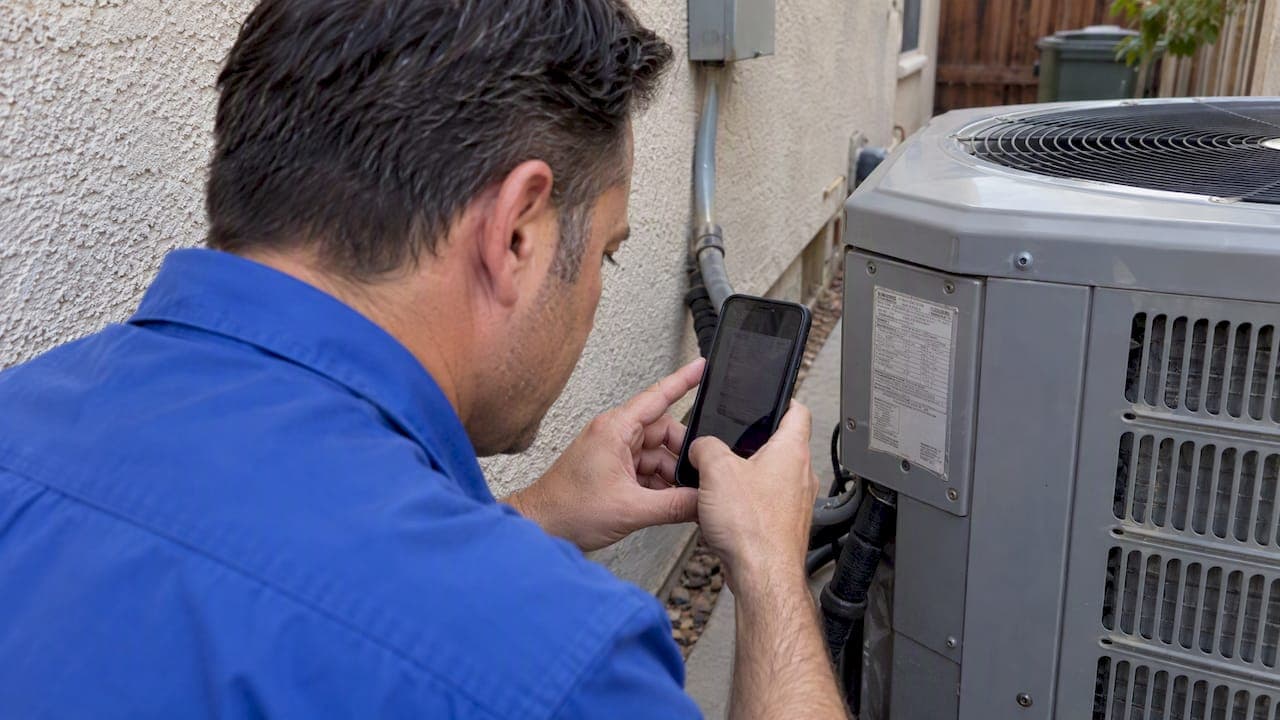
Snap a clear photo of the nameplate before your electrician visits. It saves a trip and prevents guesswork.
What does NEC Article 440 require for disconnects and receptacles?
Article 440 covers air-conditioning and heat pump equipment, and it is the section inspectors lean on for these jobs. Because it recognizes the nameplate as the sizing authority, your breaker and wire can differ from what a standard branch-circuit rule would suggest. Here is what you will typically see applied:
- A readily accessible disconnect within sight of the outdoor unit. This lets a technician cut power at the unit itself without walking back to the panel.
- A weatherproof enclosure for that disconnect, since it sits outdoors next to the condenser.
- A maintenance receptacle near the unit, which practitioners generally put on its own separate circuit so a service tool never competes with the compressor.
- Conductors and protection sized from the nameplate, not guessed from tonnage alone.
These rules decide where parts physically go, and that affects labor and permitting. A disconnect mounted on the wrong wall, or a receptacle missing entirely, is one of the more common reasons an inspection gets flagged.
Pro Tip: Pick the outdoor unit's location before the electrician quotes. The distance from your panel to the disconnect and condenser drives wire length, trenching, and cost more than almost any other variable.
Does your electrical panel have room for a heat pump?
Walk to your panel and look at two things. First, find the main breaker at the top and read its amperage. Second, count the empty breaker spaces, because a 240V heat pump circuit needs two adjacent slots.
ENERGY STAR advises homeowners to make their homes electric ready by checking exactly those items. Its guidance is straightforward: many newer homes have 200A service that is sufficient for a heat pump, while older homes with 100A service may need an upgrade or a subpanel when adding large electric loads.
A quick way to size up your situation:
- 200A main with open slots: You can often add a heat pump circuit without changing the panel.
- 100A main or a full panel: Expect your electrician to evaluate a service upgrade or a subpanel before approving a new circuit.
- Several big loads at once: A heat pump plus an EV charger plus an electric water heater can overload even a decent panel, so these projects are best planned together instead of one at a time.
Electricians use a load calculation rather than a glance at the panel door, so your own count is a starting point. It still helps. If you arrive knowing your main amperage and slot count, the quote conversation gets short and specific.
How do wire gauge, breaker size, and starting amps fit together?
The relationship is simple in principle. The breaker protects the wire, and the wire has to be thick enough to carry the load without overheating. Undersized conductors behind a breaker that is too large are a genuine fire hazard, which is why the sizing chain always runs from nameplate to wire to breaker.
Contractors commonly pair them like this:
- 12 AWG with a 20 A breaker
- 10 AWG with a 30 A breaker
- 8 AWG with a 40 A breaker
- 6 AWG with a 45–60 A breaker
Long runs from the panel to the outdoor unit can call for a heavier gauge than the chart suggests, because voltage drop eats into performance over distance. Your electrician accounts for that on site. Remember to that these pairings are common practice, and the nameplate and NEC take precedence every time.
Then there are starting amps. A compressor's locked-rotor current can reach up to roughly five times its running amps for a split second at startup. That sounds alarming, but start capacitors and hard-start kits reduce the spike, and breakers are designed to tolerate brief surges. Your circuit is sized for the nameplate, not for that momentary jolt. Once everything is wired, a proper commissioning visit confirms it all works, and our walkthrough of the HVAC startup process shows what technicians check.

How do you prepare for an electrician visit?
A little prep turns a vague visit into a firm quote.
- Photograph the outdoor unit's nameplate and note the model number.
- Read your main breaker amperage and count empty panel slots.
- Mark the proposed outdoor unit location and the distance from the panel.
- Ask which MCA and MOCP they will use, and whether a new circuit or panel upgrade is needed.
- Confirm who pulls permits and schedules inspection, then ask for the sequence: site visit, permit, install, inspection.
Why does licensed coordination make installs smoother?
We have seen how many heat pump delays come from the gaps between trades, not from the equipment. An HVAC crew finishes the outdoor unit, the electrician has not sized the circuit, and the inspector finds a disconnect in the wrong place. Licensed technicians who handle panel checks, wire sizing, disconnect installation, and permit coordination in one process avoid those gaps. Following the nameplate and code from day one is what keeps inspections passing. Our Manual J sizing guide and cold-climate performance data show how we think about the whole job.
— Edward
How does our installation team handle electrical prep, permits, and panel upgrades?

When you hire us for HVAC installation, one team is accountable for the whole job: the nameplate-led circuit design, coordination with electricians, and the permit and inspection steps. That means fewer handoffs and fewer failed inspections. Request an installation quote through our main site, and we will tell you what your panel can handle before any work begins.
FAQ
Do heat pumps require 110 or 220 volts?
Most residential heat pumps need a dedicated 240V circuit. A standard 120V outlet circuit cannot supply a full-size outdoor unit. Some small mini-splits run on 120V, so check the nameplate.
What size cable do I need for a heat pump?
Cable size depends on the nameplate's MCA and the breaker size. Common pairings run from 12 AWG for a 20 A circuit to 6 AWG for 45–60 A, with 4 to 6 AWG typical for a 5-ton unit. Long runs may need heavier wire.
Will I need a panel upgrade for a heat pump?
Not always. ENERGY STAR notes that many homes with 200A service can add a heat pump without an upgrade, while older 100A panels often need one. Adding an EV charger or electric water heater at the same time raises the odds.
Does a heat pump need a disconnect?
Yes. The NEC calls for a readily accessible disconnect within sight of the outdoor unit so power can be cut right at the equipment. Your electrician will mount it during installation.
Sources
- Heat Pump Electrical Requirements - GreenBuildingAdvisor
- How Many Amps Does a Heat Pump Use? - PICKHVAC