
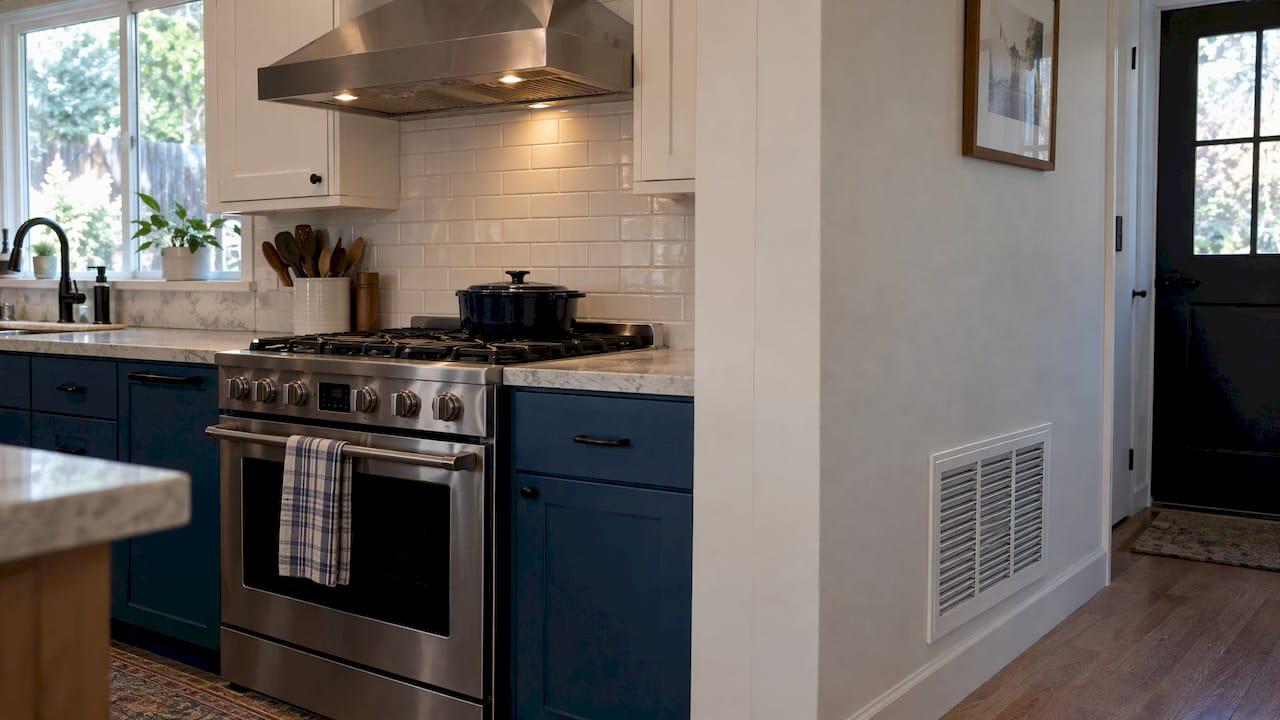
A kitchen hood that struggles, a door that sucks shut, a whistle at the window frame, a furnace or water heater that acts up whenever you cook: these are the usual signs of a makeup air problem. Every cubic foot of air your hood sends outside has to be replaced from somewhere. When there is no planned path for that replacement air, the house pulls it through the wrong places. Fixing it takes the right-sized duct, a damper that opens only when the hood runs, and controls that tie the two together. That is design and installation work for a licensed HVAC contractor, and at E320air we handle it for homes and commercial kitchens across the Inland Empire.
TL;DR
- Makeup air replaces the air your range hood or commercial exhaust removes. Without it, the building goes under negative pressure.
- Typical symptoms: weak hood capture, drafts, hard-to-open exterior doors, odors from the garage, and in the worst case combustion gases pulled back into the home (backdrafting).
- The model code trigger for homes is a hood that can exhaust more than 400 CFM, but backdrafting can happen below that when gas appliances are in the house.
- Backdrafting can involve carbon monoxide, so repeated symptoms call for a professional draft and spillage test, not guesswork.
- A properly designed system has an outside-air duct, a motorized damper and an interlock with the hood. We design and install these for residential and commercial kitchens.
Table of Contents
- What kitchen makeup air does
- The signs that something is wrong
- Why it happens
- Backdrafting: the problem that deserves attention
- When code calls for makeup air
- A safe way to check your own kitchen
- What a good fix includes
- Inland Empire conditions
- Promo: kitchen makeup air handled by one contractor
- Perspective
- FAQ
- Sources
What kitchen makeup air does
A range hood is an exhaust fan. It pulls cooking fumes, grease, heat and moisture out of the kitchen. A makeup air system brings an equal amount of outside air back in so the building stays pressure-balanced. It usually has three parts: a duct to the outdoors, a damper that stays closed when the hood is off, and controls that open the damper when the hood starts. Those controls can be a current-sensing relay, a pressure sensor, a manual switch or interlocked contacts.
Placement matters. Ideally the replacement air enters near the cooking area, so it flows through the cooking zone and the hood captures it. Air that arrives from across the room or at high speed disturbs the plume and the hood loses its grip on the fumes.

The signs that something is wrong
Penn State's Pennsylvania Housing Research Center explains that when a large exhaust system runs with no dedicated makeup air, the house depressurizes. Air is then drawn from garages, mechanical rooms and storage areas, which can bring in fumes, exhaust, radon or odors. Drafts form, and in hot, humid weather moisture-laden air can condense on cold interior surfaces and lead to mold.
In practice, here is what that looks like in a Southern California kitchen:
- The hood does not clear smoke or steam. Fans starved of air move less of it. Cooking haze drifts into the dining area instead of rising into the hood.
- Exterior doors are hard to open or slam shut. In commercial kitchens, hard-to-open exterior doors are a recognized sign of a failed makeup air unit, along with plume spillage out of the hood.
- Whistling or rushing air at windows, door gaps, the fireplace damper or a dryer vent when the hood is on.
- Garage or attic smells showing up in the kitchen.
- A pilot light that flickers, or a water heater or furnace that behaves oddly while the hood runs.
- Uneven temperatures. Replacement air that is too cold in winter or too hot in summer makes the room uncomfortable and loads the heating and cooling equipment.
PHRC also warns that a poorly specified system can cause uncomfortable drafts, overstressed HVAC equipment, mold and house depressurization, and that a badly conceived exhaust and makeup air design can be expensive as well as non-functional. That last point is why the design should come first, before equipment is bought.
Why it happens
There is rarely a single cause. The most common ones:
A powerful hood in a tighter house. Fantech's ventilation guide attributes the rise in backdrafting to two trends: homes are built tighter, with fewer random leaks, and multi-burner ranges call for more powerful hoods. Together they push the demand for replacement air past what leakage can supply. If you recently upgraded to a pro-style range or added insulation and new windows, this is the first place to look.
Other pressure imbalances in the house. PHRC lists the most common causes of unintended pressure imbalance as leaking HVAC ducts, restrictive return air pathways, combustion appliance draft and mechanical ventilation. Wind and stack effect can add 0 to 4 pascals on their own. So a kitchen complaint sometimes starts in the duct system. If bedrooms with closed doors feel stuffy or airflow is weak, our guides on undersized return air and weak airflow from vents cover the same pressure story from the HVAC side.
No damper, or the wrong damper. A duct to the outdoors with no way to close it lets hot Inland Empire air or cold desert nights pour in all day. The Building America retrofit guide from the Home Ventilating Institute and Pacific Northwest National Laboratory prefers a motorized damper over an untested gravity damper.

Undersized or clogged ductwork and filters. A makeup air path that is too small cannot deliver the volume the hood removes. Fantech recommends inspecting the makeup air filter every two to three months, or every six months once you know how the system performs.
Air delivered in the wrong place. In commercial kitchens, improper introduction of makeup air creates cross drafts and high velocities that keep the hood from capturing heat, grease vapor, odors and combustion products. California's CKV design guidance suggests keeping makeup air velocity near the hood below 75 feet per minute.
Backdrafting: the problem that deserves attention
Backdrafting is when the hood pulls air backward down a water heater flue or a wood-burning chimney because that is the easiest path in. Flue gases can contain carbon monoxide, which is why Fantech calls this dangerous and in some cases life-threatening. It is most relevant in homes with gas furnaces, gas water heaters or fireplaces, which describes a large share of homes from Riverside to Rancho Cucamonga.
Treat these as safety triggers:
- A carbon monoxide alarm sounds while the hood or other exhaust fans are on.
- Soot staining or a burnt smell around the water heater draft hood or furnace.
- Smoke or ash drawn into the room from a fireplace when the hood is running.
If any of these happen, turn off the hood, open windows, and leave the house if the CO alarm is sounding. Then call 911 or your gas utility, and have a licensed HVAC contractor inspect the appliances and the makeup air path before you cook with the hood again. PHRC recommends that qualified professionals perform draft, carbon monoxide and spillage tests to assess backdrafting risk. Our licensed, insured technicians work on heating and air quality systems, so the appliance side and the air side get looked at together.
When code calls for makeup air
The model residential code, the International Residential Code, requires makeup air when a range hood can exhaust more than 400 CFM (cubic feet per minute, the measure of airflow). The code language calls for makeup air at roughly the same rate as the exhaust, with a closure that starts and operates simultaneously with the exhaust system.
So yes, a 600 CFM hood needs makeup air. Check the CFM rating on the hood's label or spec sheet, and use the maximum speed, not the quiet setting.
The 400 CFM line is a floor, not a guarantee of safety. The same Building America guide notes that in homes with atmospherically vented combustion appliances, backdrafting is possible below 400 CFM, so makeup air should be considered for any hood size in those homes. If you have a gas water heater in the garage and a 300 CFM hood, you can still have a problem.
Commercial kitchens in California
For restaurants, cafes and other commercial kitchens, the California Energy Commission states that the 2022 Building Energy Efficiency Standards apply to every commercial kitchen with at least one exhaust hood, with healthcare facilities exempt. Mechanically cooled or heated makeup air may not exceed the greater of the supply needed for the space load or the hood exhaust minus available transfer air. Kitchens with combined hood exhaust over 5,000 CFM must also use one of several efficiency strategies, such as transfer air, demand ventilation, energy recovery, or lightly conditioned makeup air.
Projects that apply for permits on or after January 1, 2026 fall under the 2025 Energy Code, which, among other things, requires quick-service and institutional kitchens to have a dedicated 50-amp circuit and spare panel capacity for added equipment, with exceptions for healthcare and all-electric kitchens. Your city or county building department confirms which edition and local amendments apply to your permit. For a plain-language overview of what kitchens must meet, see our guide to restaurant ventilation requirements, and for how makeup air units are sized from homes to plants, our makeup air unit checklist.
A safe way to check your own kitchen
These checks are observations, not repairs. They help you describe the problem accurately.
- Find the hood's maximum CFM. It is on the label inside the hood or in the manual. Above 400 CFM, makeup air is expected.
- Look for the makeup air path. Is there a duct from outdoors that ends near the hood or connects to the HVAC system? Does it have a damper?
- Run the hood on high and watch. Does the damper open? Does the hood clear steam? Is an exterior door pulled shut or hard to open?
- Listen and feel. Whistling at windows, a draft at your ankles or a pull from the fireplace points to depressurization.
- Check the filter on any makeup air unit and the hood's grease filters. Fantech's two to three month inspection interval is a reasonable starting rhythm.
- Note the combustion appliances. Gas water heater, furnace or fireplace in the same pressure zone as the kitchen raises the stakes.
There is also a professional benchmark. The Passive House Institute's guidance describes a stress test: turn on the range hood and measure the building's pressure. If the hood causes more than 5 pascals of depressurization, makeup air is needed. A pressure gauge and a trained eye make that reading meaningful, which is one reason to have a technician run it.
If the hood only misbehaves in summer or winter, the temperature of the incoming air may be part of the story. Design guidance recommends keeping makeup air supply within 10°F of room temperature, for example no colder than 60°F when the house is at 70°F. Ducting outdoor air straight into a kitchen on a cold desert night misses that target without tempering or good placement.
What a good fix includes
The fix depends on the hood, the house and the appliances, but a sound solution generally covers:
- A right-sized outside-air duct that matches the hood's airflow.
- A motorized, interlocked damper that opens when the hood runs and closes when it stops.
- Placement near the cooking zone at low velocity, so the plume is not disturbed.
- Tempering where needed, so incoming air does not overload your heating and cooling system.
- A look at the whole duct system, since leaky ducts and restrictive returns also unbalance pressure. Our article on why ductwork matters explains how that connects to comfort and efficiency.
- For commercial kitchens, a code-aware design that works with the hood and meets California's energy standards. Dedicated makeup air units are common, and the guidance notes that if an independent unit fails, the hood loses capture and containment.
Makeup air also belongs in the larger ventilation picture. Fresh air coming in on purpose is part of healthy indoor air, as we explain in our guides to ventilation systems in Southern California homes and HVAC ventilation types.
Inland Empire conditions
Our service area runs from Corona and Norco through Riverside, Moreno Valley and Perris, out to Hemet, Banning and Beaumont, and up through Fontana, Rancho Cucamonga, Ontario, Upland, Redlands and Hesperia. Summers here are long and hot, and California's design guidance points out that evaporative makeup air cooling can be worth considering in warmer, drier climates. The point for a homeowner or restaurant owner: untreated outdoor air in July is a real cooling load, so how makeup air is delivered and tempered affects both comfort and the utility bill.
Promo: kitchen makeup air handled by one contractor
If your kitchen shows the signs above, we can look at the hood, the makeup air path and the heating and cooling equipment together. E320air serves homeowners, landlords, property managers and business owners with repairs, installations, upgrades and maintenance, with technicians who are licensed and insured and who work with all major brands. Service is available around the clock, including weekends and holidays, and flexible payment options including financing are available.

For a home, start with our residential HVAC and system enhancements page. For a new makeup air path or equipment, see HVAC installation. Restaurants and other businesses can reach us through commercial HVAC, maintenance and emergency repairs, and you can browse real jobs in our problem solving gallery.
Perspective
Most kitchen makeup air complaints we hear about look like a hood problem and turn out to be a building problem. The hood is doing its job. The house simply has no planned way to give that air back, so it takes it from the water heater flue, the garage or the cracks around a door.
That is why we think of makeup air as part of the HVAC system, not an accessory to the range. When the hood, the outside-air path, the damper and the heating and cooling equipment are designed together, the kitchen clears, the doors open normally, and the system is not fighting itself. Our focus is tailored, energy-efficient solutions with minimal disruption, and this is a good example of where that matters.
If you cook a lot, own a gas range, or run a commercial kitchen, treat makeup air as part of the plan from day one. We handle residential and commercial work, and we are available around the clock when a failure cannot wait.
Edward
FAQ
Do I need makeup air for a 600 CFM hood?
Yes. The model residential code requires makeup air when a hood can exhaust more than 400 CFM, at a rate roughly equal to the exhaust and with a damper that operates with the hood. A 600 CFM hood is well above that line. Your local building department confirms which code edition applies to your permit.
What are the signs of poor ventilation or makeup air in my house?
Watch for a hood that does not clear steam, doors that are hard to open or slam, whistling at windows, garage odors in the kitchen, and appliances that behave oddly when the hood runs. Condensation and mold in humid weather are longer-term signs. If a CO alarm sounds, leave the house and call 911 or your gas utility first.
Can I just open a window when I cook?
A window provides replacement air only while it is open, and it does not deliver the air near the cooking zone where the hood needs it. For a hood above 400 CFM, or any hood in a home with gas appliances, a dampered duct that opens automatically with the hood is the dependable approach. Our team can design and install one.
Why does my kitchen exhaust fan seem weak?
Starved airflow is a common reason: when the house cannot supply replacement air, the fan moves less. Dirty filters, undersized ducts and leaky or restricted HVAC return paths can add to it. A technician can check the hood, the makeup air path and the duct system together.
Does a restaurant need a dedicated makeup air unit?
Commercial kitchens with hoods must meet California's energy standards for makeup air, and many use a dedicated unit interlocked with the hood. The right design depends on the hood size, the layout and the building's heating and cooling. We can review it for you under our commercial HVAC service.
Sources
- Makeup Air Systems Explained: How They Work with Your Range Hood
- Kitchen Ventilation Systems: Part 1, Penn State PHRC
- Providing Adequate Makeup Air, Penn State PHRC
- CKV Design Guide 4: Integrating CKV with Building HVAC, CA EnergyWise
- Kitchen Makeup Air, CedEngineering
- Essential Guide to Kitchen Ventilation and Makeup Air, Fantech
- Kitchen Exhaust Retrofit Duct Guide, Building America
- Commercial Kitchens, California Energy Commission
- 2025 Energy Code Nonresidential Implementation Series, 3C-REN
- Makeup Air Requirements for Direct Kitchen Hood Exhaust, PHIUS