
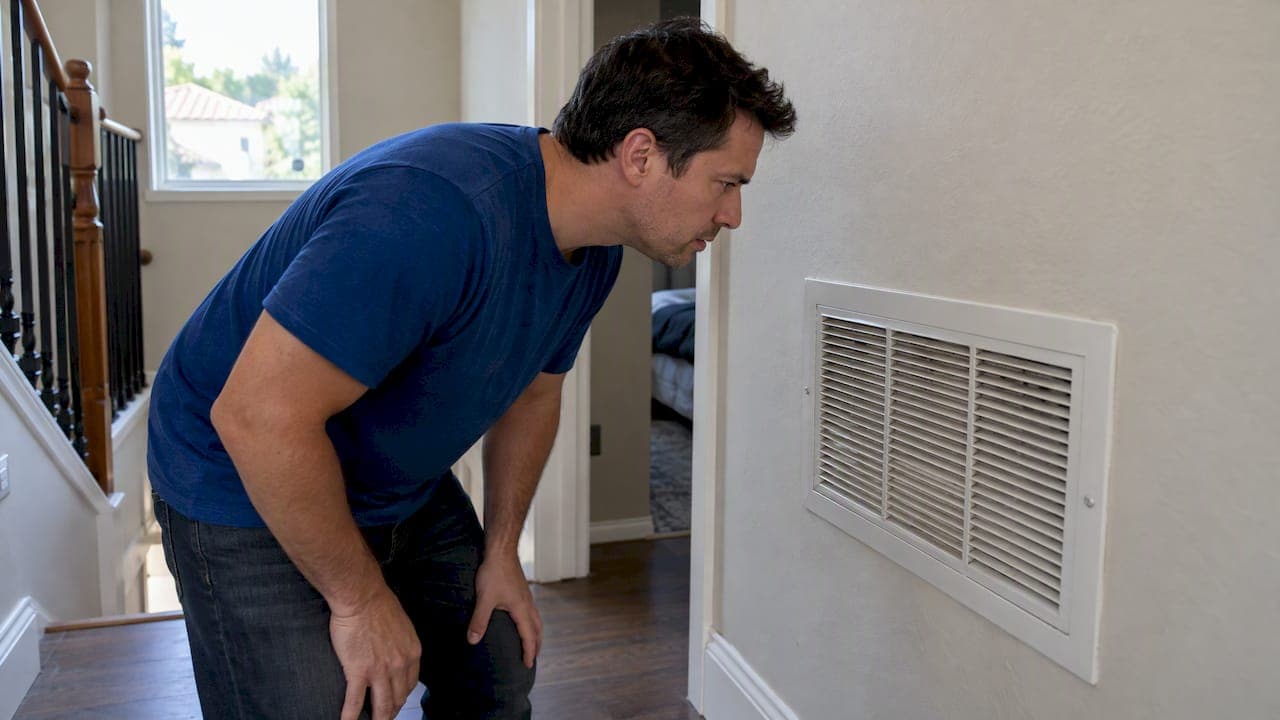
If your vents smell like sewage, the HVAC system is usually the messenger, not the source. Your air handler moves air through the whole house, so it carries along any odor it passes. The most common origins are a dry drain trap, a clogged or unsealed condensate line, or a leak in the plumbing vent or sewer line. A few causes are harmless and fixable in minutes. A few need a professional the same day. This guide shows you how to tell which one you have.
TL;DR
- Turn the system off for 15 to 20 minutes. If the smell stays, it is likely a plumbing issue. If it disappears and returns when the fan starts, the HVAC system is moving it or making it.
- Dry P-traps in rarely used drains are a common and easily fixed cause. Run water in every sink, tub and floor drain, especially near the furnace or air handler.
- A clogged condensate drain can smell musty, swampy or rotten, and many people read that as sewage.
- Strong odor with headaches, dizziness or nausea means leave the house and get fresh air first, then call for help.
- Smell that is constant, spreading or paired with slow drains points to the sewer line or plumbing vents. That is a plumber's job, not an HVAC repair.
Table of Contents
- Why the smell shows up at the vents
- Step 1: Work out when the smell happens
- Step 2: Check the cheap, common causes first
- Step 3: When it really is sewer gas
- Safety: when to leave the house
- DIY or professional: a simple split
- Our perspective
- Preventing the smell from coming back
- Need a technician to trace it?
- FAQ
- Sources
Why the smell shows up at the vents
An air conditioner or furnace does not make sewer gas. As the inspection resource InspectApedia puts it, air conditioners themselves don't produce sewer gas but might move gases and smells around a building. When the blower runs, it creates pressure differences. Return ducts pull air from wherever they can find it: a utility closet, a crawlspace, a garage, a basement corner with a floor drain.
If any of those spaces has an open path to a drain or sewer, the fan pulls the smell in and pushes it into every room. That explains why many people notice the odor only when the AC or heat kicks on.
There is a second possibility. The system itself may be producing a bad smell, from stagnant water in the drain pan, microbial growth on the coil, or a dead rodent in the ductwork. Those smells vary a lot, and sewage is a common description for them.
So the first job is sorting the cause into one of two groups: sewer gas being drawn in or the HVAC system creating its own odor.
Step 1: Work out when the smell happens
Spend a day noticing the pattern. It narrows the field fast.
| What you notice | Most likely group |
|---|---|
| Smell only when the fan or AC is running, gone within minutes of shutoff | HVAC drawing in or producing odor |
| Smell in one room, whether or not the system runs | Local drain or plumbing in that room |
| Smell at the start of cooling season after months of no use | Stagnant condensate, dry traps |
| Smell in every room all the time, plus slow or gurgling drains | Sewer line or vent problem |
| Smell near the furnace closet or floor drain nearby | Dry floor drain trap, condensate line |
The Wisconsin Department of Health Services suggests the same basic logic: check whether the odor persists with the HVAC off, then look at local drains if it stays in one area, and at condensate lines and sewer vent pipes if it is tied to system operation.
Step 2: Check the cheap, common causes first
Dry P-traps
Every sink, tub, shower and floor drain has a curved pipe called a P-trap. It holds a small plug of water that blocks gas from rising out of the sewer. Evaporation in rarely used drains is a common cause of sewer odors, and the North Dakota Department of Environmental Quality likewise lists leaks or a dry trap in a rarely used drain as the usual reason sewer gas enters a home.
Inland Empire homes are especially prone to this. Long, dry, hot stretches evaporate trap water quickly, and guest bathrooms, laundry room floor drains and garage drains can sit unused for weeks.
- Walk through the house and list every drain you rarely use.
- Pour about a quart of water down each one.
- For floor drains, pour slowly and give it a minute to settle.
- Re-check the smell after an hour with the fan running.
If the odor fades, you found it. Repeat monthly for any drain you do not use, or whenever you return from a long trip.
A floor drain near the furnace or air handler
Many homes put the air handler in a closet or garage corner with a floor drain a few feet away. A dry drain right beside a return intake is a textbook way to get sewer gas into the ductwork. Fill it with water first. If the smell disappears for a few days and returns, the trap is evaporating faster than you refill it, and a plumber can fit a trap primer or a different seal.

The condensate drain line
Your AC removes moisture as it cools, and that water leaves through a condensate line. Over time, algae and slime build up and clog it. Standing water in the drain pan turns foul. The smell is often musty or like rotten eggs, and it blows through the vents when the system runs.
The other issue is how the line is installed. Per one installer-focused discussion that ranks for this search, a likely culprit when sewer gas comes out of an AC is a condensate line run to an improper location, such as directly into a sewer line without a trap, which lets gas travel back up the line into the unit. We cannot vouch for every forum answer, so treat that as something to verify: a condensate line should end at a code-approved spot and have its own trap or air break where the local code requires it.
Signs your condensate line is the problem:
- Water around the indoor unit or in the secondary pan
- A swampy smell that is stronger right after the AC starts
- The smell eases after you clear the line
We have a step-by-step on how homeowners can clear most condensate drains in 60 to 90 seconds with a vacuum. If the line clears and the smell goes away, good. If water backs up again quickly, the pan, line slope or trap may be the real issue.
In a dry climate like ours, a slow leak can hide. Restoration professionals in Riverside County note that leaking condensate lines can soak wall cavities or crawlspaces without visible surface moisture, leading to hidden mold with a musty or even putrid odor that is easy to mistake for sewer gas. If your smell is earthy rather than sulfurous, our guide on stopping a musty AC smell with filter and drain fixes is the better starting point.
Step 3: When it really is sewer gas
Sewer gas is a mix of gases formed as waste decays. The Wisconsin DHS describes it as a complex mix of toxic and nontoxic gases, and its most hazardous component is hydrogen sulfide, which smells like rotten eggs. If drains are not the cause, these are the next suspects.
Blocked or cracked plumbing vent pipes
Plumbing vents on your roof let sewer gases escape above the house and keep drains flowing. If one is blocked, cracked or disconnected in an attic or wall, gas can leak inside the building. From there, an attic air handler or leaky return ducts can pull it in. Gurgling drains and toilets that bubble when another fixture runs are classic hints.

A damaged or backed-up sewer line
A cracked, collapsed or clogged lateral can leak gas under the slab or into a crawlspace. Multiple slow drains, wet spots in the yard, or sewage backing up in the lowest fixture point toward this. Mature trees near the line are a known risk, since roots can work their way into pipe joints; this guide to root intrusion and foundation risks explains the general mechanics, though it is written for Texas properties.
Improperly sealed toilets
A toilet with a failed wax ring can leak gas around its base. The smell tends to be strongest in that bathroom, but with leaky ducts it can spread.
Leaky ductwork in a crawlspace or attic
Duct leaks on the return side pull in whatever surrounds them. If the ducts run through a space with a broken sewer or vent pipe, they become delivery tubes. Sealing and repairing the ducts is something we handle, but only after the plumbing leak is fixed.
Vapor intrusion, a less common cause
The EPA explains that vapor intrusion happens when chemicals in soil or groundwater give off gases that seep into buildings through cracks in foundations, sewer lines or other openings. It is less common than a household plumbing leak, and it matters mostly in areas with known contamination. If you have ruled out everything else and live near a known contamination site, contact your county environmental health office.
Safety: when to leave the house
Most sewage smells from vents are a nuisance, but not all. Hydrogen sulfide is toxic. The CDC's ATSDR notes that people lose the ability to smell the gas after a few minutes at high concentrations, so the odor is an ineffective hazard warning. A house that suddenly seems fine may not be.
What to do:
- If the smell is strong, or anyone has a headache, dizziness, nausea or irritated eyes: leave the house, get fresh air, and call a plumber or your gas and sewer utility from outside. If someone is seriously ill, call 911.
- Do not rely on your nose to decide the air is safe again.
- If you smell rotten eggs and have a gas appliance, treat it as a possible natural gas leak (utilities add a similar odor). Leave and call your gas company from outside. We explain this in what a gas smell from your furnace means.
Never light flames, flip switches or run the HVAC while you suspect a gas leak.
DIY or professional: a simple split
| Task | Homeowner | Professional |
|---|---|---|
| Fill dry traps and floor drains | Yes | Only if repeated |
| Replace the air filter | Yes | No |
| Clear a clogged condensate line | Yes, with care | If water returns or pan is damaged |
| Inspect condensate trap and termination | Basic look | HVAC technician |
| Seal duct leaks | No | HVAC technician |
| Inspect roof vents, sewer line, toilet seal | No | Licensed plumber |
| Test for gas leaks | No | Utility or plumber, from outside |
If you rent, report it to the landlord rather than opening walls yourself. In California, sewage that surfaces is treated seriously: one Inland Empire city's code compliance office lists surfacing sewage as a priority violation. Property owners are responsible for keeping plumbing in working order, so documenting the odor and when it started helps.
Our perspective
We get this call every summer, usually the first week the AC runs hard after months off. The pattern is consistent: most of the time it is not a sewer disaster. It is a condensate drain that has been sitting, a trap that dried out, or a return duct pulling from a closet it should not.
What we see go wrong is people jumping to the most expensive conclusion, or ignoring a real warning sign because the smell comes and goes. Our approach is to test the simple things first, in order: when the odor appears, the condensate line and pan, the traps near the equipment, and the return path. We tell you plainly when the cause is outside our trade. If we find signs of a sewer or vent problem, we say so and recommend you bring in a licensed plumber, because covering the smell with a duct cleaning or an air freshener helps nobody.
If the cause is on the HVAC side, we fix that: clearing and correcting drain lines, repairing the pan, sealing return leaks, and replacing equipment that is past its useful life. We service all major brands, and we are licensed and insured. Because a bad smell does not wait for business hours, we are available around the clock, including weekends and holidays.
— Edward
Preventing the smell from coming back
- Run water in unused drains monthly, and add a spoonful of cooking oil on top of the water in floor drains to slow evaporation.
- Change filters on schedule. A clogged filter strains the system and changes airflow. Our 5-minute check for a blocked return vent helps you spot airflow problems.
- Flush the condensate line at the start of cooling season and again mid-summer.
- Do a seasonal check of HVAC components. This HVAC winterizing checklist covers drain lines and other parts worth inspecting as the weather changes.
- Fix leaks promptly. Our guide on preventing HVAC leaks shows where they start.
- Consider air quality upgrades if odors linger from other sources. See how HVAC improves indoor air quality and top HVAC air quality improvements.
An air purifier or fragrance will not remove a sewer gas source. Fix the source first.
Need a technician to trace it?
If your vents smell and the drain and filter checks did not solve it, we can inspect your condensate system, drain pan, return ducts and equipment. We serve homeowners, landlords, property managers and business owners across the Inland Empire, from Riverside and Moreno Valley to Rancho Cucamonga, Corona and Hemet. See our residential HVAC services, our commercial HVAC and emergency repair options, or look at the problem-solving gallery for examples of our work. If your system is old and the smell keeps returning, ask about HVAC installation; flexible payment options, including financing, are available.
FAQ
How do I stop my vent pipe from smelling like sewer?
Start by checking what you mean. If it is a roof plumbing vent, a strong smell at the roof is normal in small amounts, but a smell that drifts into windows or the house may mean a blockage or poor termination, which a plumber should check. If it is an indoor vent or drain, fill the trap with water and look for cracked pipe or a failed seal.
Is sewer smell toxic?
It can be. Sewer gas contains hydrogen sulfide, which is harmful at high concentrations, and your sense of smell can fade quickly when exposure is high. A faint smell from a dry trap is low risk, but strong odor or symptoms like dizziness or nausea mean you should leave and call for help.
Why does my house suddenly smell like sewage?
Sudden odors usually come from a dried-out trap, a newly clogged condensate line, a plumbing or vent failure, or a change in airflow when the HVAC starts running after a long break. Check the timing against the table above before assuming the worst.
How long does it take for the smell to go away?
If the cause is a dry trap, the smell often clears within minutes to hours after you add water. A cleared condensate line may take a day or so for the system to air out. If it lingers more than a day or two after those fixes, the source is likely elsewhere and needs an inspection.
Sources
- Air: Sewer Gas, Wisconsin Department of Health Services
- Sewer Gas, North Dakota Department of Environmental Quality
- Sewer Gas Septic Odor in Ducts or Conduit, InspectApedia
- What You Should Know About Vapor Intrusion, US EPA Region 7
- Hydrogen Sulfide ToxFAQs, ATSDR
- Code Compliance FAQ, City of Adelanto
- Water Damage, Mold & Fire Restoration Riverside County, 911 Restoration