

TL;DR:
- In Claremont, proper system choice depends on existing ductwork and home type, favoring ductless mini-splits for homes without ducts.
- Air-source heat pumps are highly efficient in Claremont's mild climate, especially with incentives like federal and state rebates.
For most Claremont homes, a properly sized ducted central system or an air-source heat pump is the right call. Homes with solid existing ductwork get the most value from a central AC and furnace combo or a ducted heat pump. Homes without ducts, or those adding a room or a second zone, are better served by a ductless mini-split.
Here is the short version by situation:
- Good existing ducts: Ducted central AC with a gas furnace, or a ducted air-source heat pump if you want one system for both heating and cooling.
- No ducts or poor ductwork: Ductless mini-split system, single-zone or multi-zone depending on the number of spaces you need to condition.
- Small commercial or mixed-use space: Multi-zone ductless or a light-commercial packaged unit; a licensed contractor should assess the load before you commit to anything.
Table of Contents
- Ducted vs. ductless: which system type fits your Claremont property?
- Why an air-source heat pump is often the best choice in Claremont
- Quick primer: how residential HVAC systems heat and cool a home
- Why sizing matters: Manual J, Manual D, and what a contractor should calculate
- Key factors for choosing the system that makes sense in Claremont
- How to maintain your HVAC and what service intervals and lifespans to expect
- How to vet and hire an HVAC contractor in Claremont
- Claremont-specific factors: climate, building stock, costs, permits, and rebates
- Key Takeaways
- Why installation quality beats brand selection every time
- E320air serves Claremont with local HVAC expertise
- Sources and further reading
Ducted vs. ductless: which system type fits your Claremont property?
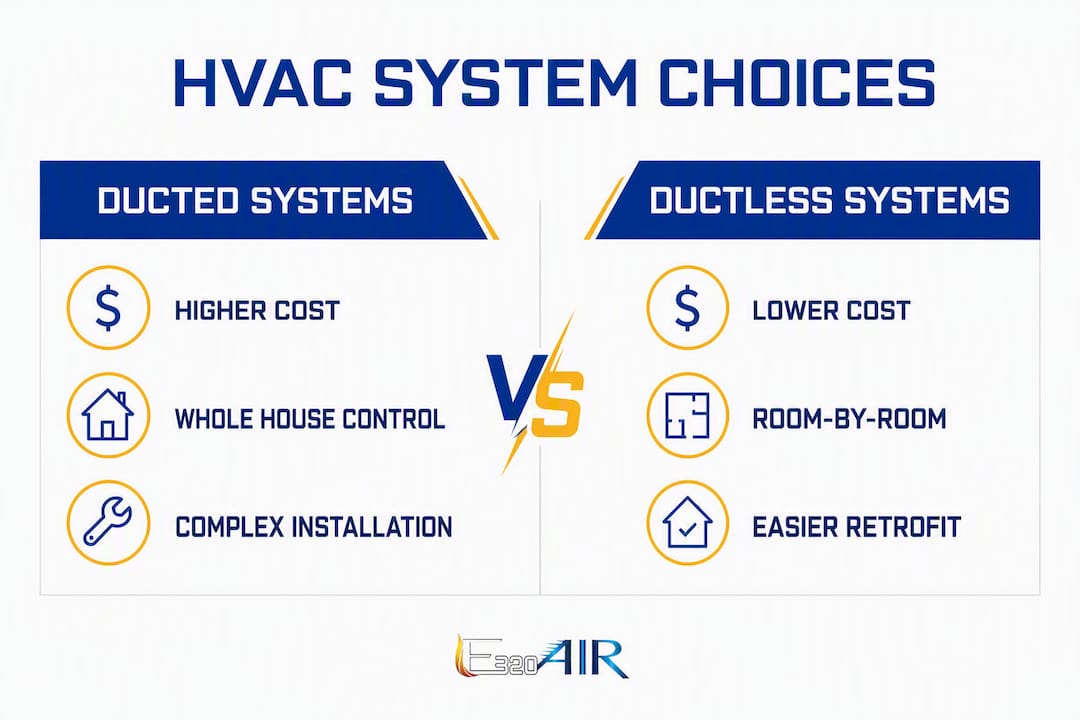
A ducted central system uses one outdoor unit connected to an air handler or furnace that pushes conditioned air through a network of ducts to every room. A ductless mini-split skips the ducts entirely, connecting an outdoor compressor directly to one or more wall-mounted indoor heads, each of which conditions its own zone independently.
Ducted central systems
- Work with your existing ductwork, which lowers installation cost when ducts are in good shape.
- Deliver whole-home comfort from a single thermostat, which most homeowners find simpler to manage.
- Tend to have lower upfront equipment costs per square foot in larger homes.
- Lose efficiency fast when ducts leak. Studies show duct leakage can waste 20–30% of conditioned air before it reaches the living space.
- Require duct replacement or sealing if the existing system is undersized, leaky, or poorly routed, which adds cost.
Ductless mini-splits
- Allow room-by-room temperature control, which cuts energy waste in unoccupied spaces.
- Install without tearing into walls for ductwork, making them the practical choice for older Claremont homes, additions, and garages.
- Typically achieve higher SEER ratings than ducted systems at the same price point.
- Cost more per zone upfront than a ducted system serving the same area.
- Require visible indoor heads, which some homeowners find aesthetically intrusive.
Quick selector by home type
| Home type | Recommended system | Key reason |
|---|---|---|
| Single-story with good ducts | Ducted central AC or heat pump | Lower install cost, whole-home comfort |
| Older home, no ducts | Ductless multi-zone mini-split | No duct retrofit needed |
| Multi-zone apartment or condo | Ductless multi-zone | Independent zone control |
| Small commercial space | Multi-zone ductless or packaged unit | Flexible zoning, commercial-grade capacity |
| Home with gas furnace, wants AC only | Add ducted central AC to existing furnace | Reuse furnace and ducts |
Hybrid and dual-fuel options deserve a mention for Claremont properties that already have a gas furnace. A dual-fuel system pairs an electric heat pump with the existing gas furnace: the heat pump handles mild-weather heating efficiently, and the furnace kicks in only when temperatures drop below the heat pump's efficient range. In Claremont, where winter lows rarely push below the mid-30s, the gas furnace in a dual-fuel setup runs very little, which means most of the heating load stays on the cheaper-to-operate electric heat pump.
Why an air-source heat pump is often the best choice in Claremont
Claremont's climate makes air-source heat pumps a strong default recommendation. Summers are hot and dry, winters are mild, and the area rarely sees sustained freezing temperatures. That profile plays directly to the heat pump's strengths: it cools efficiently in summer and heats efficiently in winter without burning fuel.
Efficiency and operating-cost benefits
- Modern heat pumps typically carry SEER and HSPF ratings well above the federal minimums for the Southwest region.
- Energy Star certified heat pumps meet stricter efficiency thresholds than the federal baseline, which translates to lower monthly utility bills.
- Because a heat pump moves heat rather than generating it, it typically delivers 2–3 units of heating energy for every unit of electricity consumed, a significant advantage over electric resistance heating.
- Look for a heat pump with a SEER rating of at least 16 and HSPF rating of at least 9 for a Claremont installation; higher efficiency units may pay back faster in this climate given the long cooling season.
When a standard heat pump is not enough
Cold-climate heat pumps (rated to operate efficiently below 5°F) are rarely necessary in Claremont, but they may make sense for properties at higher elevations near the San Gabriel Mountains where overnight lows can be more severe. For most in-town Claremont homes, a standard air-source heat pump performs well through the entire heating season.
Incentives and electrification
California's TECH Clean California program and the federal 25C tax credit can stack to reduce the installed cost of a qualifying heat pump by $1,000–$8,000 depending on equipment and household income. Ask your contractor to identify which rebates apply before you select equipment, since some programs require pre-approval or specific AHRI-certified models.
Quick primer: how residential HVAC systems heat and cool a home
Every residential HVAC system moves heat rather than creating it from scratch. A refrigerant circulates between an outdoor unit (the condenser/compressor) and an indoor unit (the evaporator coil or indoor head). In cooling mode, the refrigerant absorbs heat from indoor air at the evaporator coil and releases it outside at the condenser. In heating mode, a heat pump reverses that cycle, pulling heat from outdoor air and delivering it inside.
Key components homeowners will encounter
- Compressor: The heart of the outdoor unit. It pressurizes refrigerant and drives the heat-exchange cycle. Compressor failure is the most expensive single repair.
- Evaporator coil (indoor coil): Sits inside the air handler or furnace cabinet. This is where the refrigerant absorbs heat from your indoor air. A dirty or mismatched coil kills efficiency.
- Air handler or furnace: Moves air across the indoor coil and through the duct system. In a heat pump setup, the air handler replaces the furnace entirely.
- Ductwork: The delivery network. Leaky or undersized ducts are the single most common reason a new system underperforms. Understanding HVAC tonnage helps you verify that the duct system can handle the airflow the equipment requires.
- Thermostat: The control interface. A smart thermostat (Ecobee, Nest, or a manufacturer-matched model) adds scheduling, remote access, and zoning capability that can cut energy use noticeably.
Zoning and controls
A single thermostat controls the whole house in a standard ducted system. Zoning adds dampers inside the ducts and multiple thermostats, letting different areas of the home run at different temperatures. Ductless systems are inherently zoned since each indoor head operates independently. For a Claremont home where the south-facing rooms bake in afternoon sun while the north side stays cool, zoning makes a real difference in comfort and monthly bills.
Why sizing matters: Manual J, Manual D, and what a contractor should calculate
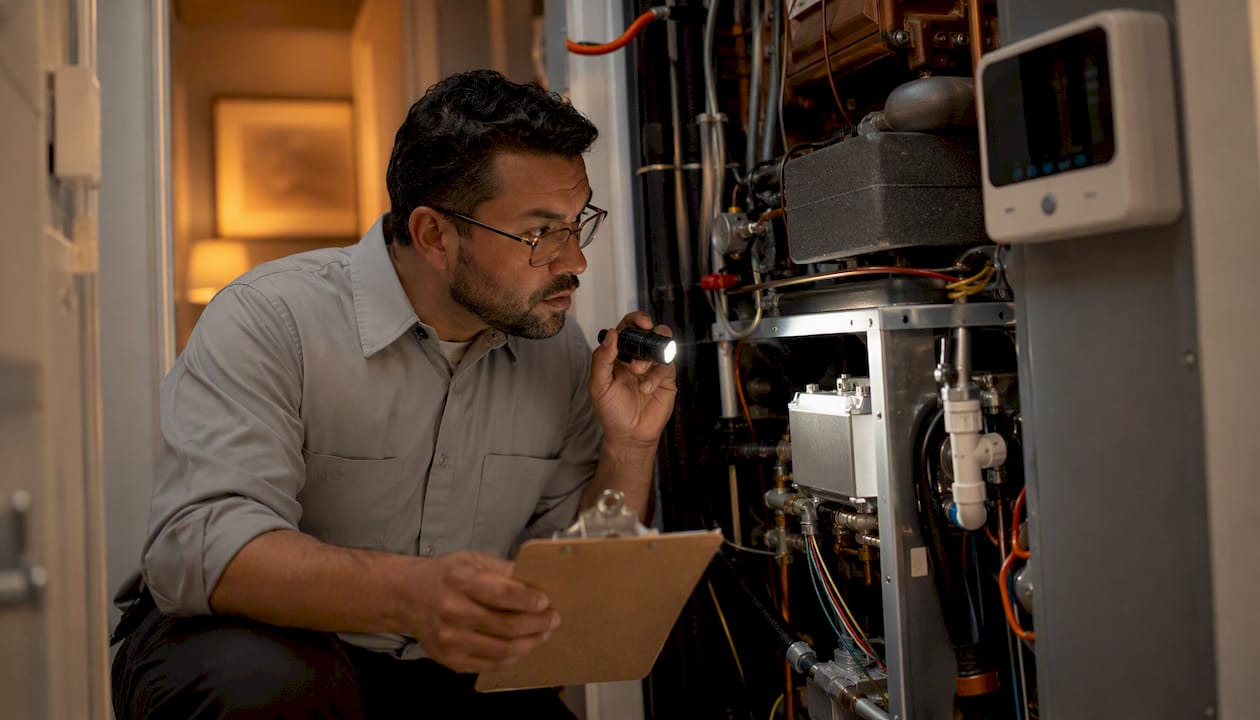
Always require a Manual J load calculation before selecting equipment. Not a rule of thumb, not "one ton per 500 square feet," not a contractor's best guess based on your old system's size. A proper Manual J accounts for your home's square footage, ceiling height, insulation levels, window area and orientation, local climate data, and occupancy. The ACCA Manual J standard is the industry benchmark for residential load calculations, and any contractor who skips it is guessing.
What to request from every bidder
- A written Manual J load calculation report, not just the summary tonnage number.
- Manual D duct design documentation if the contractor is modifying or replacing ductwork.
- Return air and exhaust airflow specifications.
- The R-values and insulation assumptions used in the calculation.
- AHRI certificate numbers for every piece of proposed equipment (outdoor unit, indoor coil, and air handler must be listed as a matched system).
- Commissioning documentation: refrigerant charge verification and airflow balancing results, provided after installation.
Pro Tip: When the installation is complete, ask the technician to show you the commissioning paperwork before you sign off. Correct refrigerant charge and verified airflow are not optional finishing touches — they are what separates a system that lasts 18 years from one that fails in six.
What goes wrong when sizing is off
An oversized system short-cycles: it cools the air quickly but shuts off before removing enough humidity, leaving rooms feeling clammy even at the set temperature. An undersized system runs continuously on the hottest Claremont days and never quite catches up. Both scenarios accelerate wear on the compressor and reduce the system's useful life. Correct sizing, confirmed by a Manual J, is the single highest-leverage decision in the whole process. For Inland Empire homes specifically, the sizing guide from E320air walks through how local climate data feeds into the calculation.
Key factors for choosing the system that makes sense in Claremont
Efficiency ratings, capacity, duct condition, noise, zoning, smart-thermostat compatibility, warranty terms, and expected lifespan all feed into the right choice. Here is what each factor actually means for a Claremont buyer.
Efficiency ratings defined
- SEER (Seasonal Energy Efficiency Ratio): Measures cooling efficiency over a season. Higher is better. The federal minimum for the Southwest region is 15 SEER2 (the updated test standard). Aim for 16–18+ for a good balance of upfront cost and operating savings.
- HSPF (Heating Seasonal Performance Factor): Measures heat pump heating efficiency. Look for 9.0+ HSPF2 for a Claremont installation.
- AFUE (Annual Fuel Utilization Efficiency): Applies to gas furnaces. A 96% AFUE furnace wastes only 4% of fuel as exhaust; 80% AFUE is the baseline. In Claremont's mild winters, the payback on a 96% vs. 80% furnace is longer than in colder climates, so the decision often comes down to upfront budget.
- Energy Star: The Energy Star certification threshold sits above the federal minimum. Certified equipment also qualifies for the federal 25C tax credit and most utility rebates.
Trade-offs worth understanding
Increasing SEER ratings generally adds to the equipment cost, but the higher efficiency may offer payback over several years through lower electricity bills, especially with heavy usage during the cooling season. Multi-zone ductless systems cost more per zone than a ducted whole-home system but eliminate the duct losses that reduce a high-SEER outdoor unit's real-world performance. When ducts are leaky or undersized, sealing them and pairing them with a mid-tier system often delivers better value than buying a premium outdoor unit and leaving the ducts untouched.
For brand-specific guidance on which manufacturers perform well in California's climate, the HVAC brands guide from E320air covers the key options with an honest installer-first perspective. The equipment buying guide explains what documentation to request and how to read AHRI ratings on a quote.
Noise and installation space
Outdoor unit sound levels matter in Claremont's denser neighborhoods. Look for units with relatively low sound ratings; premium inverter-driven compressors often operate more quietly. Check setback requirements with the City of Claremont before placing an outdoor unit near a property line.
Warranty terms
Most manufacturers offer 10-year parts warranties when the equipment is registered within 60–90 days of installation. Labor warranties are separate and typically come from the installing contractor, ranging from 1 to 5 years. Confirm that your contractor registers the equipment and provides you with the confirmation number.
How to maintain your HVAC and what service intervals and lifespans to expect
Annual professional maintenance is the single most reliable way to extend equipment life and keep manufacturer warranties intact. Most manufacturers require documented annual service as a condition of the full warranty. Keep every service record.
What a professional maintenance visit should include
- Filter inspection and replacement (or cleaning for washable filters).
- Evaporator and condenser coil cleaning.
- Refrigerant level check and leak inspection.
- Airflow measurement at supply and return registers.
- Electrical connection tightening and capacitor/contactor inspection.
- Condensate drain cleaning and pan inspection.
- Thermostat calibration and control sequence verification.
- Blower motor and belt inspection (where applicable).
Between professional visits, cleaning HVAC filters every 1–3 months is the single highest-impact thing a homeowner can do. A clogged filter restricts airflow, forces the blower to work harder, and can cause the evaporator coil to freeze.
Expected lifespans and replacement signals
| System type | Typical lifespan | Replace when... |
|---|---|---|
| Central AC (split system) | Typical lifespan spans multiple years and replacement is prompted by compressor failure, refrigerant obsolescence, or repair cost considerations | |
| Air-source heat pump | Typically lasts many years; replacement needed if compressor or reversing valve fails or efficiency drops sharply | |
| Gas furnace | Generally lasts several decades; replace when major component failures or significantly low AFUE occur | |
| Ductless mini-split (indoor head) | Lifespan covers many years; replacement considered for refrigerant leaks or control board failures | |
| Ductwork | Can last decades; replacement needed if affected by mold, major leakage, or structural damage |
The $5,000 rule is a useful starting point: multiply the equipment's age by the estimated repair cost, and if the result exceeds $5,000, replacement is usually the smarter financial move. That said, factor in the unit's efficiency relative to current standards and whether a repair history suggests more failures are coming. A 12-year-old system with a $450 capacitor replacement is a different story than a 14-year-old system facing its third compressor issue.
How to vet and hire an HVAC contractor in Claremont
Hire a contractor who holds a California C-20 warm-air heating and air-conditioning license, carries general liability and workers' compensation insurance, and provides a written, line-item estimate that lists the make, model, and AHRI certificate number for every piece of equipment. That combination is non-negotiable.
Step-by-step vetting checklist
- Verify the C-20 license number on the California Contractors State License Board (CSLB) website before the first visit.
- Request a certificate of insurance showing general liability and workers' comp coverage.
- Ask whether the technicians hold NATE certification or manufacturer training credentials.
- Request a written, line-item estimate specifying make, model, AHRI certificate numbers, and scope of work.
- Confirm the contractor will perform a Manual J load calculation and provide the report.
- Ask who pulls the mechanical permit and confirm they handle it, not you.
- Confirm the contractor will register the manufacturer warranty on your behalf and provide the confirmation.
- Ask for commissioning documentation (refrigerant charge and airflow verification) as a deliverable at job completion.
Questions to ask during the estimate visit
- What tonnage does your Manual J show, and how does that compare to my current system?
- What is the condition of my existing ductwork, and will you test it for leakage?
- What refrigerant type does the proposed equipment use, and is it current-generation?
- How long will the installation take, and when can you schedule the permit inspection?
- What labor warranty do you offer, and is it in writing?
Pro Tip: Ask the contractor to name the NATE-certified technician who will perform the installation, not just confirm that the company employs NATE techs. A company can have one certified tech on staff and send someone else to your job.
Permits and rebates
California requires a mechanical permit for virtually every new HVAC installation or major component replacement. Permit fees typically run $50–$500 in most California jurisdictions, and a final inspection is required before the job is considered complete. A reputable contractor pulls the permit, schedules the inspection, and hands you the final inspection receipt. If a contractor suggests skipping the permit to save time or money, walk away.
Claremont-specific factors: climate, building stock, costs, permits, and rebates
Claremont sits at roughly 1,150 feet elevation in the eastern San Gabriel Valley, with summer highs regularly reaching 95–105°F and winter lows rarely dropping below the mid-30s. The climate is classified as a hot-summer Mediterranean type, which means the cooling load dominates the annual energy budget. Humidity is generally low, which reduces the latent (moisture-removal) load compared to coastal or humid climates, but it also means a properly sized system is critical: an oversized unit in a dry climate will cool the air temperature quickly without running long enough to remove the modest humidity that does exist, leaving the home feeling slightly uncomfortable.
Typical installed costs in Claremont
| System type | Installed cost range | Key price drivers |
|---|---|---|
| Central AC + gas furnace replacement | $9,500–$17,500 | Efficiency tier, duct condition, tonnage |
| Air-source heat pump (standard) | $8,500–$14,500 | SEER/HSPF tier, single vs. two-stage |
| Air-source heat pump (cold-climate premium) | up to $22,000 | Cold-climate rating, brand, install complexity |
| Ductless single-zone mini-split | $3,800–$6,500 | BTU capacity, brand, line-set length |
| Ductless multi-zone mini-split | $9,500–$17,500 | Number of zones, total capacity, line-set routing |
| Ductwork replacement (whole-home) | Varies widely; typical range $4,500–$8,500 | Home size, access, material type |
Cost ranges sourced from local contractor data for Claremont. Actual quotes will vary by contractor, equipment brand, and site conditions.
Permits and licensing
California's C-20 license is required for any warm-air HVAC work exceeding $500. The City of Claremont falls under San Bernardino County's building jurisdiction for unincorporated areas, though Claremont itself is an incorporated city with its own building department. Expect a mechanical permit for any new installation or equipment replacement. Permit fees in the area typically fall in the $50–$500 range, and a final inspection is required before the system is put into service.
Rebates and incentives
- Federal 25C tax credit: Up to 30% of equipment and installation costs (capped at $2,000 per year for heat pumps) for qualifying Energy Star certified systems.
- TECH Clean California: A statewide program offering rebates on qualifying heat pump installations; amounts vary by equipment and income tier.
- Utility rebates: Southern California Edison and other local utilities periodically offer rebates on high-efficiency equipment. Check current program availability before selecting equipment.
- Stackable rebates: A qualifying heat pump installation in Claremont can combine the federal 25C credit, a TECH Clean California rebate, and a utility rebate for a total reduction of $1,000–$8,000 depending on equipment and household income.
As a practical example: a homeowner replacing a 3-ton central AC and gas furnace with a 3-ton air-source heat pump at a $13,000 installed cost could realistically net $3,000–$5,000 in combined rebates and credits, bringing the effective cost to $8,000–$10,000 before any financing.
Ask your contractor to identify applicable rebates before finalizing equipment selection. Some programs require pre-approval, and certain rebates are tied to specific AHRI-certified equipment models.
Key Takeaways
The best heating and cooling outcome in Claremont comes from correct sizing, verified duct condition, and a licensed installer who commissions the system properly — not from chasing the highest SEER number alone.
| Point | Details |
|---|---|
| Sizing first | Always require a Manual J load calculation before selecting equipment — it determines the right tonnage for your home. |
| System match to ducts | Homes with good ducts benefit from ducted central or heat pump systems; homes without ducts should consider ductless mini-splits. |
| Rebates can be stacked | Qualifying heat pump installs in Claremont can combine federal, state, and utility rebates for a total reduction of $1,000–$8,000. |
| Commissioning matters | Refrigerant charge verification and airflow balancing at installation are what protect efficiency and warranty coverage long-term. |
| E320air for Claremont | E320air installs ducted central systems, heat pumps, and ductless mini-splits in Claremont with Manual J sizing, permit handling, and warranty registration included. |
Why installation quality beats brand selection every time
The conventional wisdom in HVAC shopping is to obsess over brand names. Homeowners spend hours comparing Carrier vs. Lennox vs. Trane, reading forum threads about compressor reliability, and asking neighbors what they bought. That research is not worthless, but it is consistently overweighted relative to the factor that actually determines whether a system performs well: how it was installed.
A premium 20-SEER heat pump installed without a Manual J, with an unmatched indoor coil, and with refrigerant charged by feel rather than measurement will underperform a mid-tier 16-SEER unit installed correctly every time. The installation quality gap between a careful, licensed contractor and a rushed one is larger than the performance gap between most major brands at the same efficiency tier. That is not a controversial claim among HVAC engineers; it is just not what equipment manufacturers advertise.
For Claremont homeowners, this means the contractor vetting process described above is not a formality. The C-20 license, the NATE certification, the Manual J report, the AHRI certificate numbers, and the commissioning paperwork are not bureaucratic checkboxes. They are the evidence that the person installing your system knows what they are doing and has done it correctly. A contractor who resists providing any of those documents is telling you something important.
The other thing most guides understate: duct condition. In a home with 20-year-old flex duct that has partially collapsed in the attic, replacing the outdoor unit and air handler without addressing the ductwork is like putting new tires on a car with a bent frame. The system will never perform to its rated efficiency, and the homeowner will blame the equipment. Insist on a duct leakage test as part of any full system replacement quote.
E320air serves Claremont with local HVAC expertise
Skip the guesswork on sizing, permits, and rebate paperwork. E320air installs central AC systems, air-source heat pumps, and ductless mini-splits for Claremont homeowners and business owners, handling the Manual J load calculation, mechanical permits, AHRI-matched equipment selection, and manufacturer warranty registration from the first visit to the final inspection.

Every installation includes a written, line-item estimate with make, model, and AHRI certificate numbers before you commit to anything. Technicians are licensed under California's C-20 requirement and trained on current refrigerant standards. After installation, E320air offers maintenance plans and follow-up service to keep your system running at rated efficiency and your warranty intact.
For commercial spaces in Claremont, the commercial HVAC services page covers light-commercial packaged units, multi-zone ductless systems, and service agreements for property managers and business owners.
Ready to get a Manual J and a line-item quote? Contact E320air at e320air.com to schedule a site visit and get a written estimate with no obligation.
Sources and further reading
Rebate programs, permit fees, and equipment standards change regularly. Verify current program availability and permit requirements directly with the issuing agency before committing to equipment or a contractor.
- ACCA Manual J standard: The official residential load calculation standard. Use this to understand what a proper Manual J covers and to verify that a contractor's report meets the standard.
- ACCA Manual D standard: The companion duct design standard. Relevant when ductwork is being modified or replaced.
- Energy Star certified central air conditioners and heat pumps: Search for certified models and confirm that proposed equipment meets the threshold for federal and utility rebates.
- NATE (North American Technician Excellence): Verify technician certification status and understand what NATE credentials cover.
- E320air Manual J guide: A homeowner-focused explanation of how to read a Manual J report and what to request from contractors.
- E320air Inland Empire sizing guide: Local context on how climate data affects load calculations for homes in this region.
- E320air energy efficiency guide: Operating cost analysis and efficiency recommendations for Inland Empire homeowners.
Rebate program amounts and eligibility requirements change frequently. Confirm current TECH Clean California rebate availability at the program's official site and verify Southern California Edison rebate tiers before selecting equipment. Permit fee estimates are typical ranges; contact the City of Claremont Building Division for current fee schedules.