
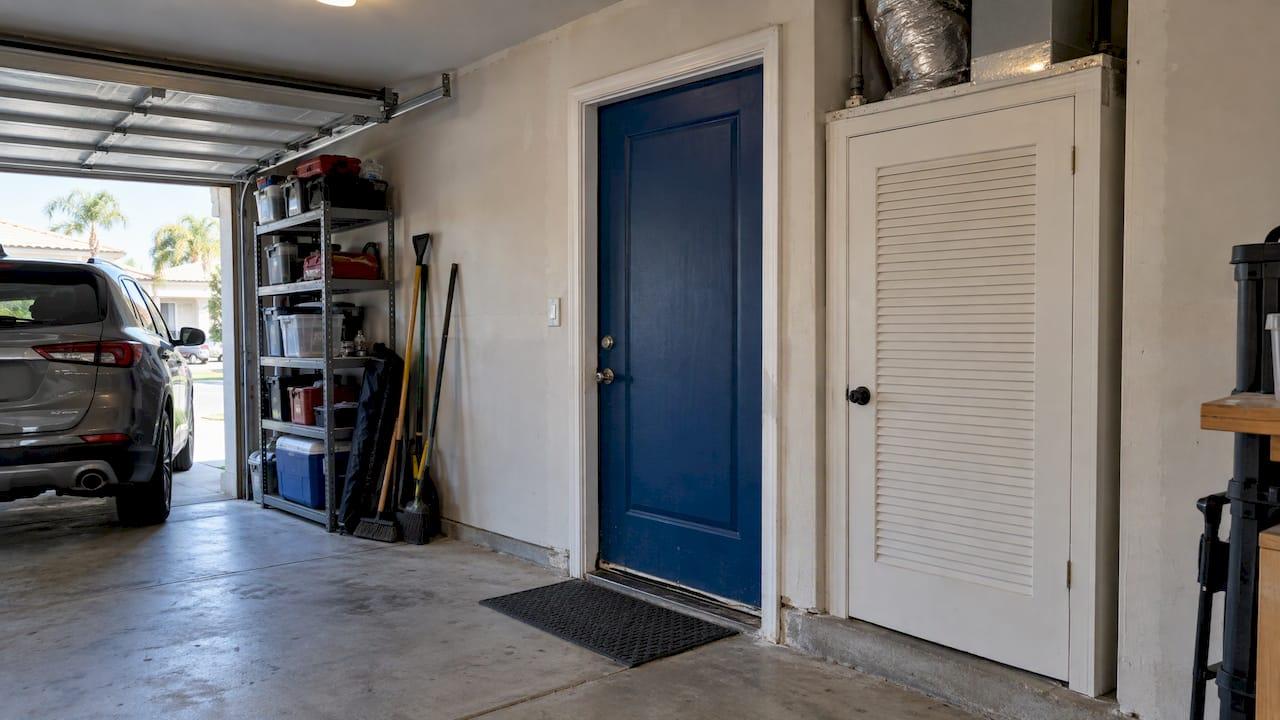
If your vents carry a whiff of gasoline, exhaust or solvents, the garage is almost certainly feeding air into your HVAC system. It usually happens through leaky return ducts, an air handler or ductwork sitting in the garage, or gaps in the wall you share with it. The lasting fix is to seal and relocate the HVAC components that connect the two spaces. A licensed HVAC contractor can inspect, repair or replace them, and E320air does that work for homeowners, landlords and property managers across the Inland Empire.
TL;DR
- Garage air gets into the house when the house sits at lower pressure than the garage. Leaky ducts, return grilles and air handlers in or next to the garage make it easy.
- Garage air can carry benzene, other volatile organic compounds (VOCs) and carbon monoxide (CO). CO has no smell, so a CO alarm matters even when you smell nothing.
- Air fresheners and filters do not solve it. The fix is sealing ducts and gaps, and moving or enclosing HVAC equipment that sits in the garage.
- California's 2025 codes, effective January 1, 2026, set rules for garage separation, duct leakage and CO alarms.
- If you smell natural gas (a rotten-egg odor), leave the house and call your gas utility or 911 from outside. Do not troubleshoot it yourself.
Table of Contents
- How garage air ends up in your house
- Where your HVAC system fits in
- What the smell actually is, and why it matters
- How to tell where the garage air is coming in
- What actually fixes it
- What California's 2025 codes say
- Who this applies to
- Fixing it with E320air
- Our view on garage fumes and HVAC
- FAQ
- Sources
How garage air ends up in your house
Air moves from high pressure to low pressure. When your home is at slightly negative pressure compared with the garage, the garage pushes air in through any opening it finds. Pacific Northwest National Laboratory (PNNL), a U.S. Department of Energy lab, explains that garage air enters the home at negative house pressure, caused by natural forces or mechanical exhaust such as a range hood or clothes dryer.
The size of the effect is measurable. In a Department of Energy Building America tracer-gas study by Armin Rudd, about 1% of the house air came from the garage with no ventilation running. With 165 cubic feet per minute of house exhaust ventilation, that rose to about 4.6%, according to the study's results. Supply ventilation, which pushes air into the house, suppressed garage air entry.

So a bathroom fan, a dryer and a range hood can all pull garage air into your living space on an ordinary day, if there is a path for it to travel.
Where your HVAC system fits in
Your HVAC system is the most efficient path of all. PNNL's guidance says HVAC equipment and ductwork should not be located in the garage, because they act as a conduit between garage and house. A furnace or air handler in the garage pulls in whatever air surrounds it, and then the fan sends it through every duct in the home.
The U.S. Environmental Protection Agency (EPA) lists the common leak points in its 2021 indoor air quality guidelines for home renovations: walls, doors, ceilings, ductwork, furnaces, and electrical and pipe penetrations. In practice, these are the usual suspects:
- Return ducts that run through or beside the garage. A return duct pulls air toward the system. A crack in the garage section draws garage air in.
- An air handler or furnace in the garage with unsealed cabinet seams or access panels.
- Supply registers or return grilles that open into the garage.
- Gaps where pipes, wires and ducts pass through the shared wall or ceiling.
- A shared attic or crawlspace that connects the garage and living space.
This is common in Inland Empire homes in Fontana, Rancho Cucamonga, Corona, Moreno Valley and Hemet, where many houses have attached garages and equipment placed in or above them. Heat adds another factor: long cooling seasons mean the system runs for many hours, so any leak moves air for many hours too.
If you want a plain-language look at why duct condition drives comfort and air quality, our piece on why ductwork matters for HVAC efficiency and comfort covers it.
What the smell actually is, and why it matters
The EPA's guidelines note that garage pollutants such as benzene, VOCs and carbon monoxide come from car emissions and stored household products. Inhaled, they can raise risks of respiratory irritation, nervous system damage and cancer. A study from the Cold Climate Housing Research Center attributed about 20 to 40% of some indoor chemicals to attached garages, per its fact sheet.
Common garage sources include:
- Gasoline, oil and exhaust from cars, mowers and generators
- Paints, varnishes, solvents and degreasers
- Pesticides, wood preservatives and automotive products, which the American Association of Poison Control Centers says are more likely to be stored in a shed or garage
- Glues, adhesives and hobby supplies
A fresh smell right after you park or open a paint can points to a simple source. A smell that arrives whenever the blower starts points to the HVAC system.
Carbon monoxide: the fume you cannot smell
The EPA describes CO as a colorless, odorless, toxic gas from poorly functioning combustion equipment. Exposure can be deadly, and at lower levels it causes headaches, fatigue and flu-like symptoms. A car running in an attached garage is one source. A gas furnace or water heater in the garage that backdrafts (pushes its exhaust back into the room instead of up the flue) is another.
PNNL warns that natural-draft or power-vented equipment in a garage closet needs a ducted outdoor combustion makeup-air intake. Without it, flue gases can backdraft into the air handler and spread combustion by-products through the house, per its guidance.
If anyone at home has headaches, dizziness or nausea that clear up when they leave the house, get out into fresh air and call 911, and see a doctor. Do not wait for a smell.
"My HVAC smells like gas"
A rotten-egg smell means natural gas, which has a different cause than garage fumes. Leave the house right away, do not flip switches or use a phone inside, and call your gas utility or 911 from outside. Once the gas company has cleared the home, call a licensed HVAC technician to inspect the furnace.
How to tell where the garage air is coming in
A professional diagnosis is the reliable route. The EPA's guidelines call for using ASTM E1186-17, a standard method for locating air leaks, to find leaks from the garage into occupied spaces. They also call for blower-door techniques, which depressurize the house to reveal and verify leakage paths. PNNL adds that measuring how far the house is depressurized relative to the garage shows whether air is moving from garage to home.
What you can observe yourself, without opening anything:
- Timing. Does the smell come with the blower, or only when the dryer or range hood runs?
- Location. Is it strongest at registers on the garage side of the house, or in rooms above the garage?
- Dust. Heavy dust near garage-adjacent registers can mean air is moving through them.
- Equipment location. Is the furnace, air handler or any ductwork in the garage or in an attic space the garage shares?
- CO alarm. Do you have working alarms, and are they where the code says they should be?
Then bring in a licensed HVAC contractor to check the system itself: return ducts, cabinet seams, connections and the shared wall.
What actually fixes it
Masking odors does not work. The EPA's minimum actions for attached garages are a clear checklist, and the full guidelines state them in detail:
- Air-seal all ductwork and fittings in the garage to UL 181A or 181B standards, which cover duct sealing materials.
- Seal gaps around ducts, pipes and cables that pass through the shared wall.
- Seal the air-handler cabinet openings.
- Disconnect and end-cap any supply diffusers and return grilles that open into the garage.
- Compartmentalize the garage: weather-strip the garage door and seal penetrations and rim-joist or subfloor cracks.
Where the budget and house allow, the EPA's expanded actions go further:
- Install a continuous-duty exhaust fan in the garage, vented outdoors.
- Relocate the air handler and ductwork into conditioned space.
- Add blocking under floors above the garage.
- Verify the result with blower-door testing.
If equipment has to stay in the garage, PNNL recommends enclosing it in an insulated, air-sealed closet with a sealed, weather-stripped, self-closing door, wide enough to allow future equipment replacement.
One caution applies to garage fans. The CCHRC says homes with natural-draft combustion appliances in the garage should not use exhaust-only ventilation, because it can backdraft the appliance. That is a reason to have a technician look at the whole system before adding a fan.
A filter alone will not do the job either, since VOCs are gases rather than particles. That is why the fix sits in the ducts, the equipment location and the air barrier.
Keep the house at neutral or positive pressure
PNNL's position is that supply or balanced ventilation is preferred over exhaust-only, because it keeps house pressure balanced or positive relative to the garage. Rudd's study found the same: supply ventilation suppressed garage air entry. Our overview of how ventilation systems improve Southern California homes explains the options.
What California's 2025 codes say
The 2025 California codes took effect January 1, 2026. Several provisions apply directly to garages and HVAC:
- Energy Code (Title 24, Part 6, Section 150.0(o)). Where a living space adjoins a garage, the design must prevent contaminants from migrating. That means air-sealing the walls, ceilings and floors between them, gasketing or weather-stripping garage doors, and sealing air-distribution joints outside the dwelling boundary. HVAC systems may not supply air to or return air from the garage. Air handlers or ducts outside the dwelling boundary are limited to 6% total leakage of fan airflow, as the state's compliance form lays out.
- Residential Code (Sections R302.5 and R302.6). Garages must be separated from the dwelling with at least 1/2-inch gypsum board on the garage side (5/8-inch beneath habitable space), with self-closing, self-latching doors. Ducts passing through the garage wall must be at least 26-gauge galvanized steel with no openings into the garage, per one city's published requirements sheet.
- CO alarms. The 2025 California Building Code requires carbon monoxide detection in buildings with attached private garages. For existing homes, the City of Irvine states that the 2025 Residential Code requires alarms in dwellings with fuel-burning appliances, fireplaces or attached garages that communicate with the home. Alarms go outside each sleeping area, on every occupiable level, and inside any bedroom with a fuel-burning appliance.
City inspectors in Riverside, San Bernardino and other Inland Empire cities apply these codes locally, so confirm details with your building department when you plan work. Our guides to California Title 24 HVAC requirements and common HVAC installation mistakes cover the installation side. Our guide to HVAC inspections shows what to expect when someone checks the system.
Who this applies to
Homeowners with attached garages are the obvious group. Landlords and property managers should pay attention too, since the CO alarm requirements cover rentals and attached-garage units. Business owners with HVAC equipment in a shared garage or service bay should have the same separation reviewed. If you rent and cannot authorize work, the first step is to tell your landlord about the smell and the CO alarm situation.
Fixing it with E320air
We repair, maintain, upgrade and install residential and commercial heating, air conditioning and air quality systems across the Inland Empire, from Corona and Ontario to Hemet and Hesperia. Our technicians are licensed and insured, we work on all major brands, and service is available around the clock, including weekends and holidays. Flexible payment options, including financing, are available.
If garage fumes are reaching your vents, a visit lets a technician look at the system itself: where the equipment sits, how the ducts run and what an upgrade or replacement would involve. See our HVAC installation page if your equipment needs to move or be replaced, or contact us through E320air to book an inspection.

For a heating system that runs but smells wrong, our heater repair service is the next step. Commercial properties can start from our commercial HVAC page, which covers routine maintenance and emergency repairs.
Our view on garage fumes and HVAC
Most garage fume complaints we hear about come down to one thing: the HVAC system was never meant to share air with the garage, and somewhere along the line it started to. That is a system problem, not a smell problem, and it is solved at the system.
Our approach is to treat the equipment, the ducts and the air path as one whole. If the system moves air from the garage into your living space, a candle or a new filter will not change that. Sealing, relocating or replacing the parts that connect the two spaces will.
This is also a good moment to look at the full system. Upgrades such as new equipment or better ventilation can address air quality, efficiency and comfort in one visit, and we design them to be energy efficient with minimal disruption to your household. Our technicians are licensed and insured, and we are available around the clock, because a smell in your vents or a CO alarm is not something to schedule for next week.
If you are in the Inland Empire and your vents carry garage odors, call us.
Edward
FAQ
Why can I smell my garage in my house?
The house is probably at lower pressure than the garage, and air is leaking through gaps, doors or ducts. Exhaust fans, dryers and the HVAC return side all lower house pressure. Leaky ductwork or equipment in the garage makes the path easier.
Does a garage have ventilation?
Most attached garages have none by design. The EPA recommends a continuous-duty exhaust fan vented outdoors in attached garages where people spend significant time or where HVAC equipment is located. If a gas appliance sits in the garage, have a technician check the setup first, since exhaust-only fans can cause backdrafting.
Why does my HVAC smell like gas?
A rotten-egg odor can mean natural gas. Leave the house and call your gas utility or 911 from outside. A gasoline or exhaust smell from the vents more likely points to garage air entering the ducts, which a licensed technician can trace.
How do I get rid of garage odor for good?
Seal the source of the air path. That means sealing garage-side ducts and the air-handler cabinet, closing gaps in the shared wall, weather-stripping the garage door, and moving or enclosing HVAC equipment in the garage. Store fuels and solvents in tightly closed containers, and make sure CO alarms are installed.
Sources
- EPA Indoor Air Quality Guidelines for Single-Family Renovations (2021)
- PNNL: Air Leakage Testing Garage to House Air Barrier
- PNNL: No Ducts or Air Handlers Located in Garage
- DOE Building America: Air Leakage and Air Transfer Between Garage and Living Space
- CCHRC: Is your garage polluting your indoor air?
- American Association of Poison Control Centers: Identifying unknown fumes in your home
- California Energy Commission: 2025 CF2R-MCH-27-H IAQ Mechanical Ventilation
- City of Sacramento: Residential Code Requirements
- 2025 California Building Code Section 915: Carbon Monoxide Detection
- City of Irvine: Smoke Detector and Carbon Monoxide Alarm