
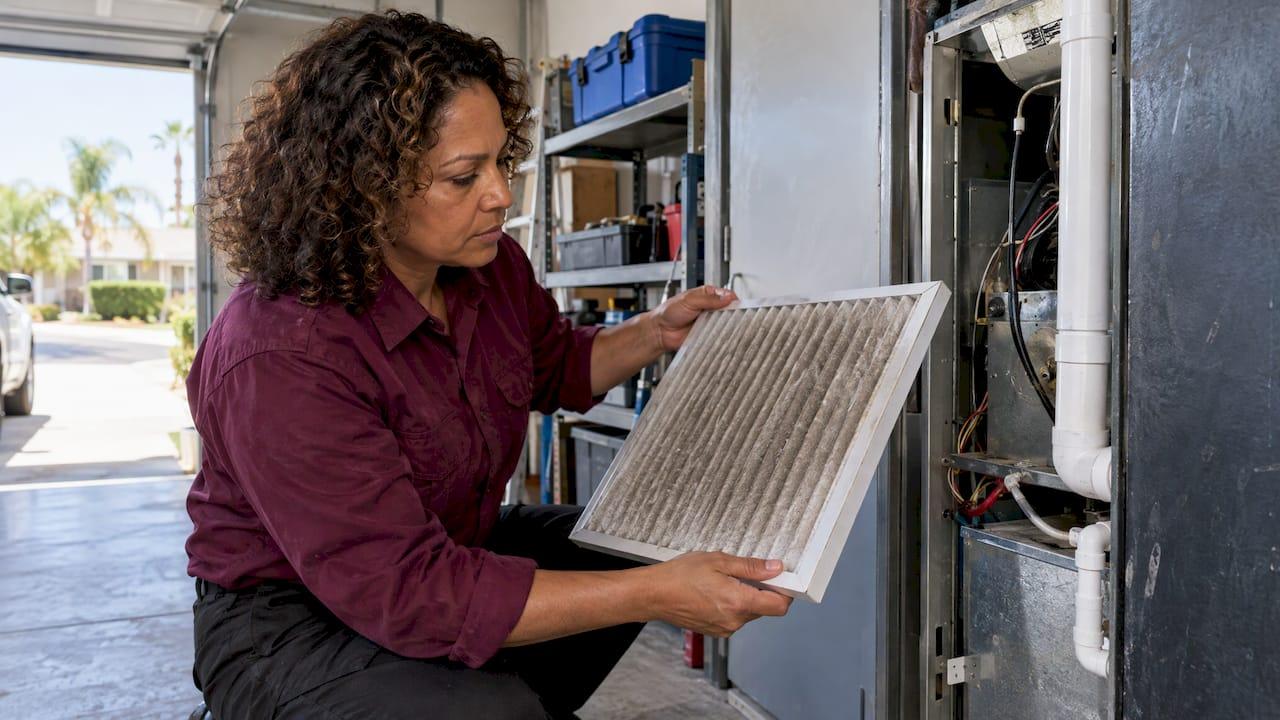
If your vents smell like cigarettes or wildfire smoke, the odor is almost always stuck in the filter, blower, coil or ductwork, and every time the system runs it spreads that smell through the house. A new filter helps, but a deep smell usually means the parts behind the filter need cleaning too. For Inland Empire homeowners, landlords and property managers, the order is: shut the system down if smoke was heavy, replace the filter, clean what the air touches, and bring in a licensed technician when the smell comes back. E320air handles HVAC repair, maintenance and installation across the Inland Empire, including emergency calls.
TL;DR
- Smoke odor lives in the filter, blower housing, evaporator coil and ducts, and the fan pushes it into every room.
- After a fire or heavy smoke, shut the air-handling system down until its condition is known.
- A standard filter catches particles but not smell. Pair a high-MERV filter with activated carbon for odor.
- Persistent odor, visible soot or a smoking outdoor unit calls for a licensed technician, not more air freshener.
- Smoke coming out of the outdoor unit itself is a different problem: power it off and call for service.
Table of Contents
- Why smoke smells stay in an HVAC system
- Find where the smell is coming from
- What to do first: safety steps
- Step-by-step: removing smoke odor from your HVAC system
- When you need a professional
- If the outdoor unit is smoking
- Keeping smoke odor from coming back
- Our perspective
- Get your system checked
- FAQ
- Sources
Why smoke smells stay in an HVAC system
Your HVAC system moves the air in your home several times an hour. Smoke, whether from cigarettes, a kitchen fire or a wildfire, leaves tiny particles and sticky residue on everything that air passes. Wildfire smoke contains particles, volatile organic compounds and reactive gases, according to Pasadena Public Health, and the odor can fade slowly by off-gassing over weeks or months.
Inside the equipment, the usual hiding places are:
- The air filter. It traps smoke particles and holds the smell.
- The blower wheel and housing. The fan blades collect residue, then recirculate odor.
- The evaporator coil. In cooling season the coil is damp, and smoke residue sticks to it. That is why a smoky smell often gets worse when the AC starts.
- Ductwork and registers. Long duct runs hold residue far from where you can see it.
The California Technical Guide for Wildfire Restoration calls HVAC systems a major conduit for spreading combustion byproducts. That is why the smell can seem to come from the vents even when the source is a room or a unit next door.
Find where the smell is coming from
Before you clean anything, work out whether the system is the source or only the messenger.
- Smell at the vents with the fan running, but not with it off. The system is carrying the odor. Check the filter first.
- Smell strongest near one return grille. Residue may be in that duct branch or the room it pulls from.
- Smell only when the AC or heat starts. Suspect the coil or the heat exchanger area. A smoky smell at startup is different from a hot-dust smell on the first heating day of fall, which usually burns off in a short time.
- Smell on a day with smoky outdoor air. The system may be pulling outside air or leaking at the filter slot or duct joints.
FEMA's April 2025 guide suggests following the odor through the home and checking horizontal surfaces for soot and ash. It also describes a wipe test: rub an alcohol wipe on unfinished wood and see whether it picks up dark residue. Visible soot means the damage is beyond light odor.
A burning smell is not the same thing. If the odor is more like hot plastic or an electrical smell than smoke from outside, read our guide to what to do when your AC smells like burning and turn the system off.
What to do first: safety steps
If your home had smoke exposure, such as a fire nearby, a kitchen fire or heavy wildfire smoke, do these before you try to freshen anything.
- Shut the system down. FEMA's guidance is that an operating air-handling system should be shut down until its condition is determined after smoke damage. Running it spreads soot into clean rooms. Our HVAC emergency shutoff procedure shows where the switches are.
- Do not open the cabinet if there was a fire in or near the equipment. Electrical parts and wiring that were exposed to heat or water need a technician's inspection before restart.
- Check outdoor air before opening windows. Pasadena Public Health says to open windows and doors only when outdoor air quality allows, and points Los Angeles-area readers to South Coast AQMD conditions. Inland Empire readers in Riverside and San Bernardino counties are in the same air basin, so check the AQMD air-quality page before ventilating.
- Close outside-air intakes during smoke. Washington State's Department of Health advises closing outside-air intakes during smoke unless MERV 13-or-higher filtration is installed. Most homes have no such intake, but some commercial rooftop units and whole-house ventilators do.
For property managers with several units or shared corridors, smoke travels along the same paths as air. Closed doors with proper seals slow it down, as covered in this overview of fire door smoke seal requirements.
Step-by-step: removing smoke odor from your HVAC system
FEMA sorts smoke damage by level. Light damage is odor without visible soot or ash, and it recommends four steps for that case: ventilate if outdoor air is not smoky, install a new MERV 11-or-higher filter and run the fan constantly, use activated-charcoal absorbers, and clean affected absorbent materials. Here is how that looks for an Inland Empire home.

Step 1: Replace the filter with the right one
Pasadena Public Health recommends a MERV 13 filter, or the highest rating your fan and filter slot can handle. This is where homeowners go wrong: a thicker, denser filter in a system not built for it restricts airflow, which strains the blower and can freeze the coil. When we size a filter for a system, we check that the unit can move enough air with it. Our HVAC filter essentials and filter replacement guide for California homes explain sizes and ratings.
Also seal gaps around the filter holder with foam or tape, as Pasadena's guidance advises, so smoky air does not bypass the filter.
Step 2: Add carbon, because filters do not remove smell
The Washington State Department of Health notes that MERV filters remove particles but not smoke smell or most gases, while activated-carbon filters can reduce some gaseous pollutants. For odor, you need carbon. A portable air purifier with both HEPA and activated-carbon filtration is Pasadena Public Health's recommendation. Run it until the odor goes away and maintain it per the filter instructions.
Step 3: Run the fan continuously
With a fresh filter in, running the system fan continuously moves indoor air through the filter over and over. The Washington guidance also advises running system fans continuously to filter indoor air during smoke. Only do this once the system is confirmed to be clean enough to run, which is why Step 1 comes after the safety checks above.
Step 4: Clean the surfaces the air touches
Soft items such as curtains, upholstery and carpet hold odor and re-release it into the airflow. The California wildfire restoration guide describes a general surface sequence: HEPA vacuuming loose particles, then damp cleaning with mild detergent and water. Do the registers and grilles this way too, then dry them fully.
Step 5: Clean the blower, coil and ducts
This is the step that homeowners skip and the one that decides whether the smell returns. A deeper job means pulling the blower, washing the housing and wheel, and cleaning the evaporator coil. It requires opening the air handler, which holds electrical components and, on a cooling system, a refrigerant coil. Our guide to what an air handler unit is shows how these parts fit together. This is work for a licensed technician. We service all major brands, so the cleaning is done as part of a visit that also checks the rest of the equipment.

Step 6: Replace the filter again
Once cleanup is done, put in a fresh filter. The EPA's guidance for commercial and public buildings advises replacing filters used during a smoke event and increasing outdoor-air ventilation after outdoor air quality improves.
When you need a professional
Some smoke odor is light and clears with a filter swap and a few days of fan time. Other cases need more:
| Situation | Likely level | Next move |
|---|---|---|
| Faint odor after a smoky day, no visible residue | Light | New filter, carbon purifier, continuous fan |
| Odor persists after a new filter and a week of airing | Moderate | Technician inspection of blower, coil and ducts |
| Visible soot at registers or dark dust on wipes | Heavy | Professional cleaning of ducts and furnace |
| House fire, or heat or water exposure at the equipment | Heavy | Keep system off, inspection before restart |
| Cigarette smell in a rental or purchased property | Moderate to heavy | Full system cleaning plus soft-surface cleaning |
FEMA's guidance includes professional cleaning of all ducts and the furnace in its deeper smoke-damage cleanup. The California restoration guide recommends a qualified contractor following NADCA standards for duct cleaning, which is the national duct-cleaning trade association's standard. Oklahoma State University Extension likewise says professional HVAC and duct cleaning can be considered after more substantial contamination.
The same guide says a smoke assessment should look for airflow-related visual signs and note odors across the whole property. That is how a technician works: following the airflow from the return to the supply rather than treating only the vent that smells.
If your ducts have damaged or wet insulation, smoke and odor can cling to it. See our note on repairing duct splits and replacing wet insulation.
If the outdoor unit is smoking
Smoke odor in your vents and smoke coming out of the outdoor condenser are different problems. Smoke or a burning smell at the outdoor unit can point to an electrical fault such as a failing capacitor, contactor or fan motor. The safe response is:
- Turn the system off at the thermostat.
- Switch off the AC breaker in your electrical panel.
- Keep away from the unit and do not remove panels.
- Call 911 if you see flames or smoke heading toward the house.
- Then call a licensed HVAC technician.
Our guide on when to call emergency HVAC service covers the signs that cannot wait, and we answer emergency repair calls around the clock, including weekends and holidays.
Keeping smoke odor from coming back
Inland Empire homes deal with wildfire smoke, Santa Ana wind dust and, for some, a smoking neighbor. Prevention is mostly about filters and timing.
- Keep a spare high-efficiency filter on hand. Washington's guidance recommends a pre-wildfire-season equipment check and spare higher-efficiency filters for smoke events.
- Check filters often in smoky weather. The same guide says to check at least monthly during heavy use and more often in heavy or prolonged smoke, replacing them per the manufacturer or sooner if heavily soiled. Pasadena's cleanup guidance says to replace filters when clogged, or monthly for up to a year after the surrounding cleanup.
- Seal the system. Leaky ducts pull in unfiltered air from attics and crawl spaces. Sealing and repairs keep the filtered path intact.
- Schedule maintenance before fire season. A tune-up that includes the coil, blower and drain pan keeps residue from building up. We cover this under routine maintenance.
- Consider an air quality upgrade. Carbon filtration and whole-home options are covered in our guides on how HVAC improves indoor air quality and top air quality improvements.
For landlords, a smoke smell between tenants is a turnover task, not a cosmetic one. Cleaning the HVAC system along with the paint and flooring is what keeps the next tenant from smelling it on the first day the AC runs.
Our perspective
Most of the smoke calls we get start the same way: the homeowner has already changed the filter, sometimes twice, and the smell is still there. That tells us the odor has moved past the filter into the blower wheel, the coil or the ducts, and no amount of fan time will wash it out.
Our approach is to look at the whole airflow path instead of the one vent that smells. We check the filter slot for leaks, the blower, the coil and the ducts, then recommend only what the system needs. Sometimes that is a filter upgrade and an air quality add-on. Sometimes it is a full cleaning, and sometimes a repair.
We are licensed and insured, we work on all major brands, and we offer flexible payment options including financing, so a thorough fix does not have to wait. If smoke has reached your system, the right time to have a technician look at it is before you run it again.
Edward
Get your system checked
If smoke odor keeps returning, or you are not sure the system is safe to run after smoke exposure, E320air serves homeowners, landlords, property managers and business owners across the Inland Empire. We handle residential HVAC repair and system enhancements, heater repair and commercial HVAC, routine maintenance and emergency repairs, with technicians available around the clock.
If the equipment is worn out and the smell is only one of several problems, we also handle HVAC installation and can walk you through replacement options and financing.
FAQ
Is smoke harmful for an AC system?
Smoke particles clog filters and coat the blower and coil, which restricts airflow and makes the system work harder. The residue also carries odor and spreads it through the ducts. A clean filter and a coil and blower cleaning after heavy smoke keep the system running properly.
How do I get cigarette smell out of my AC?
Start with a new filter, then add a carbon-based purifier and wash soft surfaces. If the smell comes back when the system runs, the blower, coil and ducts hold residue and need a professional cleaning. Cigarette residue is sticky, so the cleaning has to reach those parts, not only the vents.
Can smoke smell come through the vents from a neighbor or outside?
Yes. Leaky ducts, gaps around the filter slot and outside-air intakes can all pull smoke into the system. Sealing gaps, using a higher-rated filter your system can handle and closing outside-air intakes during smoky days reduce it.
How often should I change the filter after smoke exposure?
Check it at least monthly, and more often in heavy or prolonged smoke. Replace it when it is clogged or heavily soiled. Pasadena Public Health's guidance suggests monthly replacement for up to a year after the surrounding cleanup.
Sources
- FEMA Homeowner's Guide to Risk Reduction and Remediation of Residential Smoke Damage (April 2025)
- Pasadena Public Health: Cleaning Guidance for Ash, Soot, and Smoke After a Wildfire
- Technical Guide for Wildfire Restoration (California Department of Insurance)
- Washington State Department of Health: Improving Ventilation and Indoor Air Quality During Wildfire Smoke
- Oklahoma State University Extension: How to remove fire odor from belongings and homes
- U.S. EPA: Best Practices Guide for Improving Indoor Air Quality in Commercial and Public Buildings
- Fire door smoke seal requirements