
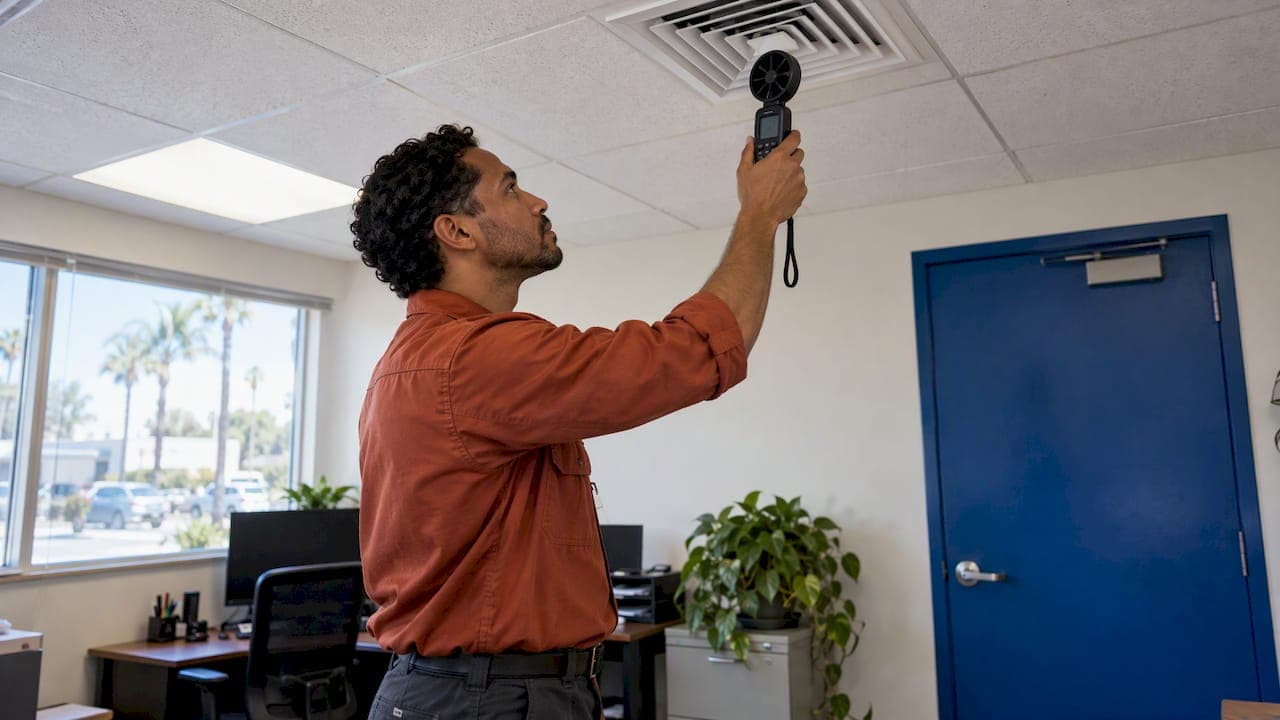
Sick building syndrome (SBS) is the name for a pattern: people get headaches, irritated eyes, fatigue or trouble concentrating while they are in a particular building, and feel better soon after they leave. No single cause is found. The HVAC system is one of the first places to look, because it controls the air you breathe: how much fresh air comes in, what the filter catches, how much moisture stays behind and whether anything is growing inside the equipment. This guide explains what SBS is, how to tell if your symptoms fit, which HVAC problems can contribute, and what a homeowner, landlord or business owner can do about it.
TL;DR
- SBS means symptoms that track time spent in a building with no identifiable cause. Building-related illness is different: it is a diagnosable condition tied to a specific contaminant.
- The classic sign is relief soon after you leave. Symptoms that fade on weekends, vacations or in another building point to the space, not to you.
- Poor ventilation, a neglected system, dirty filters, standing water in drain pans and high humidity are the HVAC factors most often named.
- Start with the basics: change filters, keep humidity in check, fix leaks and book a professional inspection. See a physician if symptoms persist or are severe.
- Newborns can show atypical symptoms, so a clean, well-ventilated home matters even more.
Table of Contents
- What sick building syndrome actually is
- Symptoms of sick building syndrome
- Why the HVAC system is a prime suspect
- What to check first: a practical order of operations
- What actually helps: ventilation, filtration, humidity, upkeep
- Newborns and indoor air
- When the problem is at work or in a rental
- What we do and do not know
- Our perspective
- Get your system checked
- FAQ
- Sources
What sick building syndrome actually is
The U.S. Environmental Protection Agency describes SBS as a situation in which occupants experience acute health effects that seem linked to time spent in a building, with no specific illness or cause identified. The complaints may be limited to one room or spread throughout the building.
That is different from building-related illness, where symptoms are clinically diagnosable and can be traced directly to airborne contaminants in the building. Examples include conditions caused by specific microbes or chemicals. SBS is defined by its subjective, reversible nature. Building-related illness may need medical treatment and a targeted fix.
You may also see different wording. The Merck Manual notes that the term SBS is being replaced by "building-related symptoms". Same idea, more modest label: it describes what people feel without claiming to know why.
Symptoms of sick building syndrome
The EPA lists the typical complaints as headache, eye, nose or throat irritation, dizziness, fatigue and difficulty concentrating. Most people who report them say they get better soon after leaving the building, per the same EPA fact sheet.
The symptoms are common ones, which is exactly why SBS is hard to pin down. A cold, seasonal allergies, poor sleep and stress can all look similar. The EPA also notes that multiple pollutants may be involved and their effects can resemble other conditions, so identifying a cause is genuinely difficult.
How to tell whether it is the building
You cannot diagnose SBS yourself, but a simple log tells you a lot. For two weeks, write down:
- When symptoms start and when they ease.
- Where you were: bedroom, home office, a particular floor, the shop.
- What the system was doing: running, off, just started after sitting idle.
- Whether anyone else in the building has the same complaints.
A pattern that follows a place, such as headaches every afternoon in one room that vanish on weekends away, is useful information for both a physician and an HVAC technician. A pattern that follows you everywhere is more likely something else, and that is a conversation for your doctor.
Why the HVAC system is a prime suspect
The EPA points to a few building-side factors. Inadequate ventilation, and a building operated or maintained in ways that differ from its original design, can contribute to indoor air problems. So can chemical contaminants such as volatile organic compounds (VOCs) from materials and furnishings, and biological contaminants that can breed in stagnant water found in ducts, humidifiers and drain pans.
Here is what that looks like in practice.
Not enough fresh air
A system that recirculates air without bringing in enough outdoor air lets odors, VOCs and carbon dioxide build up. This often happens when a space is used differently than it was designed for: a spare room turned into a crowded office, a storefront with more people than the system was sized for, or a home sealed tighter for energy savings without a plan for ventilation. Undersized or restricted return air makes it worse, because the system cannot move the air it needs to. Our guide to spotting undersized return air covers the homeowner checks.
Dirty or wrong filters
A clogged filter restricts airflow and stops catching particles. A filter that is too restrictive for the system has the same effect. The EPA lists routine maintenance, including periodic filter cleaning or replacement, among the ways to reduce pollutant levels. Our article on HVAC filter essentials explains how to choose a rating and how often to change it.
Moisture and standing water
This is the factor with the most consequences. A drain pan that does not drain, a leaking coil or a duct that sweats can feed microbial growth, and the blower then distributes whatever is growing. The EPA recommends keeping relative humidity below 50 percent to discourage dust mites and fungal growth. In US inner-city asthma studies, homes with dampness, cats and cockroach infestations were more likely to have indoor fungal levels higher than outdoor levels.
The CDC's guidance on mold makes a point that applies directly to HVAC work: fix the underlying moisture problem first, rather than cleaning surface mold and moving on. If a contractor proposes duct cleaning for suspected mold, ask to see the coil and drain pan first. We wrote a short guide on exactly that: demand coil and drain pan photos before air duct mold work.
Leaks and unbalanced systems
Leaky ductwork can pull dusty attic or crawlspace air into the supply stream. Poorly designed systems leave some rooms stuffy and others drafty. Both are comfort complaints that can double as air quality complaints. See how to prevent HVAC leaks and how HVAC design affects comfort and efficiency.
What to check first: a practical order of operations
Before you spend money, work through this list. Most of it costs little.
| Step | What to do | Why it matters |
|---|---|---|
| 1 | Check and replace the filter | A loaded filter cuts airflow and stops capturing particles |
| 2 | Look for water: stains, musty smell, damp near the air handler or a full drain pan | Moisture is the root of most biological problems |
| 3 | Measure humidity with a basic hygrometer | Aim to stay under 50 percent per EPA guidance |
| 4 | Make sure supply and return vents are open and unblocked | Blocked vents upset airflow and ventilation |
| 5 | Note new furniture, paint, carpet, cleaning products or renovation | These can add VOCs unrelated to the HVAC |
| 6 | Schedule a professional inspection | Coil, drain, ducts, airflow and fresh-air supply need tools to check properly |
If the system is old, has not been serviced in years or was never designed for how you use the space, an inspection is the fastest way to separate fixable HVAC issues from everything else. Our guide to HVAC inspections for California homeowners lists what a thorough one should cover.
What actually helps: ventilation, filtration, humidity, upkeep
The EPA's SBS fact sheet says that increasing ventilation rates and air distribution, plus routine HVAC maintenance, can reduce indoor pollutant levels. It describes air cleaning as a useful addition that has limitations. Take that framing seriously: a portable purifier does not replace fresh air or a clean system, and it does nothing about a wet drain pan.
Ventilation
Ventilation brings in outdoor air and exhausts stale air. Residential ventilation is covered by ANSI/ASHRAE Standard 62.2-2025, which sets requirements for dwelling-unit ventilation, local mechanical exhaust (kitchens, bathrooms) and source control. Its 2025 updates include a move to MERV 11 filtration, new ozone requirements for air-cleaning devices and ground cover over exposed earth. Standard 62.2 does not address thermal comfort; that falls under ASHRAE Standard 55.
There is an honest caveat from ASHRAE itself: meeting the ventilation standard does not guarantee acceptable indoor air quality, because sources, building use and occupant sensitivity vary so widely. Standards are a floor, not a promise.
Filtration
Better filtration can make a measurable difference. In a classroom study, HEPA filtration reduced Group 1 mold levels and corresponded with improved lung function results (FEV1%) in students with asthma. A home system usually cannot take a true HEPA filter without modification, because dense media restricts airflow. A technician can tell you the highest rating your blower and ductwork handle properly. For more options, see our list of top HVAC air quality improvements for your home.
Humidity control
Keep humidity below 50 percent and watch for the opposite problem too. Overly dry air irritates eyes, nose and throat, which are the same symptoms people attribute to SBS. If you run a humidifier, clean it as directed. The EPA names humidifier reservoirs among places where biological contaminants can grow.
Maintenance
Coils, drain pans, condensate lines, blower wheels and filters all need attention on a schedule. Neglect is the most common reason a system that was once fine becomes part of the problem. For background on what indoor air quality means and how a system shapes it, read our homeowner's guide to how HVAC improves indoor air quality and the definition of indoor air quality.
Newborns and indoor air
Parents often search for the right HVAC setup for a baby. There is no special "newborn HVAC" product, but there are sensible priorities. The EPA cautions that signs of indoor air problems in infants and children may be atypical, which makes diagnosis harder even for health professionals. You may not see the classic headache and watery eyes. A baby cannot tell you anything, so the environment has to be right in advance.
Practical steps, drawn from the same EPA guidance:
- Keep water reservoirs in equipment, such as humidifiers, clean.
- Repair leaks promptly and dry wet materials.
- Control exposure to pets, especially in the nursery.
- Keep humidity under 50 percent.
- Change filters on schedule and make sure the nursery gets steady airflow, not a stuffy dead end.
- Give new paint, flooring or furniture time to air out before the baby moves in.
If your baby has unexplained congestion, coughing, wheezing or skin irritation, call your pediatrician. Air quality is one possibility among many, and a doctor should rule out the others.
When the problem is at work or in a rental
SBS is classically a workplace complaint, and the same logic applies to shops, offices and multi-unit properties. The EPA suggests talking with coworkers and a supervisor, reporting problems to a physician or workplace health staff, and contacting the state or local health department. It also recommends considering an experienced professional building investigation. All of that is in its page on what to do if you suspect your office has an indoor air problem.
For business owners and property managers, the HVAC side of that investigation looks at airflow, fresh air intake, filtration and system operation. A practical guide to office air quality and HVAC walks through the same ground from the building operator's side. Tenants who suspect a problem should put the complaint in writing to the landlord or manager, because only the owner can authorize system work.

What we do and do not know
Be wary of anyone who promises that a single product cures SBS. The research does not support that. Causes are often multiple, symptoms overlap with other conditions and some buildings never reveal a single culprit. What is well supported is the boring list: adequate ventilation, clean and dry equipment, appropriate filtration, controlled humidity and removing sources of contamination. These steps reduce pollutant levels and remove the most common HVAC contributions, and that is a reasonable goal.
Our perspective
We see indoor air complaints in two kinds of homes and buildings. In the first, the system is simply worn out or neglected: a filter that has not been changed in a year, a drain line that is slowly backing up, ducts leaking in an attic. Those are fixable and the improvement is often quick. In the second, the system is running as designed, but the design no longer matches how the space is used. More people, a sealed-up envelope, a room added without return air. That takes a conversation about the whole system, not a quick patch.

Our advice is to start with the cheapest honest step: look at the filter, look for water and look at airflow. Then have a licensed technician check the coil, the drain, the ducts and the fresh air supply, and show you what they find with photos. If the evidence says the HVAC system is fine, we will say so, and the next step is a doctor or an indoor air specialist. We would rather tell you that than sell you equipment that does not address your symptoms.
We also push back on one habit: treating symptoms of moisture with cleaning products or fragrances. Fix the water source and the equipment, and keep things dry.
— Edward
Get your system checked
If your symptoms follow a building, an HVAC inspection is a sensible next step. E320air provides residential and commercial HVAC repairs, routine maintenance, system upgrades and installations, with licensed and insured technicians and service around the clock, including weekends and holidays. We work across the Inland Empire, from Riverside and Moreno Valley to Rancho Cucamonga, Corona and Hemet, and financing options are available for larger work.
For a home, start with our residential HVAC and system enhancement services. If the system is past its useful life or cannot ventilate the space properly, see our HVAC installation page. Property managers and business owners can arrange commercial HVAC, routine maintenance and emergency repairs. If heat is the issue, we also do heater repair. Not sure what a repair involves? Our HVAC repair guide for homeowners explains how to evaluate a contractor, and our problem solving gallery shows real examples.
FAQ
Is my house making me feel sick?
It can be, but confirm the pattern first. If headaches, irritated eyes or fatigue show up at home and ease soon after you leave, the building is a reasonable suspect. Check the filter, humidity and any signs of moisture, then have the HVAC system inspected. If symptoms persist or get worse, see your physician, since many conditions look alike.
What are the symptoms of sick building syndrome?
The EPA lists headache, eye, nose or throat irritation, dizziness, fatigue and difficulty concentrating. Most people feel better soon after leaving the building. Because these complaints are so common, a symptom log with dates and locations helps separate a building problem from a cold or allergies.
Why would my HVAC system make me sick?
Usually because of how it is operated or maintained. Not enough ventilation, dirty filters, high humidity and standing water in drain pans or humidifiers can all degrade indoor air. The blower then distributes the problem through the building. Regular maintenance and fixing moisture sources address most of these.
What is the difference between sick building syndrome and building-related illness?
SBS involves symptoms with no identifiable cause that tend to resolve after you leave the building. Building-related illness is a clinically diagnosable condition directly attributable to airborne contaminants in the building. The second may need medical treatment and a specific fix to the source.
What should I do about air quality for a newborn?
Keep humidity below 50 percent, keep equipment water reservoirs clean, fix leaks, change filters on schedule and limit pet exposure in the nursery. Symptoms in infants can be atypical, so talk to your pediatrician about any breathing or skin concerns rather than waiting for the classic signs.
Sources
- EPA: Sick Building Syndrome fact sheet
- Merck Manual: Building-Related Illnesses
- EPA: Indoor Air Pollution, An Introduction for Health Professionals
- EPA: Indoor Air Pollution, An Introduction for Health Professionals (2014 archive)
- CDC: Asthma in the Inner City and the Indoor Environment
- CDC: Indoor moulds, Sick Building Syndrome and building
- CDC: HEPA filtration intervention in classrooms
- ASHRAE: Standards 62.1 and 62.2
- ASHRAE: 62.2 Ventilation and Acceptable Indoor Air Quality
- EPA: Do You Suspect Your Office Has an Indoor Air Problem?