
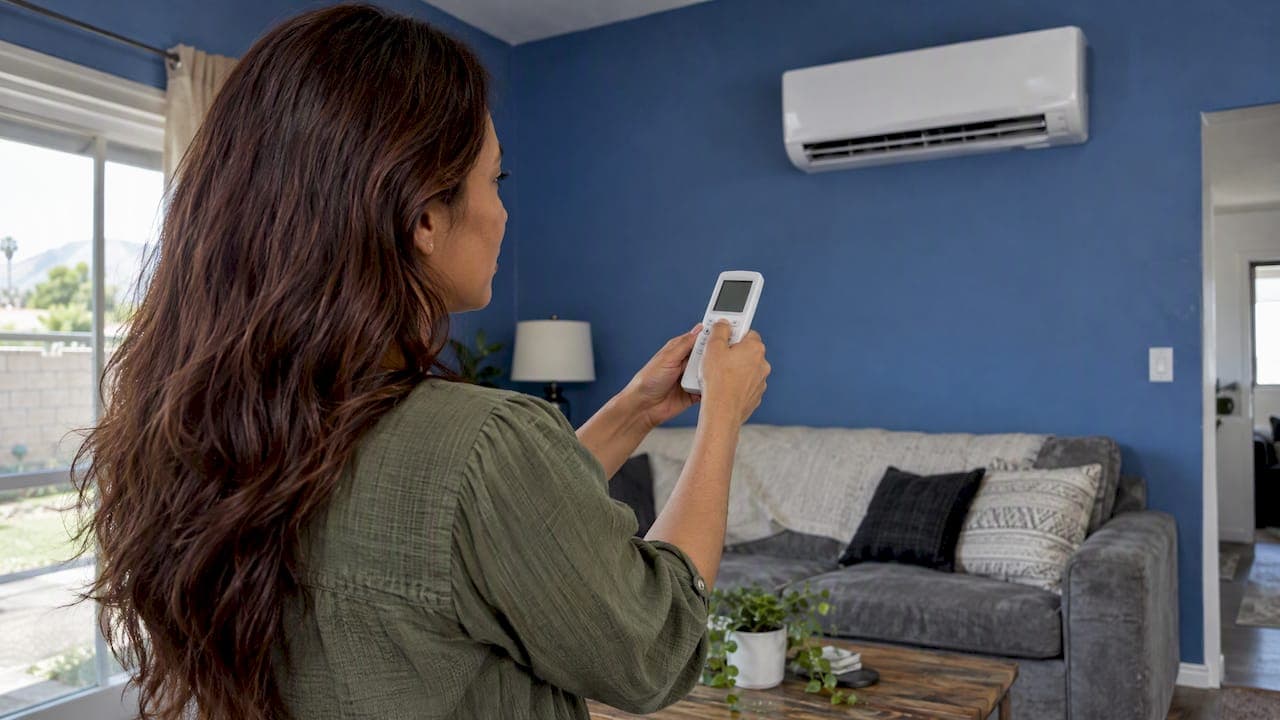
Dehumidification mode, usually labeled "dry" and shown as a water droplet, runs your system to pull moisture out of the air instead of chasing a temperature. The compressor works at low output and the indoor fan slows down, so more water condenses on the cold coil and drains away. It suits sticky, mild days. It does not suit hot afternoons, and it is not a cure for a damp house. Below, we explain how it works, how it differs from cool mode, whether heat pumps dehumidify, and where it falls short.
TL;DR
- Dry mode slows the indoor fan and runs the compressor gently so the coil stays cold longer relative to the air passing over it, which wrings out more moisture and cools the room only a little.
- Use it on humid but not hot days. On a hot day, cool mode is the right setting, because it removes heat and moisture together.
- Heat pumps and air conditioners both dehumidify while they cool. Some systems also have a dedicated dehumidify setting for mild, damp weather.
- Dry mode is for short-term humidity. Condensation on walls, musty smells or mold point to a moisture source or a system problem that a setting will not fix.
- In inland Southern California, humid spells are the exception, so check your humidity with a gauge before you run any dehumidifying mode for hours.
Table of Contents
- What dehumidification mode actually does
- Dry mode vs cool mode: how they differ
- Do heat pumps dehumidify?
- When dry mode helps and when it does not
- What to expect in the Inland Empire
- How to use dry mode well
- When dry mode is not enough
- Options when you need more dehumidification
- Our perspective
- Get your comfort settings checked
- FAQ
- Sources
What dehumidification mode actually does
Every air conditioner dehumidifies as a side effect of cooling. Warm indoor air passes over a cold evaporator coil, water vapor condenses into droplets on the coil, and the water runs out through a drain. The cooler, drier air goes back into the room.

Dry mode keeps that process but changes the priority. According to Daikin's explanation of cooling versus dry mode, the unit draws humid air from the room, cools it so the moisture condenses, returns drier air and sends the collected water outside. The goal is moisture removed, not degrees dropped.
Two changes make that possible:
- A slower fan. Slower airflow across the coil gives each pound of air more time in contact with the cold surface, so more water condenses. Sensi describes the same mechanism for HVAC dehumidification features: the fan speed is lowered to control airflow across the cooling coils, allowing more condensation.
- Gentler compressor work. Rather than running hard until the room hits a set temperature, the compressor runs at low output or in short bursts, so the room does not get much colder.
You may notice the room cools a degree or two while dry mode runs. That is normal. It is not trying to reach your thermostat setting.
What the symbol and the name look like on your equipment
The names vary. You may see "Dry," "Dehumidify," "Dry Mode" or a droplet icon on a mini-split remote or a portable unit. On a ducted central system, the feature may live on the thermostat or in the equipment's control board and be labeled as a dehumidification call or comfort setting.
Trane's installer literature for its Integrated Dehumidification Solution is one example of the ducted version. It lets occupants choose low, medium or high dehumidification, and when humidity is high it runs for a defined time each hour, using the cooling coil with electric heat to limit overcooling. That system can start a dehumidification call on its own when humidity is above a set point, even with no demand for a lower temperature. Not every system has that, so your owner's manual is the authority on what your equipment can do.
Dry mode vs cool mode: how they differ
Both modes use the same refrigeration cycle. The difference is the duty cycle and the fan.
A Times of India explainer on dry mode describes cool mode as longer, higher-load compressor operation with a variable or high fan speed, and dry mode as intermittent, low-load compressor operation with a low, steady fan. It also notes that dry mode typically draws less power than cool mode.
| Cool mode | Dry (dehumidify) mode | |
|---|---|---|
| Main goal | Reach the set temperature | Reduce humidity |
| Compressor | Longer, higher-load runs | Low output or short bursts |
| Indoor fan | Variable or high | Low and steady |
| Room temperature | Drops until it hits the set point | Drops slightly, often a degree or two |
| Power draw | Higher | Typically lower |
| Best for | Hot days | Humid, mild days |
Why cool mode can leave a room clammy
There is a reason dry mode exists. A classic engineering reference, Dehumidification in HVAC Systems, explains that at full load an air conditioner usually dehumidifies adequately. At part load, on/off cycling raises the average coil temperature and significantly reduces dehumidification capacity.
In plain terms, on a mild day your system satisfies the thermostat quickly and shuts off before it has removed much water. The air feels cool but sticky. Dry mode, or a system that can run at a low speed for long stretches, is built for exactly that situation.

Do heat pumps dehumidify?
Yes. In cooling mode a heat pump works like an air conditioner: the indoor coil is cold, moisture condenses on it and drains away. The same part-load limits apply, so a heat pump that cycles off quickly on a mild day removes less moisture.
Can one remove moisture without noticeably cooling the room? To a degree, yes, if it has a dry or dehumidify setting or a variable-capacity design. Two research points show what that looks like:
- In a Building America study, dry mode cut the share of hours with indoor relative humidity above 60% from 65% to 15% during a nine-day low-cooling-load stretch. The study is in this Department of Energy report.
- The same researchers recommend that variable-capacity systems operate at their lowest cooling capacity for long periods when load is very low, so runtime and dehumidification go up.
A variable-speed heat pump or inverter mini-split is the type of equipment that does this best, because it can idle low instead of snapping on and off. A single-stage system has fewer ways to hold humidity down without overcooling.
In heating mode, a heat pump does not dehumidify the way it does when cooling, since the indoor coil is warm. If winter indoor humidity is your problem, the cause is usually moisture sources in the home and ventilation, not the heating setting.
When dry mode helps and when it does not
Good times to use it
- Humid but mild weather. Dry mode is aimed at sticky conditions where it is not hot enough to justify full cooling.
- Shoulder-season evenings. Rooms that feel damp but do not need real cooling.
- After a spell of moisture. Laundry drying indoors, a long shower session or a rainy stretch can push humidity up for a day or two.
- Closed-up rooms. A bedroom or guest room that has been shut can benefit from a few hours of dry mode.
Times to skip it
- Hot afternoons. Dry mode will not remove enough heat. Switch to cool mode.
- Already dry air. Running dry mode in low humidity wastes energy and can leave the air uncomfortably dry, with a scratchy throat or dry skin.
- Around the clock. MrCool's support guidance says dry mode is not recommended for more than 10 to 13 hours at a time. Extended use can cause discomfort and inefficient energy use, and can effectively freeze out the room.
That guidance comes from a mini-split manufacturer, so look at your own manual for your own limits.
What to expect in the Inland Empire
Our service area runs from Riverside and San Bernardino through Corona, Fontana, Hemet and Redlands. For most of the year the issue here is heat, not humidity. The U.S. Department of Energy's Oak Ridge National Laboratory heat pump design work notes that in California and the Southwest little dehumidification is required, and that hot, dry climate designs can use larger coils and higher airflow to improve performance.
What that means for you:
- Dry mode is a niche setting in our area. You may use it on the odd muggy or overcast day, but cool mode will do most of the work.
- Very dry indoor air is a more common complaint here. If that is your situation, our guide on measuring 30% to 50% humidity before using a humidifier covers it.
- Desert conditions also stress equipment in other ways. Our homeowner's guide to desert climate and HVAC systems walks through that.
- For the full year, see our notes on seasonal HVAC needs for Riverside County homeowners.
How to use dry mode well
- Measure first. A basic hygrometer costs little and tells you the actual indoor relative humidity. Aim for the 30% to 50% range we recommend and avoid letting it sit above 60%.
- Pick the right mode. Hot and sticky: cool. Mild and sticky: dry.
- Do not expect a set temperature. On many mini-split systems, Daikin service manuals describe Program Dry operation as automatically controlling temperature and airflow through the unit's microcomputer, often disabling manual fan speed and temperature adjustments. If your remote will not let you change them, that is by design.
- Close doors and windows. Dry mode removes moisture from the space it serves. Open windows bring more in.
- Set a time limit. Use the timer and stop after several hours, then recheck the hygrometer.
- Keep the drain clear. The water has to go somewhere. A clogged condensate line or dirty coil can cause leaks or poor results, and this is a job for a technician during maintenance.
When dry mode is not enough
Dry mode handles short-term humidity. It is not a dedicated dehumidifier. Persistent dampness, condensation on walls or windows, or a musty smell mean something else is going on, and the MrCool guidance says the same: persistent humidity may need a separate, standalone dehumidifier.
Before buying anything, look for the source:
- Exhaust fans and leaks. The EPA advises running kitchen and bathroom exhaust fans and fixing water leaks to control indoor moisture and prevent mold.
- Tight, efficient homes. In hot-humid climates, high-performance building envelopes reduce cooling loads and runtimes, which cuts incidental dehumidification, and continuous mechanical ventilation adds moisture that must be removed, according to the same Building America research.
- Oversized equipment. A system that is too large cools quickly, shuts off and leaves moisture behind. This is one of the reasons proper sizing matters on an installation.
- Mold risk. If you see or smell mold, treat it as a moisture problem first. Ask for photos of the coil and drain pan before anyone starts duct work, as we explain in our guide to mold in air ducts. Homeowners and landlords dealing with damp rooms can also look at residential humidity targets for mold control for practical moisture management.
Options when you need more dehumidification
If dry mode keeps falling short, you have a few routes. Which one fits depends on the home.
| Situation | Likely fix |
|---|---|
| Occasional muggy days | Dry mode on the mini-split or portable unit, with a time limit |
| Rooms clammy after the AC cycles off | Check sizing, fan settings and thermostat control with a technician |
| One damp room | A standalone dehumidifier for that room |
| Whole house stays humid | A system upgrade with variable-speed equipment or a dehumidification control |
| Dry air instead | A whole-house humidifier, see our humidifier benefits guide |
If you want the bigger picture of how your system, thermostat and air quality fit together, our pages on HVAC comfort control and how HVAC improves indoor air quality are good next reads.
Our perspective
We get the question most often from homeowners who just replaced a system or added a mini-split and are surprised the room feels cool but not comfortable. Usually the setting is not wrong. The equipment is not matched to the home, or no one explained what each mode is for.
Our view is simple. Dry mode is a useful tool for mild, muggy days, and it works best when the system has a controlled way to run at low capacity. If you are buying new equipment, ask about variable-capacity options and how the system handles humidity, not only how fast it cools. If you already own a system, ask for a check of the coil, drain line, airflow and thermostat settings before you assume you need another appliance.
Our technicians are licensed and insured, work across all major brands, and aim for tailored, energy-efficient solutions with minimal disruption. We would rather size and set up your equipment properly the first time than have you fight humidity with a remote control.
Edward
Get your comfort settings checked
If your home feels sticky, your equipment has modes you do not understand, or you are weighing an upgrade, we can help. We handle residential and commercial repairs, routine maintenance, new equipment sales, system upgrades and installation across the Inland Empire, with service available around the clock, including weekends and holidays, and flexible payment options including financing.

For a new system or a replacement, start with our HVAC installation page. For homeowner questions and upgrades, see our residential HVAC and system enhancements page. Business owners and property managers can go to our commercial HVAC, maintenance and emergency repair page.
FAQ
Is dry mode the same as a dehumidifier?
No. Dry mode uses your air conditioner's cooling coil to remove moisture, so it also cools the room a little and has to vent heat. A standalone dehumidifier is designed for more serious dampness. Use dry mode for short-term humidity and a separate unit for persistent problems.
Is dry mode or cool mode more energy efficient?
Dry mode typically draws less power than cool mode because the compressor runs at low output and the fan is slow. But on a hot day it will not keep you comfortable, so you may end up running cool mode anyway. Choose the mode that matches the weather, and do not run dry mode in already dry air.
Do heat pumps dehumidify?
Yes, in cooling mode they dehumidify the same way an air conditioner does. Variable-capacity models do it best on mild days because they can run at low speed for longer. In heating mode they do not dehumidify the same way, because the indoor coil is warm.
How long can I run dry mode?
Follow your manual. One mini-split manufacturer advises against running it more than 10 to 13 hours at a time, since long runs can cause discomfort and wasted energy. Use a hygrometer, aim for 30% to 50% relative humidity, and stop when you get there.
What humidity level is too high indoors?
We recommend keeping indoor humidity between 30% and 50%. Sustained readings above 60% invite mold and dust mites. If you cannot get below that with ventilation and your system, have a technician look at it.
Sources
- Daikin: What's the difference between cooling and dry mode
- Trane: Installer's guide for Integrated Dehumidification Solution
- Times of India: What is dry mode in AC
- Dehumidification in HVAC Systems
- U.S. Department of Energy Building America: Energy-efficient management of mechanical ventilation
- MrCool: Using dry mode on your mini-split
- DOE/ORNL Heat Pump Design Model analysis
- Daikin service manual, LV series slim duct
- EPA: Improving your indoor environment
- Residential humidity targets for mold control