

TL;DR:
- Refrigerants are the primary heat-transfer fluid in HVAC cooling systems, not fuel, and they operate in a closed loop to absorb and release heat.
- Understanding refrigerant types, regulations, and proper diagnosis helps homeowners maintain efficiency, prevent system failures, and comply with environmental laws.
Most homeowners think their air conditioner runs on electricity alone. It does not. The real workhorse inside every cooling system is refrigerant, and understanding the role of refrigerants in HVAC can completely change how you think about your home's comfort, energy bills, and repair decisions. Whether you are facing a system breakdown in the middle of a Riverside summer or shopping for a new installation, knowing what refrigerant does and why it matters puts you in a far stronger position than most homeowners ever reach.
Table of Contents
- How refrigerants make your HVAC system work
- The types of refrigerants and their impact on HVAC performance
- Environmental considerations and refrigerant regulations in Southern California
- Common refrigerant issues homeowners face and how they affect your system
- Applying refrigerant knowledge to optimize your home's HVAC system
- A fresh look at refrigerants: what most homeowners miss
- Trust E320 Air for expert HVAC refrigerant services in Southern California
- Frequently asked questions
Key Takeaways
| Point | Details |
|---|---|
| Refrigerants transfer heat | Refrigerants absorb indoor heat and release it outdoors to cool your home effectively. |
| Correct refrigerant matters | Using the right refrigerant is crucial for HVAC efficiency, safety, and system longevity. |
| Environmental rules impact choices | EPA regulations phase out harmful refrigerants, requiring homeowners to choose compliant systems. |
| Watch for refrigerant issues | Symptoms like weak cooling or ice buildup often signal refrigerant-related problems needing professional care. |
| Professional service essential | Certified HVAC technicians ensure proper refrigerant handling, compliance, and system performance. |
How refrigerants make your HVAC system work
Refrigerant is not fuel. It does not get burned or used up under normal conditions. Instead, it functions as a heat-transfer fluid in a closed loop that continuously absorbs heat from inside your home and releases it outdoors. That distinction matters because it explains why a well-maintained system should never need a refrigerant "top-off" unless there is a leak somewhere.
The process follows a four-step cycle known as the vapor-compression refrigeration cycle: evaporation, compression, condensation, and expansion. Each step changes the refrigerant's pressure and physical state, which is precisely what allows it to move enormous amounts of heat with relatively little energy. Here is how it plays out in your home:
- Evaporation (indoors): Refrigerant enters your indoor evaporator coil as a cold, low-pressure liquid. It absorbs heat from your home's air, boils into a gas, and sends cooler air back through your vents.
- Compression: The compressor (located in your outdoor unit) pressurizes that gas, raising its temperature significantly above outdoor air temperature.
- Condensation (outdoors): The hot, high-pressure gas flows through the condenser coil outside, releases its heat to the outdoor air, and turns back into a liquid.
- Expansion: The liquid refrigerant passes through an expansion valve, pressure drops sharply, temperature falls, and the cycle begins again.
What makes this so efficient is the phase change itself. When a substance shifts from liquid to gas, it absorbs far more energy than simply warming up a degree or two. That is why refrigerants in cooling systems can move heat so effectively compared to, say, a fan pushing air around.
Understanding this cycle helps you recognize how even a small refrigerant leak or the wrong refrigerant type disrupts every step. For a deeper look at how the overall system fits together, the basics of HVAC system design give useful context.
Key takeaways about how refrigerants work in HVAC:
- The refrigerant never leaves the system under normal operation
- Heat is moved, not destroyed, meaning your AC is essentially a heat pump running in one direction
- Any interruption to pressure levels or refrigerant volume breaks the entire cycle
- The efficiency of the system depends heavily on the refrigerant's specific thermodynamic properties
The types of refrigerants and their impact on HVAC performance
Not all refrigerants behave the same way, and the type your system uses is not a minor detail. The thermodynamic properties of a refrigerant directly influence how hard the compressor works, how much heat transfers at each stage, and ultimately how much electricity your system consumes every month.
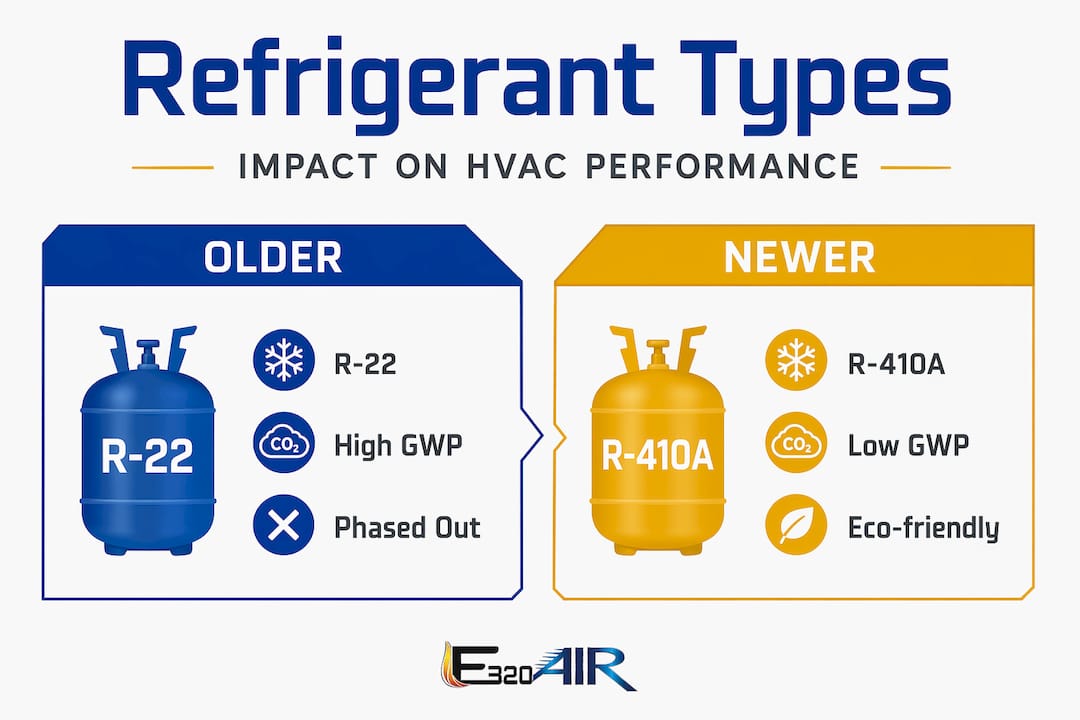
Here is a comparison of the three most common refrigerants found in residential HVAC systems:
| Refrigerant | Status | Global warming potential (GWP) | Typical use |
|---|---|---|---|
| R-22 (Freon) | Phased out | ~1,810 | Older systems pre-2010 |
| R-410A | Being phased down | ~2,088 | Most systems 2010 to present |
| R-32 | Growing adoption | ~675 | Newer high-efficiency systems |
| R-454B | Emerging standard | ~466 | Next-generation equipment |
Each refrigerant operates at different pressures and requires system components designed specifically for those pressures. Using the wrong refrigerant does not just reduce efficiency. It can cause equipment failure outright because seals, lubricants, and compressors are all matched to specific refrigerant types. The differences also affect the impact of refrigerants on energy efficiency in real ways you will feel on your electricity bill.
Key differences that matter to you as a homeowner:
- R-22 is no longer manufactured and is increasingly expensive to source for legacy system repairs
- R-410A systems are widely available but are being phased down due to their high GWP
- R-32 offers better efficiency with a significantly lower environmental footprint
- R-454B is the likely standard for new systems going forward, already appearing in newer equipment
Pro Tip: Never attempt to swap or add refrigerant yourself. Federal law restricts refrigerant handling to EPA-certified technicians, and the wrong refrigerant in your system can void your warranty, damage your compressor, and create safety hazards. Always confirm your technician is certified before any refrigerant work begins.
Environmental considerations and refrigerant regulations in Southern California
Southern California homeowners operate under some of the stricter environmental standards in the country, and refrigerants are squarely in the regulatory crosshairs. The EPA's SNAP program evaluates refrigerants for two key environmental metrics: ozone depletion potential (ODP) and global warming potential (GWP). These numbers determine which refrigerants are approved for use, phased down, or banned entirely.
ODP measures how much a substance degrades the ozone layer relative to a reference compound. GWP measures how much heat a gas traps in the atmosphere compared to CO2 over 100 years. R-22, once the most common residential refrigerant, carries a high ODP and has been fully banned from production in the U.S. since 2020. R-410A replaced it widely, but its GWP of over 2,000 has now put it in the crosshairs of the EPA's American Innovation and Manufacturing (AIM) Act phase-down.
What this means for you right now:
- If your system still uses R-22, repairs are becoming expensive and parts are increasingly scarce
- New HVAC equipment sold in 2026 must meet stricter GWP thresholds, making new installs more environmentally sound
- HVAC professionals are now required to follow strict documentation and handling protocols during service
- Choosing a contractor who understands these rules is not optional. It is a legal and financial protection for you as the homeowner
- California's own Air Resources Board (CARB) adds another layer of compliance on top of federal rules
Staying current on California HVAC efficiency standards is genuinely useful here because state rules evolve faster than many homeowners realize.
Common refrigerant issues homeowners face and how they affect your system
Here is where refrigerant knowledge becomes immediately practical. Most homeowners call for HVAC service because something feels wrong but they cannot name the cause. A refrigerant problem has a recognizable set of symptoms, and recognizing them early saves money.
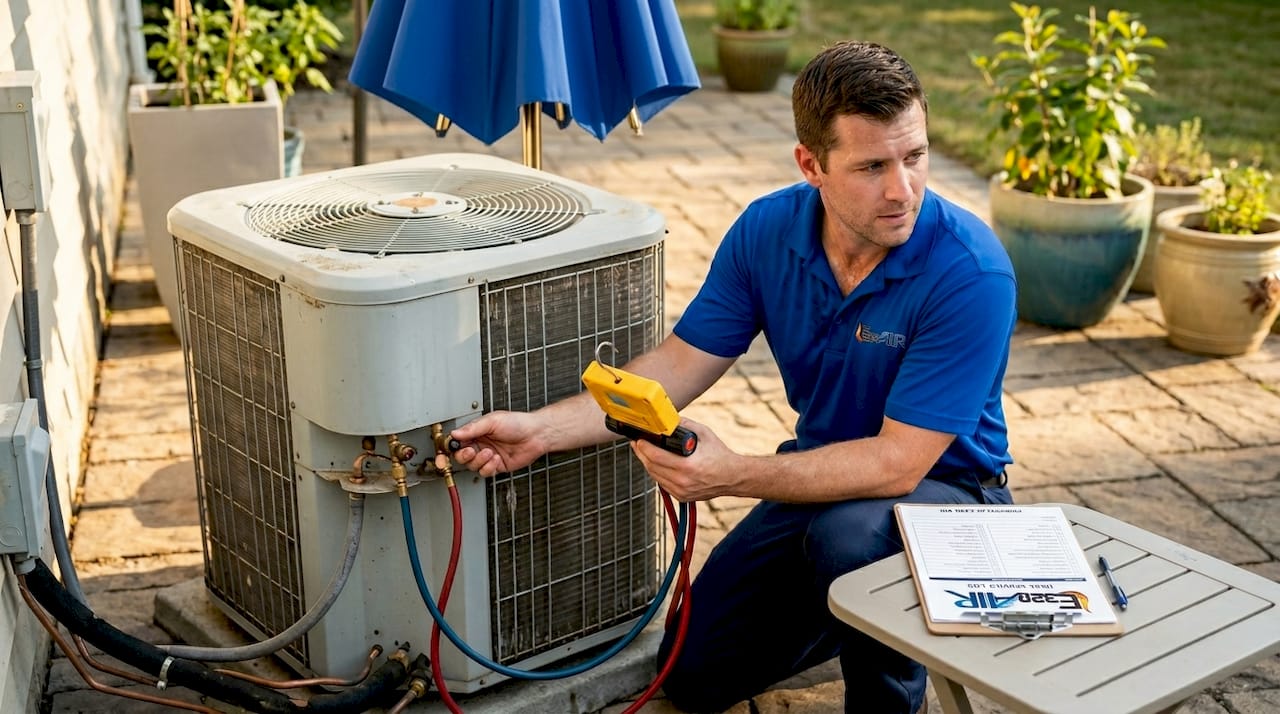
Low refrigerant levels or restrictions cause weak cooling output, uneven temperatures throughout the home, and longer run times as the system struggles to transfer enough heat. The coils may also ice over because without enough refrigerant absorbing heat, the evaporator drops below freezing and moisture on the coil turns to ice.
Signs of a refrigerant problem to watch for:
- Ice or frost on the indoor coil or refrigerant lines, even in summer
- Warm air from vents despite the system running continuously
- Hissing or bubbling sounds near the indoor or outdoor unit, which can indicate a leak
- Higher than usual electricity bills without any change in usage habits
- Uneven cooling, where some rooms are comfortable and others stay warm
"The practical foundation of refrigerant diagnosis is not guessing at levels. Trained technicians measure superheat and subcooling to pinpoint performance deviations before a breakdown occurs." This is the standard your technician should be working to.
Tracking refrigerant states like superheat and subcooling gives a technician a precise picture of what is happening inside your system without opening it unnecessarily. It is a diagnostic skill that separates thorough HVAC service from a quick gas top-off. For a full breakdown of when and why to call for help, the guide to HVAC repair decisions is worth reading.
Pro Tip: Scheduling annual HVAC maintenance means a technician checks refrigerant levels and looks for early signs of leaks before your system fails on the hottest day of the year. In Southern California, that is not a minor convenience. It is a genuine health and comfort issue.
Applying refrigerant knowledge to optimize your home's HVAC system
Understanding refrigerants is useful only if it changes what you do. Professional handling of refrigerant is not just a legal requirement. It is the most reliable way to ensure your system performs as designed, stays energy efficient, and lasts as long as possible. Here are the five practical steps that refrigerant-aware homeowners take:
- Monitor system performance year-round. Note any changes in cooling time, comfort levels, or energy bills. These are your early warning signals.
- Schedule annual maintenance. A yearly inspection that includes refrigerant checks, coil cleaning, and pressure testing is the single best investment you can make in your HVAC system's lifespan.
- Address symptoms without delay. A refrigerant issue does not resolve on its own. It worsens and causes compressor damage if ignored.
- Choose new equipment with compliant refrigerants. When it is time to replace your system, prioritize units using R-32 or R-454B, which meet 2026 efficiency and environmental standards.
- Leave refrigerant handling to certified professionals. No exception. Not for top-offs, not for leak repairs, not for system changes.
Connecting with a contractor who understands the full scope of refrigerant services means you are not just getting a technician who tops off gas. You are getting a professional who can evaluate your entire system and make decisions that hold up long-term.
A fresh look at refrigerants: what most homeowners miss
Here is something almost no homeowner hears from their HVAC contractor: the refrigerant is not the problem most of the time. It is the symptom of something else. A refrigerant leak means there is a physical failure somewhere in the system, whether it is a corroded coil, a loose fitting, or a stressed component. Simply adding more refrigerant without finding the source is the HVAC equivalent of putting tape over a warning light.
The practical difference between a successful repair and repeated failures is matching refrigerant type and system design rather than reaching for a quick retrofit. We have seen homeowners pay for multiple "recharges" on the same system over two or three seasons because the original leak was never found and fixed.
There is also a diagnostic depth that most homeowners never see. Technicians think in terms of refrigerant states and component functions, which is why two systems showing identical symptoms might need completely different repairs. One might have a failing TXV valve. Another might have a dirty evaporator coil affecting heat absorption. The refrigerant readings tell the story if you know how to read them.
"Matching the refrigerant to system design, not just topping up gas, is the foundation of effective HVAC repair and maintenance."
Pro Tip: Before any technician starts refrigerant work on your system, ask two questions: What refrigerant does my system use? And is this system designed for the refrigerant you're adding? If they cannot answer both clearly, that is a signal to find a more knowledgeable contractor.
Want to go deeper on refrigerant troubleshooting? The guide on diagnosing HVAC issues covers practical steps for Southern California homeowners.
Trust E320 Air for expert HVAC refrigerant services in Southern California
Understanding the role of refrigerants in HVAC is one thing. Having a certified team who applies that knowledge correctly in your home is what actually keeps your system running efficiently and compliantly.

E320 Air serves Southern California homeowners with professional HVAC installation, certified refrigerant handling, and repair services built around proper diagnosis, not quick fixes. Our technicians are EPA-certified, current on California's 2026 refrigerant compliance rules, and committed to transparent communication about every service recommendation. Whether you need a refrigerant leak tracked down, a new high-efficiency system installed with modern low-GWP refrigerant, or a maintenance plan that keeps your equipment performing at its best, we handle it with the care and accountability your home deserves. Browse our problem-solving gallery to see real results, or visit E320 Air to schedule service today.
Why Southern California homeowners choose E320 Air:
- EPA-certified technicians with current refrigerant training
- Full compliance with California and federal refrigerant regulations
- Honest assessments with no unnecessary refrigerant top-offs
- Transparent documentation on all refrigerant handling
- Warranty-backed service and reliable follow-through
Frequently asked questions
What is the main role of refrigerants in a home HVAC system?
Refrigerants absorb heat indoors and release it outdoors through a continuous closed-loop cycle, allowing your HVAC system to cool or heat your home without consuming the refrigerant itself.
Why can't I just add any refrigerant to my air conditioner?
Using the wrong refrigerant can reduce efficiency and cause equipment failure because each refrigerant operates at specific pressures that your system's components are designed to handle.
What environmental regulations affect refrigerant choices in Southern California?
The EPA's SNAP program and the AIM Act phase down ozone-depleting and high-GWP refrigerants, requiring HVAC professionals to use approved substitutes and follow strict handling protocols.
How do I know if my HVAC system has a refrigerant problem?
Symptoms like ice buildup, weak airflow, longer cooling cycles, and uneven temperatures throughout your home are reliable signals that you should call a certified HVAC technician promptly.
Can I switch to a newer refrigerant for my older system?
Retrofitting requires major modifications and a professional evaluation to confirm compatibility, since mismatched refrigerants can damage your compressor and void your equipment warranty.