
TL;DR:
- Proper air balancing ensures even temperature distribution and energy efficiency in homes by accurately measuring and adjusting airflow to each room. It prevents hot or cold spots, reduces energy waste, and extends system lifespan, especially important in the varied climate of the Inland Empire. Professional balancing involves detailed measurement and adjustment, which home inspections alone cannot reliably achieve, making expert service essential for optimal comfort and savings.
You replaced the old unit, scheduled regular tune-ups, and still one bedroom feels like a sauna while the living room stays perfectly cool. That's not a broken HVAC system. That's an airflow problem, and it happens in homes across the Inland Empire every single day. Air balancing is the often-skipped step that determines whether your system actually delivers comfort to every room, or just works hard and wastes money heating and cooling the wrong spaces.
Table of Contents
- Understanding air balancing and why it matters
- How air balancing works: steps, tools, and standards
- Common causes of air imbalance in homes
- How to recognize and fix air balance problems
- Why neglecting air balancing wastes energy and comfort
- Get expert air balancing and maximize your comfort
- Frequently asked questions
Key Takeaways
| Point | Details |
|---|---|
| Air balancing defined | Air balancing means adjusting HVAC airflow so every room in your home receives proper heating or cooling. |
| Boost comfort and efficiency | Balanced air boosts comfort, energy savings, and air quality for California homes. |
| Signs of imbalance | Uneven temperatures, poor airflow, or stuffy air show that air balancing is needed. |
| DIY vs. expert | Homeowners can do basic checks, but pros are needed for stubborn or complex problems. |
| Act after renovations | Always reassess air balancing if your home’s layout or HVAC system changes. |
Understanding air balancing and why it matters
Air balancing is the process of measuring, adjusting, and verifying the airflow delivered to each room in your home so it matches what the system was originally designed to provide. Think of your duct system like a highway network. If every lane funnels traffic toward one exit, everything else backs up. When air isn't distributed correctly, some rooms get too much while others get almost nothing.
This matters for comfort, obviously. But it also has a direct impact on how efficiently your system runs. An unbalanced system forces your air handler to work harder to compensate, which drives up energy consumption without improving results. Better HVAC and indoor air quality is also tied to proper airflow since stagnant, poorly circulating air traps pollutants and moisture in specific zones of your home.
The technical benchmark comes from ASHRAE Standard 111, which specifies tolerances of ±10% of design CFM (cubic feet per minute) for each terminal or register. CFM is simply the volume of air moving through a duct per minute. Getting within that 10% tolerance for every outlet in your home is the goal of a proper balance. Systems must also meet ventilation requirements under ASHRAE 62.1 and 62.2 to maintain healthy indoor air.
Here's what proper air balancing delivers for Inland Empire homeowners:
- Consistent temperatures in every room, including upstairs bedrooms and room additions
- Lower energy bills because your system stops overworking to fight imbalanced airflow
- Better air quality since balanced systems circulate and filter air more effectively
- Extended equipment life because components aren't straining against airflow resistance
- Reduced humidity issues, especially important during hot Inland Empire summers
When your airflow is calibrated correctly, your HVAC doesn't need to run as long or as hard to reach the set temperature. That means real savings. Pairing balanced airflow with HVAC zoning basics can push efficiency even further by letting you condition only the areas you're actually using. Getting proper HVAC sizing right from the start is also part of the equation, since even a perfectly balanced system can't fully compensate for a unit that's too large or too small for your home.
How air balancing works: steps, tools, and standards
With an understanding of why air balancing matters, it helps to see exactly how professionals and informed homeowners go about making sure air moves as it should.
Here is the typical air balancing process a trained technician follows:
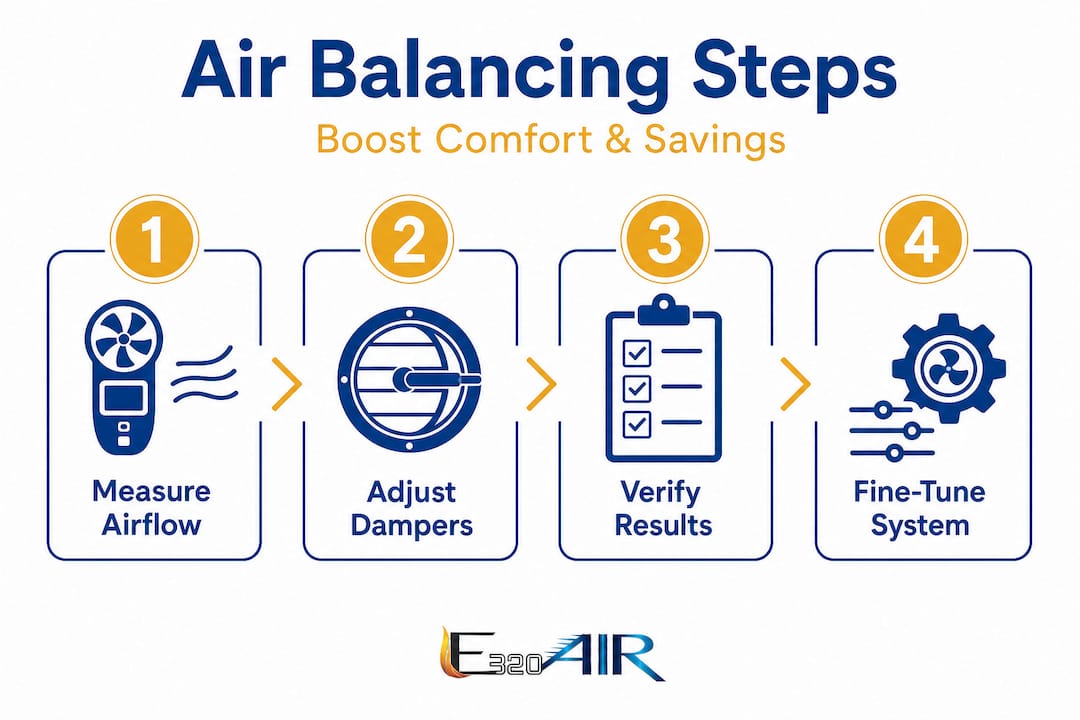
- Review the design specifications. A technician pulls the original HVAC design documents or performs a Manual J load calculation to know the target CFM for each room.
- Inspect filters and ductwork. Before any measurements happen, clogged filters and obvious duct damage are addressed. You can't balance a system that's being choked.
- Measure existing airflow at every register. Using an airflow meter (also called an anemometer or flow hood), the technician records how much air is actually coming out of each vent.
- Compare measured values to design targets. Any register falling outside the ±10% tolerance noted in ASHRAE Standard 111 gets flagged for adjustment.
- Adjust dampers and registers. Balancing dampers inside the ductwork are opened or closed to redirect airflow. Registers may also be partially adjusted at the vent.
- Re-measure and verify. After adjustments, the technician measures again to confirm every room is within tolerance.
- Document the results. A professional balance always ends with written records, which are useful for future service visits.
The tools involved make a big difference in accuracy:
| Tool | What it measures | Why it matters |
|---|---|---|
| Flow hood / anemometer | CFM at each register | Pinpoints over and underperforming vents |
| Manometer | Static pressure in ducts | Reveals restrictions and leaks |
| Balancing dampers | Controls airflow volume in duct branches | The primary adjustment lever |
| Thermometer / thermal camera | Temperature differentials | Confirms results after adjustment |
Pro Tip: Always replace or inspect your air filter before a balancing appointment. A clogged filter starves the whole system of airflow and will throw off every single measurement. Good HVAC filter maintenance is the simplest thing you can do to support a balanced system between professional visits.
The key HVAC features for home comfort all depend on clean airflow to perform correctly. Variable-speed air handlers, smart thermostats, and high-efficiency coils can't do their job when the air isn't moving where it needs to go.
Common causes of air imbalance in homes
Understanding the process is one thing, but knowing what throws off balance is another. These common issues deserve special attention, especially in Inland Empire homes that have been expanded, remodeled, or simply aged over time.
The most frequent culprits behind unbalanced airflow include:
- Duct leaks and kinks. A duct that has pulled apart at a joint or been pinched behind drywall loses a significant portion of its airflow before it ever reaches the register. These common residential air balancing challenges are among the top causes of hot and cold spots in homes.
- Clogged or restrictive filters. A filter that's been in place too long creates a pressure drop that starves the entire system. Filters rated too high for your system (overly dense MERV ratings) can do the same thing even when new.
- Blocked return air vents. Furniture pushed against a return vent prevents the system from pulling air back to the handler. Without proper return airflow, the whole distribution loop gets disrupted.
- Poor original installation. Some systems were never balanced correctly from day one. Ductwork sized for a different layout, vents placed in low-priority locations, or improper fan speed settings all create imbalance from the start.
- Home additions and renovations. Adding a room, converting a garage, or opening up a floor plan changes the air demands of your home. The original duct layout wasn't designed for the new configuration.
Pressure imbalances don't just mean discomfort. They cause stale air that builds up in rooms where fresh supply never quite reaches, creating noticeably stuffy spaces that no amount of scented candles can fix.
Understanding impacts of home renovations on HVAC is critical before starting any project. What seems like a simple wall removal can completely redirect how air flows through your home. And if you're already dealing with system quirks, solid HVAC troubleshooting tips can help you narrow down whether the problem is a balancing issue or something more serious.
Pro Tip: Schedule an air balancing assessment after any renovation, room addition, or major HVAC repair. Don't wait until the next summer heat wave to find out your newly renovated bedroom gets no airflow.
How to recognize and fix air balance problems
Now that you know the causes, here's how to spot air imbalance in your own home and what to do about it.
Common warning signs your home needs balancing:
- One or more rooms are consistently 3 to 5 degrees hotter or cooler than the rest of the house
- Certain vents produce barely any airflow when you hold your hand near them
- Your thermostat reaches the set temperature but some rooms never feel right
- Stale or musty-smelling air in specific rooms despite good ventilation elsewhere
- Your system runs longer cycles than expected without achieving full comfort
Once you spot these signs, here's a logical sequence to work through:
- Check and replace all air filters. If any filter is gray and dense with debris, replace it before doing anything else.
- Walk every register in the home. Feel for airflow at each one. Note which rooms feel weak and which feel strong.
- Clear blocked return vents. Move any furniture, drapes, or stored items that are covering return air grilles.
- Partially close registers in over-conditioned rooms. This simple adjustment can redirect some airflow toward weaker areas.
- Call a professional if the problem persists. Systems that are outside 80-120% total airflow cannot be balanced through register adjustments alone. The fan speed or ductwork may need to be addressed directly.
Here's how DIY efforts compare to professional balancing:
| Factor | DIY adjustments | Professional balancing |
|---|---|---|
| Cost | Free to minimal | $200 to $600 depending on home size |
| Time | 1 to 2 hours | 2 to 4 hours |
| Tools required | None beyond your hands | Flow hood, manometer, balancing dampers |
| Accuracy | Rough approximation | Within ASHRAE ±10% tolerance |
| Best for | Minor comfort tweaks | Persistent imbalance, after renovations |
| Lasting results | Short-term only | Long-term with documentation |
The benefits of expert HVAC balancing go beyond just comfort. A professionally balanced system is documented, measurable, and gives you a baseline for future maintenance. If you're also dealing with warmth problems in specific areas, heating repair services can help rule out mechanical issues before a balance is performed.
Why neglecting air balancing wastes energy and comfort
Here's the perspective we've built after working on homes throughout the Inland Empire: most homeowners think buying a better HVAC system solves the comfort problem. It doesn't. Not without addressing airflow.
We see it constantly. A homeowner invests in a high-efficiency unit, complete with smart thermostat integration and all the right best HVAC systems for home comfort features, and still has a master bedroom that sits five degrees above the rest of the house in July. The equipment isn't failing. The air isn't going where it needs to go.
Inland Empire homes have specific challenges that make this worse than average. Many homes here have had additions built on over the decades, creating layouts that original duct systems were never designed to serve. Others have tile and vaulted ceilings that create dramatic temperature stratification. Summer temperatures pushing past 105°F put systems under real stress, and even a small imbalance becomes painfully obvious when the outdoor temperature is extreme.
The financial cost of ignoring air balancing is harder to see but very real. A system working against itself runs longer cycles, wears components faster, and delivers comfort that doesn't match the energy it consumes. That gap between what you're paying and what you're getting is pure waste. We've seen homes where a proper balance reduced runtime by 15% or more, which adds up quickly on an energy bill.
The uncomfortable truth is that air balancing is often treated as optional maintenance rather than the foundation it actually is. You wouldn't set up a sound system without adjusting the speakers. You wouldn't fill a pool with a leaking drain. Getting the airflow right is the first step that makes everything else in your HVAC investment actually work.
Get expert air balancing and maximize your comfort
If any of the warning signs in this article sound familiar, the right next step is a professional air balancing assessment tailored to your specific home layout and duct system.

Our team at E320 Air serves homeowners across the Inland Empire with targeted air balancing, duct inspections, and complete HVAC installation services designed for the region's demanding climate. We don't offer generic fixes. Every home gets measured, documented, and adjusted to actual ASHRAE performance standards. You can also browse our real problem solutions to see how we've resolved the exact issues described in this article for local homeowners. Reach out today to schedule your assessment and start getting full value from your system.
Frequently asked questions
What are the main benefits of air balancing?
Air balancing delivers consistent temperatures in every room, reduces energy waste, and improves indoor air quality by keeping air moving through your entire home. Per ASHRAE Standard 111, staying within ±10% of design airflow targets is the standard for a properly performing system.
How do I know if my house needs air balancing?
Warning signs include rooms that are always hotter or colder than the rest of the house, weak airflow at specific vents, or stale air buildup in certain rooms caused by pressure imbalances.
Can I perform air balancing myself or should I hire a professional?
You can handle basic checks like clearing blocked vents and replacing filters, but systems outside 80-120% of their target airflow require professional fan speed or ductwork adjustments that can't be done by hand.
How often should air balancing be checked?
Air balancing should be evaluated after any major renovation or expansion and every few years as part of regular HVAC maintenance, especially in homes with older ductwork or multiple room additions.