
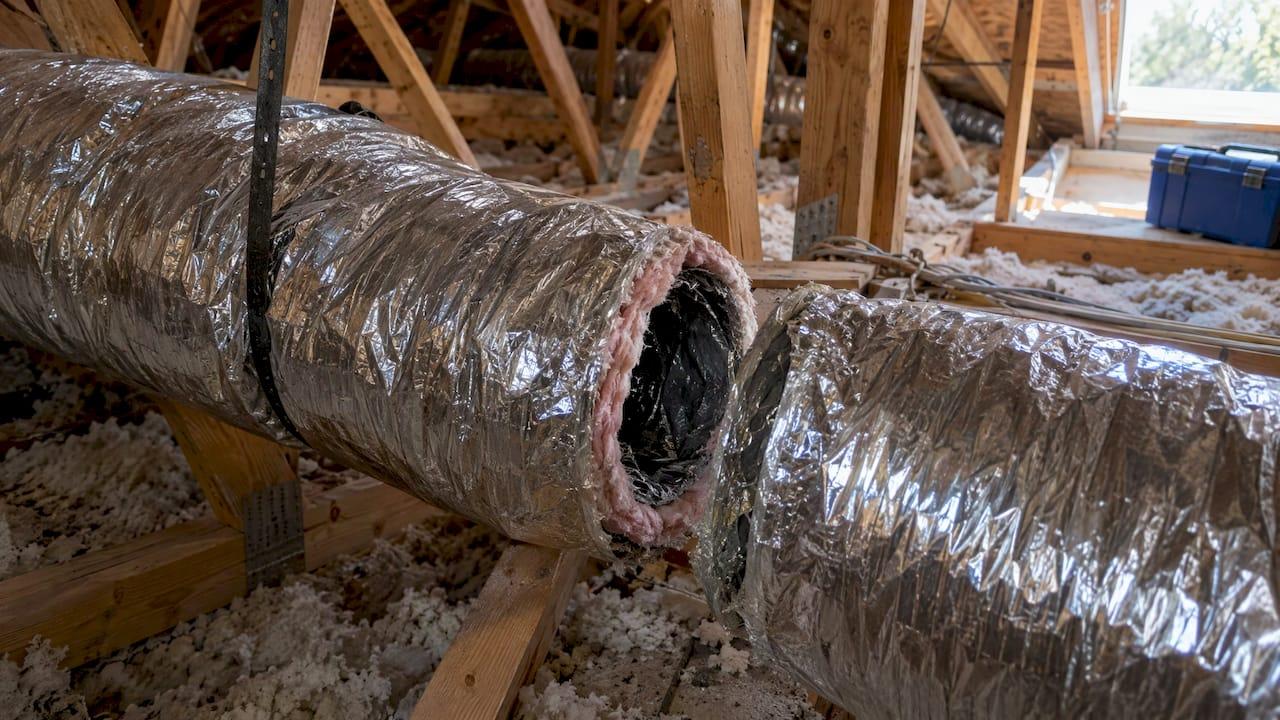
The most common leaky duct symptoms are high energy bills, rooms that never reach the set temperature, dust near the vents, weak airflow, whistling or hissing sounds, and musty odors. Any one of them can have another cause, but two or three together point strongly at the ductwork. In a typical U.S. house, ENERGY STAR reports that 20 to 30 percent of the air moving through the duct system is lost through leaks, holes and poorly connected ducts. If you own a home or manage a property in the Inland Empire, that is cooled air you paid for going into an attic or crawlspace. E320air repairs, maintains and upgrades residential and commercial HVAC systems across the area, and this guide shows what to look for before you call.
TL;DR
- Leaky ducts show up as high bills, hot or cold rooms, dusty vents, weak airflow, whistling sounds and musty smells.
- A typical home loses 20 to 30 percent of its duct air to leaks, according to ENERGY STAR.
- Some symptoms overlap with a dirty filter, a closed damper or a failing system, so a measured test is the only way to confirm a leak.
- Leaks on the return side can pull attic or crawlspace air into the home, which affects air quality.
- If you notice several signs at once, schedule an inspection rather than waiting for the next heat wave.
Table of Contents
- Why duct leaks matter in the first place
- The 8 most common leaky duct symptoms
- Is it a leak or another HVAC problem?
- A 10-minute walk-through you can do safely
- How professionals confirm a leak
- What a proper repair looks like
- Repair or replace?
- Where E320air fits
- Our perspective
- FAQ
- Sources
Why duct leaks matter in the first place
Ducts are the sheet metal or flexible tubes that carry heated and cooled air from your equipment to each room. Supply ducts deliver conditioned air to the registers. Return ducts bring room air back to the system. If either side has a gap, a torn joint or a disconnected section, the system works harder and delivers less.
That is why a duct problem rarely looks like a duct problem. You do not see the hole. You see the result: a bedroom that stays warm, a bill that climbs, a system that runs longer. If you want the basics of how the whole network is built, our guide on what HVAC ductwork is covers it, and why ductwork matters for efficiency and comfort explains the stakes.
The risk is highest where ducts run through unconditioned space. ENERGY STAR names ducts in an attic, crawlspace or garage as a warning sign in themselves, along with tangled or kinked flexible ducts. In Southern California, attic duct runs are common in single-story tract homes and small commercial buildings, so the leak has a long way to waste air.
The 8 most common leaky duct symptoms
1. Energy bills that rise without a reason
The symptom most owners notice first is a bill that is high in both summer and winter even though you have not changed your habits and your utility has not raised its rates. Trane lists this as the first sign of leaking ductwork. The logic is simple: if a fifth or more of the air never reaches a room, the thermostat keeps the system running to make up the difference.
One caution: a bill spike alone does not prove a leak. Rate changes, a hotter month, an aging compressor or a refrigerant problem can all do it. Compare your usage in kilowatt-hours or therms, not just dollars, against the same month last year.
2. Rooms that are always too hot or too cold
Every house has a room or two that is a little off. A leak makes it worse and more consistent. Trane's second sign is rooms that are always hotter or colder than the rest of the house, and ENERGY STAR lists difficult-to-heat or difficult-to-cool rooms among its warning signs as well.
The typical pattern is the room at the far end of a long duct run, or the room over the garage. Air leaks out along the way, so less arrives at the last register. If a room feels fine in the morning and miserable by late afternoon when the attic is hottest, that points to a duct in the attic losing air or picking up heat.
3. Dust that returns quickly
Excess dust is Trane's third sign. Holes, tears or disconnected ducts can let the return system pull dust in from a basement, attic or crawlspace, and dusty return vents are a particular clue. If you wipe surfaces and they are dusty again within days, or the grille on a return looks gray and furry, take note.
Dust also has simpler causes, so look at the filter first. A clogged filter can make a register dusty without any leak. If you change the filter and the dust persists, a leak becomes more likely.
4. Weak airflow at one or more registers
Hold your hand over each register with the system running. You should feel a steady flow of conditioned air. Energy Trust advises turning the system on with all registers open and checking that air comes from each one. A register that is weak or silent while its neighbors are strong often sits downstream of a disconnected or split duct.
Weak airflow can also come from a closed damper, a blocked return, a crushed flexible duct or an undersized run. That overlap is why a measured airflow check beats guessing. Our article on HVAC airflow testing explains what the numbers mean.
5. Whistling, hissing or rattling sounds
Air escaping through a small gap under pressure makes noise, usually a whistle or a hiss while the blower runs. Loose or separated sections can also rattle or thump when the system starts or stops. Pay attention to when the sound appears. If it begins and ends with the blower, the ducts are a suspect. If it continues after the system shuts off, look elsewhere, such as a loose panel or a settling attic.
6. Musty or stale smells
A leaky return can draw air from places you do not want it from: an attic, a crawlspace or a wall cavity. A PG&E technical brief explains that a leaky return duct can draw in outside, stale or polluted air, lowering indoor air quality. A musty smell that comes and goes with the system is worth taking seriously. If you suspect moisture is involved, read about mold in HVAC systems and the first hours of response, and have the system inspected so the source is found.
Our overview of how HVAC improves indoor air quality shows how filtration and ductwork work together, and why a sealed duct system makes the filter more effective.
7. Insulation or debris on the air filter
This one is less known and very specific. Energy Trust notes that insulation stuck to your air filter likely means leaks on the return side of the duct system. If you pull the filter and find fibers, flecks or a coating that looks like attic insulation, the return is pulling it in from somewhere.

8. Combustion and safety concerns near gas appliances
This is the symptom that should move you from "someday" to "this week." PG&E's brief explains that a leaky return duct can pull in combustion air from a gas furnace, clothes dryer, stove or water heater located near it. That can disturb how those appliances vent. If you smell exhaust, see soot near a furnace or water heater, or a carbon monoxide alarm sounds, leave the home and call 911 or your gas utility first, then have the system inspected before using it again.
Is it a leak or another HVAC problem?
Most leaky duct symptoms have a second possible cause. Use this table to separate them quickly.
| Symptom | Could be a duct leak if... | Check first |
|---|---|---|
| High bills | Usage is up year over year and the system runs longer cycles | Rate changes, weather, system age |
| Hot or cold room | The room is far from the equipment or ducts run through the attic | Closed vents, blocked returns, dampers |
| Dusty vents | Dust persists with a fresh filter, especially at returns | Filter condition |
| Weak airflow | One register is weak while others are strong | Crushed flex duct, closed damper |
| Whistling | Sound starts and stops with the blower | Loose panels, undersized grilles |
| Musty smell | It appears when the system runs | Moisture, drain pan, filter |
Two rules help. First, one symptom is a clue, three is a pattern. Second, only a test can confirm a leak and measure its size. Everything else is an educated guess, however good.
A 10-minute walk-through you can do safely
You do not need tools to gather useful information before an inspection. Energy Trust suggests turning on the system with all registers open, looking over any accessible ducts for gaps, tears, disconnections or discolored insulation, and feeling for air escaping at the joints while the system runs. It also suggests marking any suspected spots with a grease pencil or ribbon so they are easy to find again.
Keep it simple and stay safe:
- Change or inspect the filter and note anything unusual on it.
- Walk the house with the system running and compare airflow at every register.
- Note which rooms are off and when, morning or afternoon, summer or winter.
- Look at ducts you can reach without climbing into a hot attic. In summer an attic can be dangerously hot, so leave that to a technician.
- Write down your last three months of usage, not just the bill amount.
Hand that list to the technician. It shortens the diagnosis and points the test at the right part of the house.
How professionals confirm a leak
A technician does not need to find every hole to know how bad the leakage is. PG&E describes the preferred method: a calibrated fan with digital pressure gauges connects at the blower compartment or main return grille, all registers are temporarily sealed, the fan pressurizes the ducts, and the pressure reading converts into a leakage rate in cubic feet per minute (cfm). That gives the leak a number instead of a feeling.
What counts as acceptable? ENERGY STAR's duct specifications set no more than 10 percent or 40 cfm per ton for new ducts, and up to 25 percent leakage for existing ducts. Building codes can be stricter for new work. Our article on the 4 CFM25 duct leakage code limit walks through how testing relates to code in the U.S.
The number matters because it turns a repair into a decision. A small leak at a boot may need a patch. Widespread leakage across old flexible duct may call for a larger upgrade.
What a proper repair looks like
Homeowners often ask whether a roll of tape from the hardware store is enough. It is not. ENERGY STAR says never to use duct tape on ducts because it is not long lasting, and PG&E notes that correct sealing materials carry a UL 181 marking: tape on its outside surface and mastic on the container.
The federal Standard Work Specifications scale the repair to the gap. Mastic alone handles small holes, mesh and mastic handle larger ones, and the biggest leaks need a mechanically fastened rigid patch with mesh and mastic. Another approach is aerosol sealing, where particles are injected into pressurized ducts and build up at leaks until they close. According to the Building America Solution Center, gaps larger than 5/8 inch still have to be sealed by hand.
If insulation around a duct is wet or split, that is its own repair. See our note on repairing dry duct splits and replacing wet insulation. To understand what you gain from the work, read about duct sealing benefits.

Repair or replace?
Repair usually makes sense when the leaks are localized: a few joints, a boot that has pulled loose, a section that was crushed. Replacement or a system upgrade makes sense when the duct material is brittle, undersized for the equipment, repeatedly damaged or routed poorly. Return placement can matter too, and our post on return air location explains the spacing homeowners should look at.
If you are also weighing a new system, the ducts should be evaluated at the same time. A new high-efficiency unit connected to leaking ducts will not deliver what it was designed for. Comparing system types is part of that decision, and a look at forced air heating compared with radiant heat shows what comfort and cost trade-offs come with ducted systems.
Where E320air fits
E320air is a licensed and insured HVAC contractor serving homeowners, landlords, property managers and business owners across the Inland Empire, from Riverside, Corona and Fontana to Hemet, Redlands and Rancho Cucamonga. Our technicians handle residential and commercial repairs, routine maintenance, system upgrades and installations, work on all major brands, and are available around the clock, including weekends and holidays. Flexible payment options, including financing, are available.
If your symptoms match the list above, start with a conversation about what you have noticed. For a heating problem, see our heater repair page. For a new system or a full ductwork upgrade, see HVAC installation. For everything else, the E320air homepage covers residential service and system enhancements.

Property managers with several units can also use our routine maintenance and emergency repair services, which are built for commercial buildings.
Our perspective
Most owners call us about the symptom, never about the duct. They say the back bedroom is hot, or the bill jumped, or the house is dusty. Those are all duct questions in disguise, and the reason is that the ducts are the one part of the system nobody sees.
Our view is that the duct system deserves the same attention as the equipment. A great air conditioner or furnace is only as good as the path that carries its air to the rooms. When we look at a system, we treat the equipment and the ducts as one job, because comfort, efficiency and air quality depend on both.
That is also why we focus on tailored, energy-efficient solutions and on keeping disruption low. You should not have to live through a mess to get a house that cools evenly. If you have two or three of the symptoms above, a visit is a small step that can settle the question.
Edward
FAQ
How do I know if my air ducts are leaking?
Look for several signs together: high bills with no rate change, rooms that are always too hot or cold, dusty vents, weak airflow, whistling sounds and musty smells. A pressurized duct test gives the definitive answer by measuring leakage in cfm.
How much duct leakage is acceptable?
ENERGY STAR's specifications call for no more than 10 percent or 40 cfm per ton for new ducts, and allow up to 25 percent for existing ducts. Local codes for new construction can be tighter, so the right target depends on the job.
Can leaky ducts affect indoor air quality?
Yes. A leaky return can pull air from an attic, crawlspace or the area around gas appliances into your living space. That air can carry dust, odors and other pollutants, which is why dusty returns and musty smells are worth checking.
Is it safe to seal ducts with duct tape?
No. ENERGY STAR advises against duct tape on ducts because it does not last. Proper repairs use mastic or tape marked UL 181, applied to clean, accessible joints.
Sources
- Duct Sealing | ENERGY STAR
- Top 3 Signs Your HVAC Ductwork Is Leaking | Trane
- How to check for leaky air ducts in your home | Energy Trust of Oregon
- Tech Brief, Duct Testing | PG&E
- ENERGY STAR Duct Specifications
- General Duct Sealing | Standard Work Specifications
- Injected Spray Sealant for Existing HVAC Ducts | Building America Solution Center