
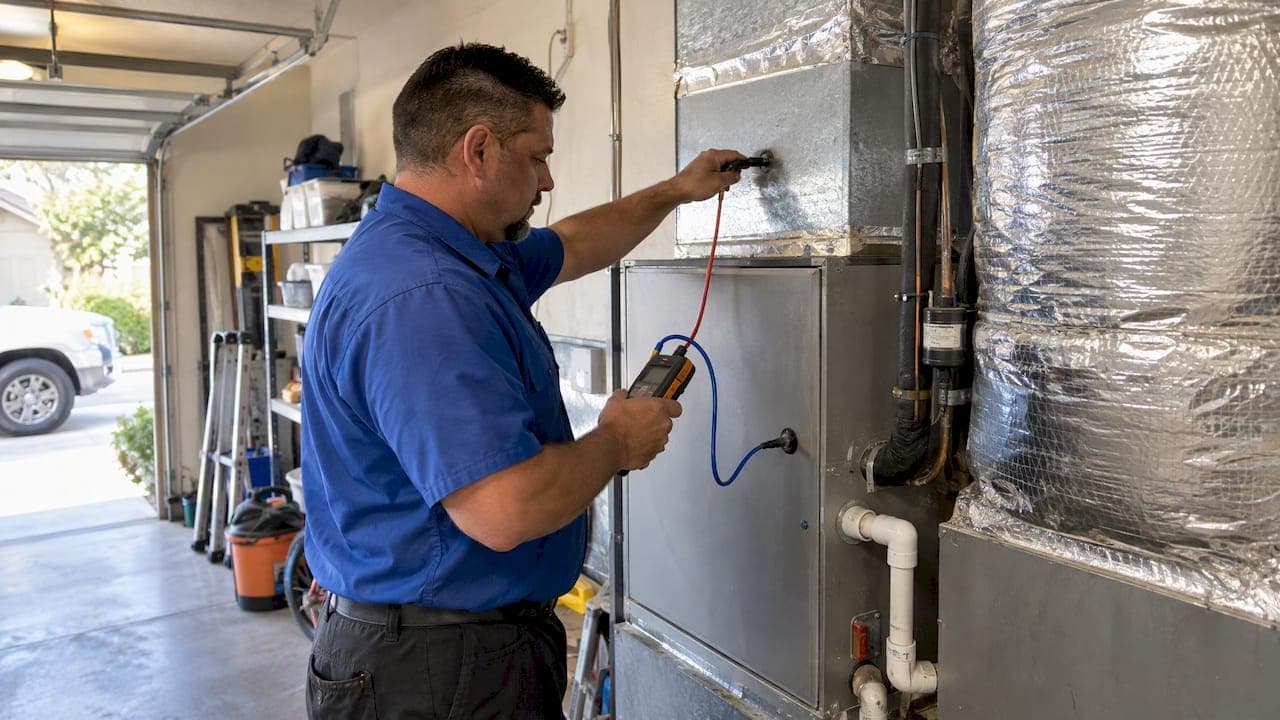
HVAC airflow testing measures how much air your system actually moves and how hard the blower works to move it. The core test is simple: a technician reads static pressure on the return and supply sides, adds the two together, and compares the result to the equipment's blower table. In California, a separate duct leakage test is also required by law in many cases, and it has to be done by a certified rater. Below we explain each test, what a good result looks like, and when a homeowner or property manager in the Inland Empire should call a pro.
TL;DR
- Airflow is verified by measuring total external static pressure (TESP) with a manometer, then checking it against the manufacturer's blower table for the fan speed in use.
- Temperature split alone is a rough check. Direct measurement with calibrated tools is preferred, and a single reading is rarely enough.
- Duct leakage testing is a different test. In California, Title 24 requires it for many system replacements, additions and new construction, performed by a certified HERS rater.
- Weak airflow usually traces to a short list of causes: dirty filters, closed dampers, kinked flex duct, leaky or undersized ducts.
- You can check a filter and your registers yourself. Pressure readings and leakage tests need instruments and training.
Table of Contents
- What HVAC airflow testing actually measures
- Static pressure: the test most techs start with
- Measuring CFM directly
- Duct leakage testing is a separate test
- California and the Inland Empire: what Title 24 adds
- Signs your system needs an airflow test
- What you can check yourself
- What a professional airflow test should include
- Our perspective: measure first, then fix
- Airflow problems in the Inland Empire: get a pro involved
- FAQ
- Sources
What HVAC airflow testing actually measures
People use "airflow test" for three different things, and mixing them up is the main reason homeowners get confused by a service quote.
- Airflow volume (CFM). How many cubic feet of air per minute the system moves across the coil or out of the registers.
- Static pressure. The resistance the blower pushes against, measured in inches of water column (iwc). It tells you whether the ducts, filter and coil let air through freely.
- Duct leakage. How much of the air the blower produces escapes through gaps before it reaches the rooms.
They are connected. High static pressure usually means low airflow. Leaky ducts can hide a system that looks fine at the equipment but delivers little to the bedrooms. If you want the basics of the unit itself, our guide to HVAC airflow and CFM for homeowners covers it.
Static pressure: the test most techs start with
Static pressure is the closest thing to a blood pressure reading for a duct system. ACCA's guidance notes that ACCA Manual D (residential duct design) and ANSI/ACCA 5 (quality installation) call for static pressure measurement to verify that a field-installed system performs as designed. The reading is compared to the maximum rated TESP of the equipment.
How TESP is calculated
Per ACCA's quality installation standard, TESP is the sum of the absolute values of the return static pressure and the supply static pressure. That total is then used with the manufacturer's blower table to find the actual CFM at the fan speed in use.
The standard's example: a return reading of -0.2 iwc plus a supply reading of +0.4 iwc gives a TESP of 0.6 iwc.
The basic steps
- Check the filter and make sure it is clean and the right size.
- Drill small test ports (or use existing ones) in the return and supply plenums.
- Insert the manometer probes and read both sides with the blower running at the speed used for cooling.
- Add the two absolute values to get TESP.
- Look up that TESP on the blower table for the model and fan speed to estimate CFM.
- Compare against the rated maximum and the target airflow for the system's size.
The HVAC School session on airflow testing makes a point worth repeating: manufacturer charts assume ideal conditions such as long straight duct runs, which rarely exist in cramped residential attics and closets. So the table is a starting point, and a good tech confirms the result with other readings instead of trusting one number.
What a result tells you
A TESP well above the equipment's rating means the blower is fighting restriction. A federal duct retrofit decision guide describes TESP as a key health indicator for ducted systems and recommends a manometer to test it. Common causes of high readings include closed dampers, kinked flex duct, a clogged filter or coil, and a duct design that was too small from the start.
Measuring CFM directly
Static pressure plus a blower table gives an estimate. Direct measurement gives a number you can check.
Flow hoods and flow grids
A flow hood (balometer) sits over a register and captures all the air coming out. A flow grid, such as a TrueFlow grid, replaces the filter and measures air entering the system. The Building America measure guideline on air conditioner diagnostics lists these as direct measurement methods, alongside velocity devices. It also reports that basic balometers can be off by 20 to 30 percent, while powered flow hoods and specialized grids are significantly more accurate.

Anemometers
An anemometer measures air speed. To turn that into CFM you multiply by the area of the opening. The catch is that speed varies across a register face or duct cross section. Accurate use means taking several readings and averaging them, as the same guideline explains. This is why a quick wave of a handheld anemometer in front of a vent is a poor diagnostic, however many videos make it look easy.
Temperature split
The difference between return and supply air temperature is a common quick check. The same federal guideline treats direct measurement with calibrated devices as the preferred method, and says the industry is moving away from relying only on manufacturer charts because field-installed systems vary so much from lab conditions. Think of temperature split as a screening tool that tells a technician where to dig.
Rule of thumb: 400 CFM per ton
California's compliance documents use a nominal air handler airflow of 400 CFM per rated ton of cooling capacity, per the Energy Commission's duct leakage procedure. A 3-ton system, for example, is expected to move roughly 1,200 CFM. If your measured airflow is far below that, something is wrong with the ducts, filter, coil or blower.
| Method | What it measures | Good for | Watch out for |
|---|---|---|---|
| Manometer (TESP) | Pressure the blower works against | Finding restriction, checking against the blower table | Charts assume ideal duct runs |
| Flow hood | Air leaving one register | Room-by-room balancing | Basic units can be off 20 to 30% |
| Flow grid | Total system airflow | Verifying whole-system CFM | Needs filter slot access and proper setup |
| Anemometer | Air speed | Duct traverses, spot checks | Needs multiple readings averaged |
| Temperature split | Heat removed or added | Quick screening | Not a direct airflow measurement |
Duct leakage testing is a separate test
A system can have healthy static pressure and still lose a lot of conditioned air through gaps. The U.S. Department of Energy's training module states that on average about 25 percent of air is lost through leaks in duct systems, which can mean a 20 to 30 percent increase in heating and cooling energy costs for the average home. It also stresses sealing accessible leaks before testing.
That is why we point homeowners to our pages on duct sealing benefits and how to prevent HVAC leaks. Sealing is cheap compared with years of paying to condition an attic.
Damage from outside can also open ducts and equipment to the weather. If a storm has hit your property, this overview of how hail damages HVAC units is useful when you are documenting damage for an insurance claim.
How leakage is tested
The typical method uses a duct blower (often called a duct blaster) to pressurize the duct system and measure how much air it takes to hold that pressure. According to the Energy Commission's procedure, simply looking for loose tape is not enough: technicians follow a set protocol, which often involves a blower door and duct tester, to verify leakage against a target rate.
Leakage standards versus leakage limits
ASHRAE's handbook chapter on duct construction recommends that supply, return and exhaust systems be tested for leakage at operating conditions. Test methods give repeatable measurements, but the maximum allowed leakage is set by designers and local codes. So the answer to "what is a passing number?" depends on your project and jurisdiction.
ACCA's quality installation standard, from the same ACCA document, sets total leakage tolerances of 10 percent for new homes with ducts in conditioned space and 6 percent for ducts in unconditioned space. For existing homes it asks for 20 percent total leakage or a 50 percent reduction in existing leakage.

California and the Inland Empire: what Title 24 adds
If you own property in Riverside, San Bernardino, Fontana, Corona, Hemet or anywhere else in the region, the state's energy code applies. Residential duct leakage testing in California is a regulated HERS (Home Energy Rating System) procedure, particularly for new construction, system replacements and additions. Per the Energy Commission, the test must be verified by a certified HERS rater. The same document gives compliance targets of 15 percent leakage or less for an existing duct system and 6 percent or less for new systems. If a system fails, a smoke test may be used to confirm that all accessible leaks have been sealed.
What this means in practice:
- Replacing an AC or furnace with ducts? Expect a permit and a duct test as part of the job, not an optional extra.
- Failed the test? The fix is usually sealing and repair, then retesting.
- Selling or buying? Ask whether the last system change was permitted and tested.
The rules are detailed, and we cover them in California Title 24 HVAC requirements and in our piece on meeting the 4 CFM25 duct leakage code limit. Confirm the specifics for your project with your local building department, since requirements depend on the type of work.
Signs your system needs an airflow test
You do not need to test a system that works well. Call someone when you notice:
- One room is always hotter or colder than the rest.
- Registers feel weak, or the system runs nearly nonstop on hot Inland Empire afternoons.
- Energy bills climb with no change in how you use the house.
- The evaporator coil ices up or the furnace shuts off on its limit switch.
- The system is noisy, with whistling at the registers or rumbling at the return.
- A new system was installed and nobody measured airflow or tested the ducts.
Our article on why ductwork matters for efficiency and comfort explains why the ducts are often the real problem, and how HVAC design affects comfort covers sizing and layout.
What you can check yourself
You are not going to perform a TESP test with a screwdriver, but a few checks cost nothing:
- Filter. Hold it up to light. If you cannot see through it, replace it. A higher-rated filter that is too restrictive can raise static pressure.
- Registers and returns. Make sure furniture, rugs and closed vanes are not blocking them.
- Visible ducts. In an accessible attic or crawlspace, look for crushed or kinked flex duct, disconnected joints and torn insulation. If you find wet or split insulation, read how to repair dry duct splits and replace wet insulation.
- Outdoor unit. Clear leaves and debris from around the condenser.
Stay out of electrical panels and do not open the blower compartment while the system is powered. Anything involving refrigerant, wiring or drilling into the plenum belongs to a licensed contractor.
What a professional airflow test should include
When you hire for this, ask what will be measured and what you will receive. A thorough visit usually covers:
- Filter and coil inspection before any readings.
- Return and supply static pressure, with TESP calculated and compared to the equipment rating.
- Airflow estimated from the blower table and, where possible, confirmed with a direct method such as a flow hood or grid.
- Duct inspection for leaks, restrictions and damaged insulation.
- A written summary of readings and the recommended fixes, in order of impact.
- Duct leakage testing by a certified HERS rater where the work is covered by Title 24.
If the airflow is uneven between rooms rather than low overall, the next step is balancing. We walk through that in our practical airflow balancing workflow, and a short professional check can also reveal hidden losses, as described in our post on 30 minute HVAC checks.
Our perspective: measure first, then fix
The most common mistake we see in the field is treating a comfort complaint as an equipment problem. A homeowner is told the system is too small, or that it needs replacing, when nobody has measured static pressure or looked at the ducts. Sometimes the equipment is the issue. Often it is a restrictive return, a crushed run of flex duct, or leaks in an attic that gets very hot in summer.
So our approach is to measure before recommending. Readings tell us whether a repair, a duct fix or a system upgrade makes sense, and they let you see why we are suggesting it. We work on all major brands, and we would rather show you a pressure reading than ask you to take our word for it.
For property managers and business owners, the same logic holds across rooftop units and larger systems: confirm airflow, then decide. It keeps repair budgets spent where they will change comfort and energy use.
— Edward
Airflow problems in the Inland Empire: get a pro involved
E320air is a licensed and insured HVAC contractor serving homeowners, landlords, property managers and business owners across the Inland Empire, from Corona and Riverside to Rancho Cucamonga, Redlands and Hemet. We handle repairs, maintenance, equipment sales, upgrades and installations, with flexible payment options including financing, and service is available around the clock, including weekends and holidays.
If your system is not moving the air it should, start with our residential HVAC services. Planning a replacement and want it set up right from the start? See HVAC installation. For offices, shops and rental properties, our commercial HVAC page covers maintenance and emergency repair.
FAQ
How do you check airflow on a furnace?
Start with the filter, then have a technician measure return and supply static pressure with a manometer and compare TESP to the furnace's blower table at the fan speed in use. Temperature rise across the furnace is also checked against the nameplate range. If the furnace is cycling off on its high limit or heating unevenly, call a licensed technician rather than opening the cabinet yourself. Our heater repair service covers this.
How many CFM is a typical system supposed to move?
California's compliance procedure uses a nominal 400 CFM per rated ton of cooling. A 2-ton system would be about 800 CFM and a 4-ton about 1,600 CFM. Actual targets depend on the equipment and the design, so the installer's documentation matters.
How do you test for duct leaks?
A technician seals the registers, connects a duct blower to the system, pressurizes the ducts and measures how much air is needed to hold that pressure. In California, official compliance tests for many projects must be verified by a certified HERS rater. A smoke test can help confirm that accessible leaks are sealed.
What is the difference between static pressure and CFM?
CFM is the volume of air moving through the system. Static pressure is the resistance that air meets. High static pressure generally means the blower cannot deliver its rated CFM, which is why technicians measure pressure to learn about airflow.
Can I use an anemometer to test my own HVAC airflow?
You can get a rough number, but accuracy is limited. Air speed varies across a register or duct, so you need several readings averaged and a correct measurement of the opening area. For decisions about repairs or replacement, a professional test with calibrated tools is more reliable.
Sources
- ACCA quality installation standard (TESP, duct leakage tolerances)
- ACCA HVAC Blog: static pressure measurement
- HVAC School: All About Airflow Testing
- Duct retrofit decision guide (TESP and manometer)
- Building America measure guideline: air conditioner diagnostics
- DOE training module: HVAC duct leakage testing
- California Energy Commission: duct leakage procedure NRCV-MCH-04c
- ASHRAE Handbook: duct construction