
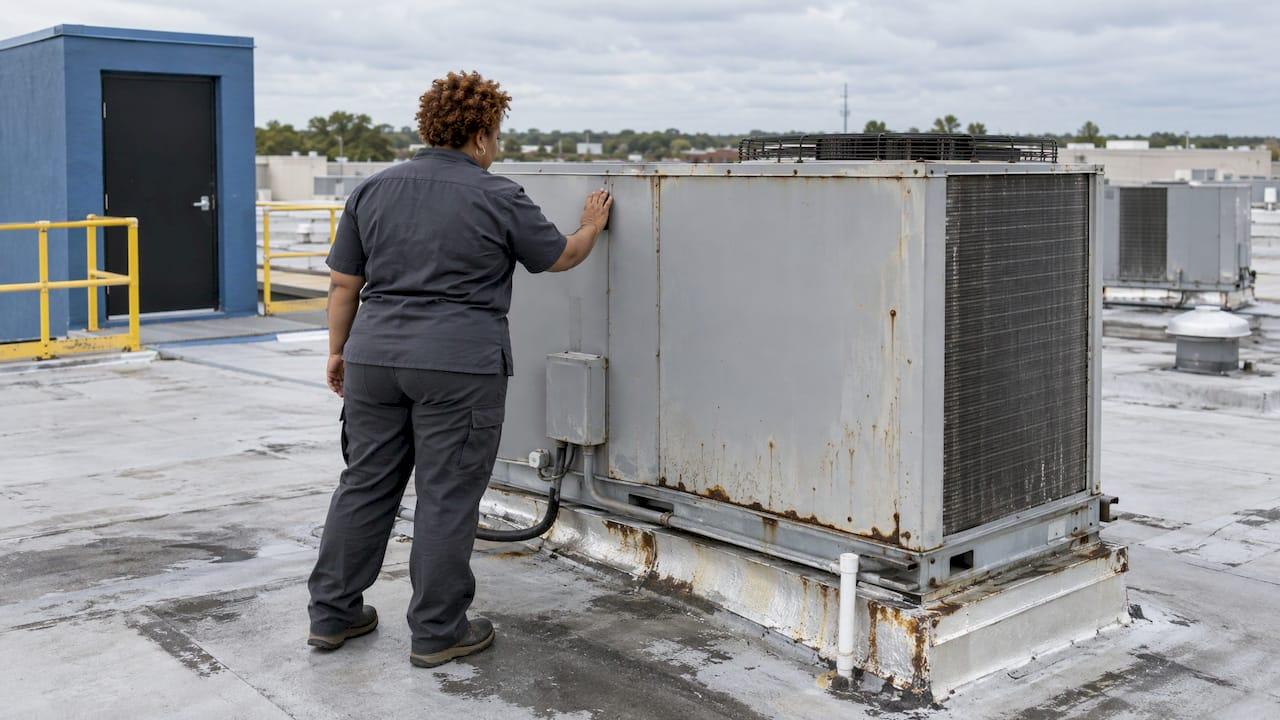
The best RTU replacements are planned months before the old unit fails. Start with an inventory and a field evaluation, size the new unit from the building's real loads, confirm the curb, roof, power and gas, and pull the permit with California's acceptance-testing paperwork in hand. Then schedule the crane and the shutdown window. If you work in this order, the replacement is a scheduled capital project. If you wait for a breakdown, it becomes an emergency purchase. We are E320air, an Inland Empire HVAC contractor, and our commercial team handles commercial rooftop HVAC for owners and property managers across the region.
TL;DR
- Build an RTU inventory first, then evaluate each unit in the field. Replace the ones that are failing, undersized, or too costly to keep repairing.
- Find the root cause of any early failure before ordering. Oversizing, poor airflow, low voltage and bad drainage will hurt the new unit too.
- Size from loads, ventilation and ductwork, never from the nameplate of the old unit alone. Check the curb, roof structure, electrical capacity and gas supply.
- In California, permits for commercial rooftop replacements now involve Title 24 acceptance testing by certified technicians. Build that time into your schedule.
- Budget for more than the unit: crane, curb work, electrical, permits, startup and testing.
Table of Contents
- When to replace a rooftop unit instead of repairing it
- Start with an inventory and a field evaluation
- Size and select the replacement from the building's loads
- Check the curb, roof and utilities before you order
- What an RTU replacement budget should include
- California permits, Title 24 and acceptance testing
- Timeline: from first walk to commissioning
- Our perspective
- How E320air can help
- FAQ
- Sources
When to replace a rooftop unit instead of repairing it
Replace when repair bills, comfort complaints and energy use all point the same way. Age alone should not decide it. A unit in good shape can run past its expected life, and a neglected one can fail early.
These signals, taken together, make the case for replacement:
- Repeat failures. Compressor, heat exchanger or control failures that return within a season or two.
- Refrigerant or heat exchanger problems. These are the repairs that tend to cost the most relative to the value of an older unit.
- Comfort complaints. Tenants report hot or cold zones that service calls have not fixed.
- Rising utility bills with no change in occupancy or schedule.
- Parts that are hard to find for an older model.
Before you decide, read our guide to commercial rooftop AC failures, which covers causes and checks that separate a repairable fault from an end-of-life unit. If the unit is also being cycled hard, the short cycling guide explains why that matters for both the old unit and its replacement.
In the Inland Empire, rooftop units run long cooling seasons with high roof temperatures. Units here accumulate runtime quickly, so maintenance history carries as much weight as the calendar year on the nameplate. A rooftop unit maintenance checklist with measurable readings gives you the records to make this call with data.
Start with an inventory and a field evaluation
The U.S. Department of Energy's Better Buildings program lays out a seven-step RTU evaluation methodology: RTU inventory, preliminary screening, field evaluation, energy and economic analysis, project planning, procurement, and measurement and verification. It is a sound backbone for any owner with more than one rooftop unit, and it works for a single building too.

What the inventory should record
For each unit, capture:
- Manufacturer, model and serial number, plus install year
- Nominal tonnage and heating type (gas, electric, heat pump)
- Area served and the tenant or process it supports
- Service history and the cost of the last three years of repairs
- Roof curb type and condition, and visible roof condition around it
- Known complaints, such as hot spots, noise, or leaks
What the field evaluation should confirm
A technician on the roof checks what a spreadsheet cannot: corrosion, coil condition, refrigerant circuit condition, electrical connections, drainage, and how the unit is physically mounted. HVAC Engineering Canada recommends measuring existing supply airflow, outdoor airflow and external static pressure before the old unit is removed. That tells you whether the duct system can carry the design airflow for the new unit and what fan the new unit needs. Our explainer on HVAC airflow testing shows what those numbers mean.
The same source cautions that when a unit fails early, the cause will affect the next unit too. Short cycling from oversizing, poor airflow, low voltage and bad drainage are the usual suspects. Identify the cause before you buy, or you are paying to repeat the problem.
Size and select the replacement from the building's loads
Do not order "the same tonnage as before." The building has probably changed since the old unit went in: new tenants, a different occupancy, added equipment, better windows or a reroof.
A sound selection process, as laid out in the HVAC Engineering Canada guide, covers these points:
- Review current use and occupancy.
- Calculate or estimate cooling and heating loads and compare them with the old unit's capacity and the complaints on file.
- Confirm ventilation requirements under ASHRAE 62.1 or the code-referenced standard.
- Check economizer requirements.
- Verify curb dimensions, roof structure, electrical capacity and gas supply.
The DOE's Advanced RTU Campaign decision tree adds financial questions. Is the unit properly sized? Can the replacement be combined with other efficiency measures? Do predicted savings and return on investment meet your requirements before you proceed?
Efficiency, economizers and controls
A replacement is the cheapest moment to improve a rooftop system, because the crane and labor are already booked. Look at higher-efficiency equipment, better controls and a properly functioning economizer. Our pages on HVAC economizer benefits and efficiency upgrades that pay back fastest explain which options tend to matter most for commercial buildings.
Oversizing is a real risk
A bigger unit is not a safer unit. An oversized RTU satisfies the thermostat quickly, shuts off, and cycles often. That wears out components and can leave humidity and comfort problems behind. A load-based selection avoids it.
Check the curb, roof and utilities before you order
The physical fit decides whether crane day goes smoothly. Even units with similar capacities can have different footprints, supply and return openings and weights. Catching a mismatch on paper costs far less than catching it on the roof.
Before the order is placed, confirm:
- Curb dimensions and condition. Roof curbs carry the equipment's full dead and live loads and transfer wind and seismic forces to the structural deck. If the new unit's footprint does not match the old curb, an adapter curb is the usual solution and can preserve the existing roof membrane termination.
- Supply and return opening locations against the new unit's duct connections.
- Operating weight of the new unit against the roof structure. Newer high-efficiency units can weigh more than the models they replace, so have a structural engineer or roofing contractor confirm adequacy when the difference is meaningful.
- Electrical capacity: voltage, phase, disconnect and breaker size.
- Gas supply: line size and pressure for gas heat.
- Submittals. Review the manufacturer's submittal early for dimensions, airflow configuration, weight and utility requirements.
Crane, access and safety
Rooftop replacements run on logistics. Plan the crane date, the street or parking staging area, the route for the old unit out and the new unit in, and a building shutdown window that suits tenants. Weather matters too: wind can stop a lift.
Overhead power lines are a hard constraint. Federal rules for cranes, including OSHA's standard 1926.1408, set required clearances from energized lines. Walk the site for lines before a crane is scheduled.
What an RTU replacement budget should include
The unit is only one line. A realistic commercial budget includes:
| Cost line | What it covers |
|---|---|
| Equipment | The RTU itself, with any ordered options such as economizer or controls |
| Curb work | Adapter curb or curb repair, and roof penetration repair |
| Crane and rigging | Crane time, staging and the lift crew |
| Electrical and gas | Disconnects, wiring, gas line modifications |
| Ductwork | Transitions and connections to existing ducts |
| Permits and testing | Permit fees, plan review, acceptance testing |
| Startup | Commissioning, airflow and controls checks |
| Contingency | Hidden conditions found once the old unit is out |
Per-ton prices move with equipment, scope and season, so our rooftop unit replacement cost guide walks through per-ton ranges and a worked 5-ton example. Treat any figure you see online as a starting point and ask for a written scope that lists each line above.
Two budget habits save money. First, replace on your schedule: an emergency replacement removes your chance to compare options and compress the timeline. Second, price the lifetime of the unit, including energy and maintenance, not only the purchase.
California permits, Title 24 and acceptance testing
California owners face a layer of requirements that out-of-state guides skip. Here is what the sources show.
- The California Energy Commission's 2025 NRCC-MCH-E form requires a declaration of the certificates of acceptance a project needs. These include outdoor air testing for newly installed HVAC units, testing of economizer and related ventilation controls, and fault detection and diagnostics for packaged direct expansion units. Forms marked "-A" are completed through an Acceptance Test Technician Certification Provider.
- The 2025 Title 24 energy standards took effect January 1, 2026. Reporting on the code says end-of-life rooftop units of a certain size in most retail, school and office buildings are to be replaced with high-efficiency systems, including heat pumps.
- For permit applications submitted from January 1, 2026, acceptance testing must be performed by certified Acceptance Test Technicians for commercial rooftop replacements.
- Plan checkers in some large California jurisdictions have been flagging non-compliant applications, and contractors there have reported two-to-four-week review delays.
What this means for your plan: confirm which requirements apply to your building type and unit size with your local building department before you finalize equipment. Choosing a gas/electric unit when the code points to a heat pump can mean a rejected permit and a redo. Our Title 24 HVAC requirements overview explains the basics in plain language.
Timeline: from first walk to commissioning
There is no single schedule, because lead time depends on the equipment, the permit office and the building. The sequence is reliable, though:
- Assessment and inventory. Walk the roof, collect records, and measure airflow.
- Selection and scope. Size from loads, check code, and confirm curb and utilities.
- Budget approval. Share a line-item scope with ownership.
- Order and submittals. Order equipment and review submittals for fit. Ask for the current lead time at ordering, since it changes with supply conditions.
- Permit. Submit with the Title 24 forms. Allow for plan review.
- Crane day and installation. Shut down, lift, set, connect.
- Startup, testing and commissioning. Verify operation and complete acceptance documents.
- Follow-up. Confirm the results over the next weeks, in line with the measurement and verification step in the DOE method.
The longest items are usually equipment lead time and permit review, which is why planning ahead pays off. Our overview of the stages of HVAC replacement shows the same flow from the comfort side.
Startup and commissioning checks
After the unit is set and connected, expect these checks and ask for them in writing:
- Electrical connections, voltage and rotation of fans and compressors
- Supply, return and outdoor airflow against the design values
- Economizer operation and outdoor air control
- Refrigerant circuit and heating operation
- Condensate drainage
- Controls and thermostat or building automation programming
- Required California acceptance test certificates, completed by a certified technician where the form requires it
Our perspective
Most rooftop replacements we hear about go wrong before the crane arrives. The unit was ordered off a nameplate, the curb did not match, or nobody asked why the last one died early.
We think the plan matters more than the box. Measure the airflow, understand the loads, and settle the permit path before anything is ordered. That is how a commercial building gets a system that fits and a schedule that holds.
Our technicians are licensed and insured, and we work across all major brands, so the recommendation can follow the building rather than a product line. We also focus on tailored, energy-efficient solutions with minimal disruption to the people working below the roof.
Edward
How E320air can help
If you manage a commercial property in the Inland Empire, our commercial HVAC team handles repairs, routine maintenance, emergency repairs and new equipment. Service is available around the clock, including weekends and holidays, and we offer flexible payment options, including financing. For replacement and new equipment work, see our HVAC installation page.

We serve Riverside, San Bernardino, Moreno Valley, Fontana, Ontario, Corona and surrounding communities. Contact us to schedule a rooftop evaluation before the next failure schedules one for you.
FAQ
How early should I start planning an RTU replacement?
Start as soon as a unit shows repeat failures or reaches the later part of its expected life, ideally before the cooling season. Equipment lead time, permit review and crane scheduling all take time. Starting early lets you replace on your terms instead of during a breakdown.
Can I reuse my existing roof curb?
Sometimes. It depends on whether the new unit's footprint, opening locations and weight match what the curb and roof were built for. When they do not, an adapter curb can bridge the difference. Confirm this from the manufacturer's submittal before ordering.
Do I need a permit to replace a rooftop unit in California?
Commercial rooftop replacements generally go through the local building department, and California's energy code adds acceptance testing requirements. Check with your city or county for the exact submittal list, and have your contractor prepare the Title 24 forms with the application.
Should I replace all my rooftop units at once?
Not necessarily. A staged plan that replaces the worst units first, based on your inventory and field evaluation, spreads the cost and keeps the building running. Grouping nearby units into one crane mobilization can reduce logistics costs.
Sources
- RTU Evaluation Methodology, U.S. Department of Energy Better Buildings
- Advanced RTU Campaign decision tree, U.S. Department of Energy
- Replacing rooftop units: what to check first, HVAC Engineering
- OSHA standard 1926.1408, power line safety for cranes
- 2025 NRCC-MCH-E Mechanical Systems, California Energy Commission
- California's 2025 Title 24 Code Takes Effect, ServiceMag
- California Tightens HVACR Rules in 2026 Energy Code, HVAC Insider