
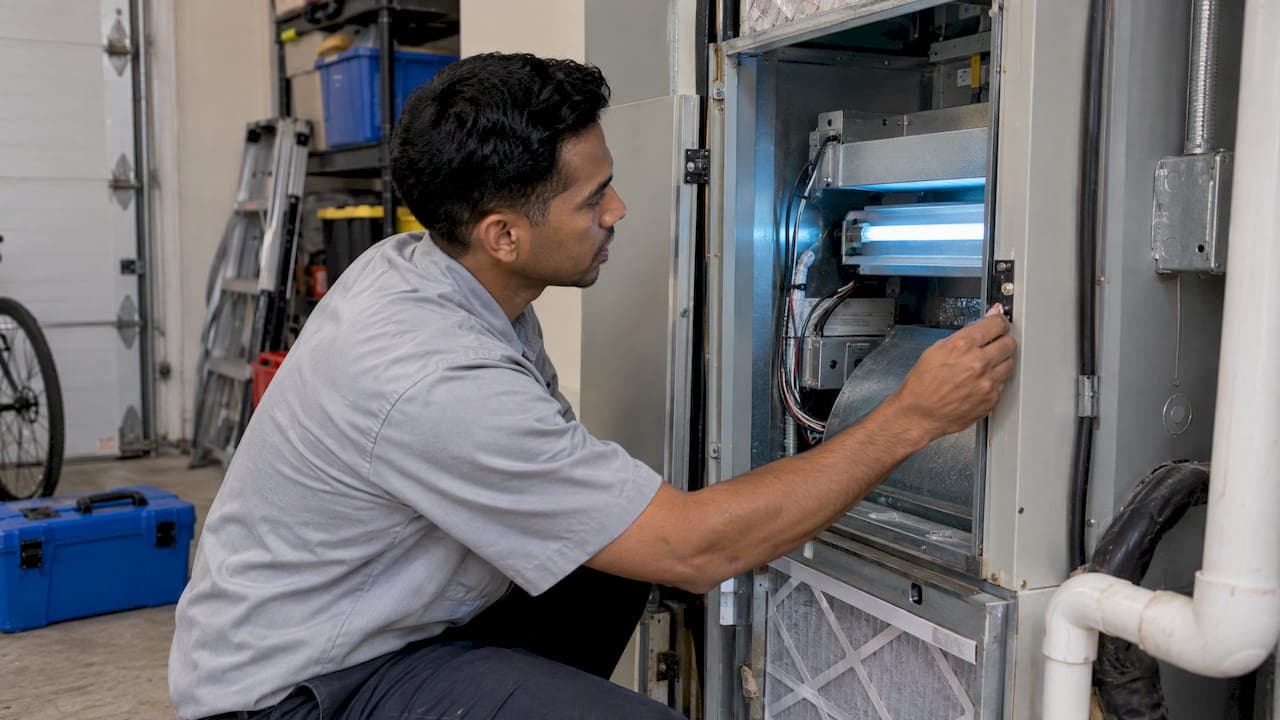
A UV air purifier is safe when the UV-C light stays sealed inside the equipment, the lamp does not make ozone, and the unit is maintained with the power off. Problems come from poor containment, uncertified consumer devices and ozone-producing designs. This guide explains each risk in plain terms and gives you a checklist to use before you buy, install or service one in your Inland Empire home or building.
TL;DR
- UV-C light can injure skin and eyes, so a safe unit fully encloses the lamp and shuts it off when anyone opens the housing.
- Some UV lamps and coatings can emit ozone and other byproducts. The EPA says ozone generators should never be used in occupied spaces.
- UV works best on microbes growing on moist HVAC surfaces, and it does little against spores. Treat it as a supplement to filtration, not a replacement.
- Look for full safety certification, follow the manufacturer's maintenance steps, and always power the unit down before touching the lamp.
- For whole-home systems, a licensed technician installing the lamp inside the ductwork keeps the light away from your family and pets.
Table of Contents
- What UV means on an air purifier
- Is UV-C light safe around people and pets?
- Ozone and other byproducts
- How well does UV-C actually work?
- A buyer's checklist for UV air purifier safety
- Maintaining a UV unit safely
- Inland Empire considerations
- Our perspective
- Plan your air quality upgrade with E320air
- FAQ
- Sources
What UV means on an air purifier
UV stands for ultraviolet, a band of light just beyond what the eye can see. The part used for cleaning air is UV-C, the short-wave germicidal band. The U.S. EPA describes it as roughly 100 to 280 nanometers, and notes that many residential mercury lamps emit mostly at 254 nanometers, according to its Residential Air Cleaners technical summary.
The idea is simple. When microorganisms such as bacteria, viruses and mold pass through or sit in front of UV-C light, the light damages their genetic material so they can no longer reproduce. The CDC makes a similar point about germicidal ultraviolet in rooms: viral particles can remain in the air after UV kills them, but they are no longer infectious, as explained on its germicidal ultraviolet page.
The same properties that make UV-C useful against microbes are why safety matters. Light strong enough to disrupt microbial DNA is not something you want shining on people. If you want the mechanics of how these systems are built into ducts and air handlers, our guide on how UV air purifiers work in HVAC goes deeper.

Is UV-C light safe around people and pets?
UV-C is safe around people and pets when it is completely contained. The risk is direct exposure. A poorly installed, damaged or tampered-with unit that is switched on can expose skin and eyes, which is why the design of the housing matters more than the brand name on the box.
UL, the product safety organization, is direct about consumer devices. Its consumer sheet on UVC germicidal devices says consumers currently have no assurance against overexposure from devices lacking proper containment, and it recommends against buying products that do not carry full safety certification.
UL also makes a point that matters in family homes: children and pets cannot be expected to follow written warnings, so warning labels and behavior rules alone are not a reasonable safeguard in consumer settings. The protection has to be built into the hardware.
What good containment looks like
UL gives one clear example of an adequate safety measure: an interlock switch that disables the device when the UV-C lamp is accessed. In practice, a well-designed unit has these traits:
- The lamp sits inside a closed housing or inside the duct, with no gaps or vents that let light out.
- An interlock cuts power when a panel, door or access cover is opened.
- The unit has been tested and certified for safety by a recognized testing body.
- There is no way to see the lamp in normal operation.
This is one reason in-duct and air-handler installations are a different proposition from a loose portable gadget. The lamp lives inside metal ductwork, away from rooms, kids and pets.
The blue glow question
People often ask about a visible blue light coming through the grille of a portable purifier. Some units use blue LEDs or indicator lights that are not UV-C at all, and UV-C itself is invisible. A visible glow does not tell you whether UV is escaping. The only reliable answers are the manufacturer's documentation and the unit's safety certification. If you cannot confirm what the light is, switch the unit off and ask the manufacturer or a licensed HVAC technician.
Ozone and other byproducts
The second safety factor is chemistry. Some UV-based devices make ozone, a lung irritant, and some create other compounds you did not ask for.
Here is what the EPA says:
- Electronic air cleaners that use UV bulbs or titanium dioxide surface coatings can emit ozone and, in some cases, volatile organic chemicals, according to the EPA's Indoor Air Filtration fact sheet.
- The same fact sheet says ozone generators produce large amounts of ozone and should never be used in homes or other occupied spaces.
- Uncoated UVGI lamps can generate high amounts of ozone, described in the EPA's technical summary as a well-documented lung irritant.
- Ozone reacts with chemicals from common indoor sources and can form formaldehyde, ultrafine particles, ketones and organic acids, per the EPA's Residential Air Cleaners summary.
- At concentrations below public health standards, ozone has little potential to remove indoor air contaminants, so there is no good reason to tolerate it.
Lamp type is a big part of this. Lamps that emit shorter wavelengths can split oxygen molecules and create ozone. A 2026 modeling study in PubMed Central found that, at a specific fluence rate, air-pollution health risks from germicidal UV were at least about 20 times higher below 242 nm than above it, mainly because of ozone production. The same study concludes that no single wavelength is best across exposure limits, disinfection, indoor air pollution and practical requirements, so trade-offs have to be weighed.
Other byproducts exist too. A 2024 publication from the National Institute of Standards and Technology reported that tested germicidal UV cleaners produced aldehyde byproducts at 243 µg per hour, and that both 222 nm and 254 nm UV produced ultrafine particles. Findings like these are why it pays to choose equipment designed and certified to limit byproducts, and to place UV where it treats a surface or an airstream rather than the air you breathe in a closed room.
How to avoid ozone problems
- Choose a unit that states it is ozone-free and ask for the test or certification behind that statement.
- Never buy an ozone generator marketed as an air cleaner for an occupied space.
- Keep spaces ventilated and keep your filtration up to date, since filtration remains the foundation of clean air.
- If you smell a sharp, bleach-like odor near a unit, turn it off and have it inspected.
If anyone in your home has asthma or another respiratory condition, talk with their doctor about air quality choices, and see our guide to asthma-friendly HVAC for the setup side.
How well does UV-C actually work?
Safety is only worth the trouble if the device does something useful. Here the honest answer is: it depends on where the UV is installed and what you want it to do.
The EPA says properly designed UV germicidal irradiation may destroy viruses, bacteria and some molds growing on moist HVAC surfaces, but typical home units have limited effectiveness. Killing some viruses and most mold and bacterial spores usually takes much higher exposure, and dead mold spores can still trigger allergic reactions, according to the EPA's page on whether UV lamps kill mold.
The EPA's technical summary adds that airstream UV may reduce viable vegetative bacteria and molds and give low-to-moderate virus reductions, with little or no reduction in spores, because spores resist UV and need high dose and long exposure. It also explains why: microorganisms pass a lamp in a fraction of a second, while dose depends on lamp power, airflow, temperature, humidity and the geometry of the system. Microbial growth on a coil surface gets far longer exposure than a particle flying past.
A peer-reviewed study in PubMed tested two air cleaners with an internal UV-C lamp. The lamp added no overall air-cleaning performance, but it did inactivate 75% of captured fungal spores and 97% of captured bacterial cells after 60 minutes under the study conditions. That points to a sensible way to think about UV: it is strongest at treating what a filter or coil has already captured.
The CDC frames germicidal UV as a supplemental ventilation measure, one that does not replace code requirements for outdoor-air delivery or filtration. That is the right mental model for your home too.
| Where UV is used | What it targets | Main safety consideration |
|---|---|---|
| In-duct or air-handler lamp | Microbial growth on moist coil and drain pan surfaces, and some airstream microbes | Lamp sealed inside metal ductwork, interlock on access panels |
| Portable room purifier with UV stage | Captured particles and some airborne microbes | Containment, certification, ozone and byproduct output |
| Ozone generator | Marketed as odor and germ removal | Not appropriate for occupied spaces, per the EPA |
A buyer's checklist for UV air purifier safety
Use these questions before you buy or approve an installation. They apply to a home, a rental property you manage, or a small business.
- Is the unit fully certified for safety? Look for documented certification from a recognized testing organization, as UL recommends.
- Where does the UV light go? The lamp should be enclosed, with an interlock that cuts power when the housing is opened.
- Is it ozone-free? Ask for the wording in the specifications and the standard it was tested against.
- What wavelength does the lamp use? Different wavelengths carry different trade-offs for ozone and byproducts, as the research above shows.
- What does it replace and what does it add? UV should sit alongside a properly sized, well-fitted filter. Our HVAC filter essentials guide explains how to choose one.
- Who installs and services it? A licensed, insured technician can place the lamp correctly for your equipment and airflow.
- What does maintenance involve? Ask how often the lamp needs replacing and how to service it safely.
Wondering how UV compares to other upgrades? Our roundup of top HVAC air quality improvements puts it in context, and the whole house air purifier cost guide covers budgeting.
Maintaining a UV unit safely
Most injuries and surprises with UV equipment happen during service, not during normal operation. A few habits keep it safe.
- Power down first. Turn the unit off, and where possible disconnect power, before opening any access panel or touching the lamp. Do not bypass an interlock.
- Follow the manufacturer's guidelines. The EPA's summary lists checking manufacturer guidance and making sure the device is certified safe as basic steps before using or maintaining a unit.
- Keep the lamp clean and current. Dust on a lamp reduces its output, and UV-C lamps lose strength over time, so they need replacing on the schedule the manufacturer gives, even if they still glow.
- Mind the temperature and airflow. One 2024 study in conference proceedings from IBPSA found that 254 nm lamp output varied with temperature and air velocity, while 222 nm output changed very little. Duct conditions affect how a lamp performs, which is another reason placement should be planned.
- Avoid stirring up trapped pollutants. The EPA advises minimizing drafts and excessive movement when cleaning or replacing air cleaners, and disposing of used filters in a plastic bag or similar container so captured particles are not re-released.
Filter care is part of the same routine. See our guides to HVAC filter replacement for California homes and cleaning HVAC filters in Claremont, and keep the whole system healthy with these ways to extend HVAC lifespan.
Inland Empire considerations
Homes from Riverside to Rancho Cucamonga run air conditioning hard through long hot summers, and many also deal with dust and smoke-season air. That means filters load up faster and equipment runs more hours, so air quality upgrades are worth thinking through carefully. Whatever you choose, keep the basics in order: a correctly sized system, a clean filter of the right rating, sealed ducts and regular tune-ups. Our how HVAC improves indoor air quality guide and the definition of indoor air quality explain the fundamentals.
For landlords and property managers, one more point applies. Tenants and visitors cannot be expected to read warnings, so equipment placed where the public or residents can reach it should be fully enclosed and certified. Sealed in-duct equipment installed by a professional is the simplest way to meet that standard.
Our perspective
We see the same pattern in homes and businesses across the Inland Empire: people want cleaner air, they see a UV claim on a box, and they are not sure what is behind it. Our view is that air quality works best as a system. A well-fitted filter, a clean and properly maintained air handler, good ventilation and, where it makes sense, a professionally planned addition to the equipment.
Safety is the first question we ask, and it is a design question. Light should stay inside the equipment. Ozone should not be part of the picture. Service should be done with the power off by someone who knows the system. Those are the standards we hold ourselves to as licensed and insured technicians, and they are the standards we encourage you to expect from anyone you hire.
Because we handle repairs, maintenance, installations and system upgrades on all major brands, we can look at your whole system rather than a single gadget. That lets us recommend what fits your equipment, your budget and your household, and explain the reasoning in plain language.
Edward
Plan your air quality upgrade with E320air
If you are weighing a UV air purifier or any other air quality improvement, we can look at your system, explain the options in plain language and install what fits. Our licensed and insured technicians work on residential and commercial systems of all major brands, with flexible payment options including financing, and service is available around the clock, including weekends and holidays.
See our HVAC system enhancements and residential services, learn about HVAC installation, or visit our commercial HVAC and maintenance page if you manage a business or rental property. We serve Riverside, San Bernardino, Moreno Valley, Fontana, Corona, Ontario and communities across the region.
FAQ
Are UV air purifiers safe for babies and pets?
They can be, provided the UV-C light is fully enclosed and the unit has full safety certification. UL notes that children and pets cannot be expected to follow warnings, so the protection must come from the hardware, such as sealed housings and interlocks. In-duct installation keeps the lamp out of living areas entirely.
Do UV air purifiers make ozone?
Some do. The EPA says electronic air cleaners using UV bulbs or titanium dioxide coatings can emit ozone and, in some cases, volatile organic chemicals. Choose equipment that is documented as ozone-free, and never use an ozone generator in an occupied space.
Can UV light kill mold in my home?
Properly designed UV may destroy some molds growing on moist HVAC surfaces such as coils, but the EPA says typical home units have limited effectiveness and spores resist UV. Dead spores can still cause allergic reactions. If you see or smell mold, have your system inspected instead of relying on a lamp.
What does UV mean on an air filter or purifier?
UV means ultraviolet light. On air cleaning equipment it usually refers to UV-C, the germicidal band that damages the genetic material of microorganisms. It does not tell you how well the unit filters particles, so check the filter rating and the safety certification too.
What is the downside of a UV sterilizer?
The main points to manage are possible ozone or byproduct output, skin and eye injury if the light is not contained, and upkeep such as lamp cleaning and replacement. Choosing a certified, enclosed, ozone-free unit and servicing it with the power off addresses each of them.
Sources
- EPA: Residential Air Cleaners, A Technical Summary
- EPA: Indoor Air Filtration fact sheet
- EPA: Residential Air Cleaners (Second Edition) summary
- EPA: Does UV radiation from UV lamps kill mold?
- CDC NIOSH: About Germicidal Ultraviolet (GUV)
- UL: UVC germicidal devices, what consumers need to know
- NIST: Quantifying byproduct formation from portable air cleaners
- PubMed Central: Is there an optimal wavelength for germicidal ultraviolet?
- PubMed: UV air cleaners and upper-room germicidal UV
- IBPSA: Evaluation of 222 nm vs 254 nm lamps for in-duct UVGI